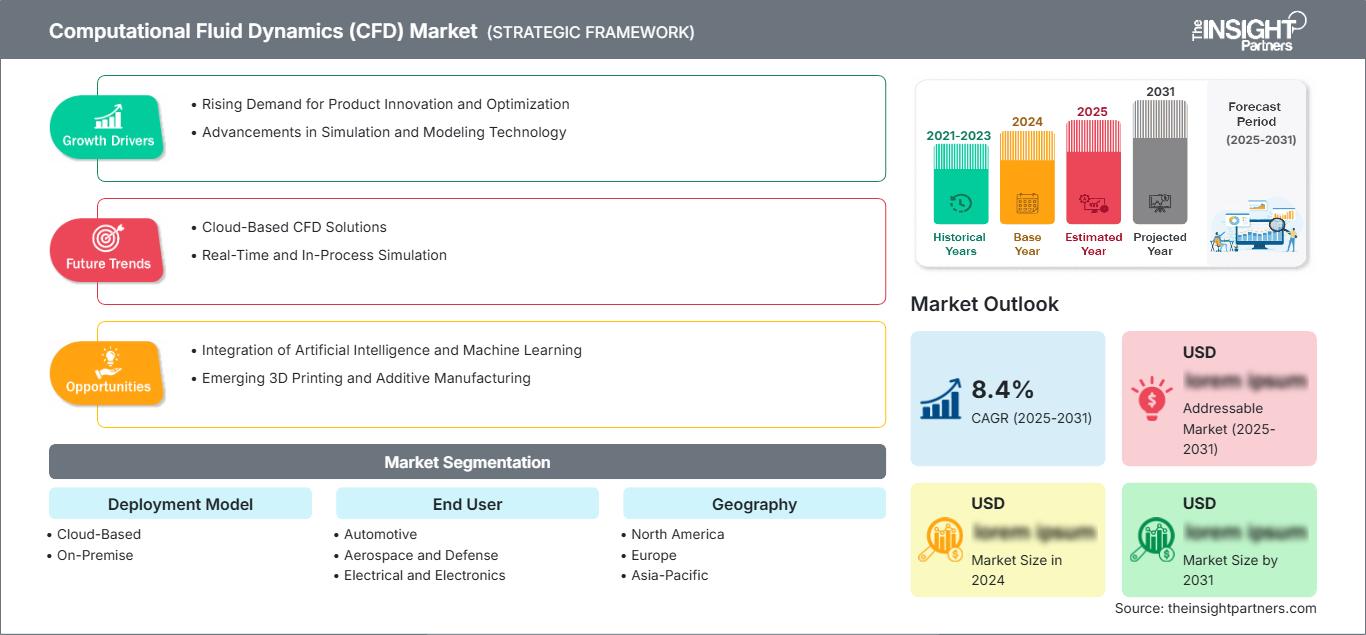
The Computational Fluid Dynamics (CFD) has become one of the most valuable simulation technologies across modern engineering and manufacturing industries. By using numerical methods and advanced algorithms to analyze fluid flow, heat transfer, turbulence, and related physical phenomena, CFD enables organizations to optimize product designs before manufacturing begins. The technology significantly reduces the need for expensive physical prototypes while improving performance, safety, and operational efficiency.
The Computational Fluid Dynamics (CFD) Market size is expected to reach US$ 5.83 Billion by 2034 from US$ 2.88 Billion in 2025. The market is estimated to record a CAGR of 8.13% from 2026 to 2034.
Market Overview
The Computational Fluid Dynamics market continues to experience steady growth as manufacturers invest heavily in digital product development. The demand for virtual testing has increased due to rising product complexity, stricter regulatory requirements, sustainability initiatives, and growing pressure to reduce product development timelines.
The market includes both commercial and open-source CFD software, consulting services, cloud-based simulation platforms, and engineering support services. Vendors continue introducing integrated simulation environments that combine CFD with structural analysis, electromagnetic simulation, optimization software, and artificial intelligence.
Cloud deployment has emerged as a major growth area because it enables organizations to perform computationally intensive simulations without investing in expensive high-performance computing infrastructure.
Key Market Drivers
- Rising Adoption of Digital Engineering:-Companies are increasingly shifting toward simulation-driven engineering to reduce product development costs. Virtual testing allows engineers to evaluate hundreds of design alternatives before manufacturing begins.
- Growth in High-Performance Computing:-Modern CFD simulations require significant computational power. Advances in GPU computing, parallel processing, and cloud-based high-performance computing have dramatically reduced simulation times.
- Increasing Product Complexity:-Modern aircraft, electric vehicles, wind turbines, medical devices, semiconductors, and industrial machinery involve increasingly complex fluid interactions.
- Sustainability and Energy Efficiency:-Governments worldwide continue implementing stricter environmental regulations. Manufacturers use CFD to improve fuel efficiency, reduce emissions, optimize cooling systems, and develop sustainable products that comply with regulatory standards.
Emerging Market Trends
- Artificial Intelligence Integration:-Artificial intelligence is transforming Computational Fluid Dynamics. Machine learning algorithms help automate mesh generation, optimize solver parameters, predict simulation outcomes, and accelerate computational workflows.
- Cloud-Based CFD Platforms:-Cloud deployment has become one of the fastest-growing segments of the CFD market .Instead of maintaining expensive local computing clusters, organizations can access scalable simulation resources through cloud platforms.
- Digital Twins:-Digital twins combine real-world operational data with simulation models.
- CFD plays an important role in digital twin development by accurately simulating thermal behavior, airflow, fluid movement, and heat transfer in real-time operating environments.
- GPU Acceleration:-Graphics Processing Units are transforming simulation performance.GPU-enabled CFD solvers perform calculations significantly faster than traditional CPU-based systems for many workloads, allowing engineers to complete simulations within hours instead of days.
Market Challenges
Despite significant growth opportunities, the Computational Fluid Dynamics market faces several challenges.
High software licensing costs remain a major barrier for small and medium-sized enterprises.
CFD simulations also require highly skilled engineers with expertise in fluid mechanics, numerical methods, turbulence modeling, and simulation validation.
Simulation accuracy depends heavily on proper meshing, boundary condition selection, and mathematical modeling.
Large-scale simulations continue to demand considerable computational resources despite improvements in cloud computing and GPU technology.
Additionally, validating simulation results against experimental data remains essential in safety-critical industries.
Get Sample PDF of the report @ https://www.theinsightpartners.com/sample/TIPRE00009903
Market Opportunities
Several emerging technologies present substantial opportunities for market expansion.
Growing investments in electric vehicles require advanced thermal management simulations for batteries, power electronics, cooling systems, and aerodynamics.
Renewable energy projects increasingly utilize CFD for wind turbine optimization, hydrogen production, carbon capture, and offshore engineering.
Healthcare applications continue expanding through medical device development, respiratory system simulation, cardiovascular research, and pharmaceutical manufacturing.
Semiconductor manufacturers increasingly depend on CFD to manage thermal performance in high-density electronic devices.
These expanding applications continue creating long-term opportunities for CFD vendors.
Segment Analysis
By Component
The software segment accounts for the largest share of the Computational Fluid Dynamics market.
Commercial CFD software provides comprehensive simulation capabilities including meshing, solver technologies, visualization, optimization, and multiphysics integration.
The services segment continues expanding due to growing demand for consulting, implementation, customization, technical support, and engineering services.
By Deployment
On-premise deployment remains important for organizations handling sensitive engineering data or requiring dedicated computing infrastructure.
However, cloud deployment continues experiencing rapid growth due to lower infrastructure costs, scalability, and remote accessibility.
Hybrid deployment models are also becoming increasingly popular.
By End User
The aerospace and defense sector remains one of the largest users of CFD technology.
Automotive manufacturers rely heavily on CFD for vehicle aerodynamics, battery cooling, combustion analysis, and thermal management.
Energy companies utilize CFD for power generation, wind energy, oil and gas operations, and nuclear engineering.
Electronics manufacturers use CFD to improve cooling efficiency in processors, servers, and semiconductor devices.
Healthcare organizations increasingly employ CFD in biomedical engineering and medical device development.
Get the Premium Research Report @ https://www.theinsightpartners.com/buy/TIPRE00009903
Regional Analysis
North America
North America represents one of the largest markets for Computational Fluid Dynamics.
The region benefits from strong aerospace, automotive, defense, semiconductor, and industrial manufacturing industries.
Major investments in research and development, advanced computing infrastructure, and engineering software continue supporting market expansion.
The United States remains the largest contributor due to its concentration of technology companies, aerospace manufacturers, and engineering research institutions.
Europe
Europe maintains a significant share of the CFD market through its automotive, aerospace, renewable energy, and industrial manufacturing sectors.
Countries including Germany, France, and the United Kingdom continue investing heavily in simulation-driven engineering and sustainable manufacturing technologies.
European organizations increasingly utilize CFD to support emission reduction initiatives and energy-efficient product development.
Asia-Pacific
Asia-Pacific is expected to witness the fastest market growth.
Rapid industrialization, expanding automotive production, electronics manufacturing, semiconductor fabrication, and government investments in digital engineering continue driving regional demand.
China, Japan, South Korea, and India are becoming important markets for simulation software adoption.
Growing manufacturing activities and infrastructure development further strengthen regional growth prospects.
Middle East & Africa
Energy projects, industrial diversification, infrastructure development, and smart manufacturing initiatives contribute to increasing CFD adoption across the Middle East.
Oil and gas companies continue investing in advanced simulation technologies to improve operational efficiency.
South America
Manufacturing modernization and increasing engineering investments are supporting gradual CFD adoption across South America.
Industrial automation and digital transformation initiatives are expected to generate additional opportunities over the coming years.
Competitive Landscape
The Computational Fluid Dynamics market remains highly competitive, with leading software providers focusing on innovation, cloud capabilities, AI integration, and multiphysics simulation.
Key market participants continue expanding their product portfolios through acquisitions, strategic partnerships, and research investments.
Major companies operating in the market include:
- Altair Engineering, Inc.
- ANSYS, Inc.
- Autodesk Inc.
- COMSOL
- Convergent Science
- Dassault Systemes
- ESI Group
- Hexagon
- PTC
- Siemens AG
These companies continue investing in cloud-native simulation platforms, GPU optimization, AI-assisted engineering, and integrated digital engineering ecosystems.
Future Outlook
The future of the Computational Fluid Dynamics market appears highly promising as digital engineering becomes standard practice across industries. Artificial intelligence will increasingly automate simulation setup, optimization, and result interpretation.
Related Report
Big Data Analytics In Healthcare Market
About The Insight Partners
The Insight Partners is a global leader in market research, delivering comprehensive analysis and actionable insights across diverse industries. The company empowers decision-makers with data-driven intelligence to navigate evolving markets and accelerate growth.
Contact Us:
- Contact Person: Ankit Mathur
- E-mail: ankit.mathur@theinsightpartners.com
- Phone: +1-646-491-9876
Also Available in :
Korean German Japanese French Chinese Italian Spanish
