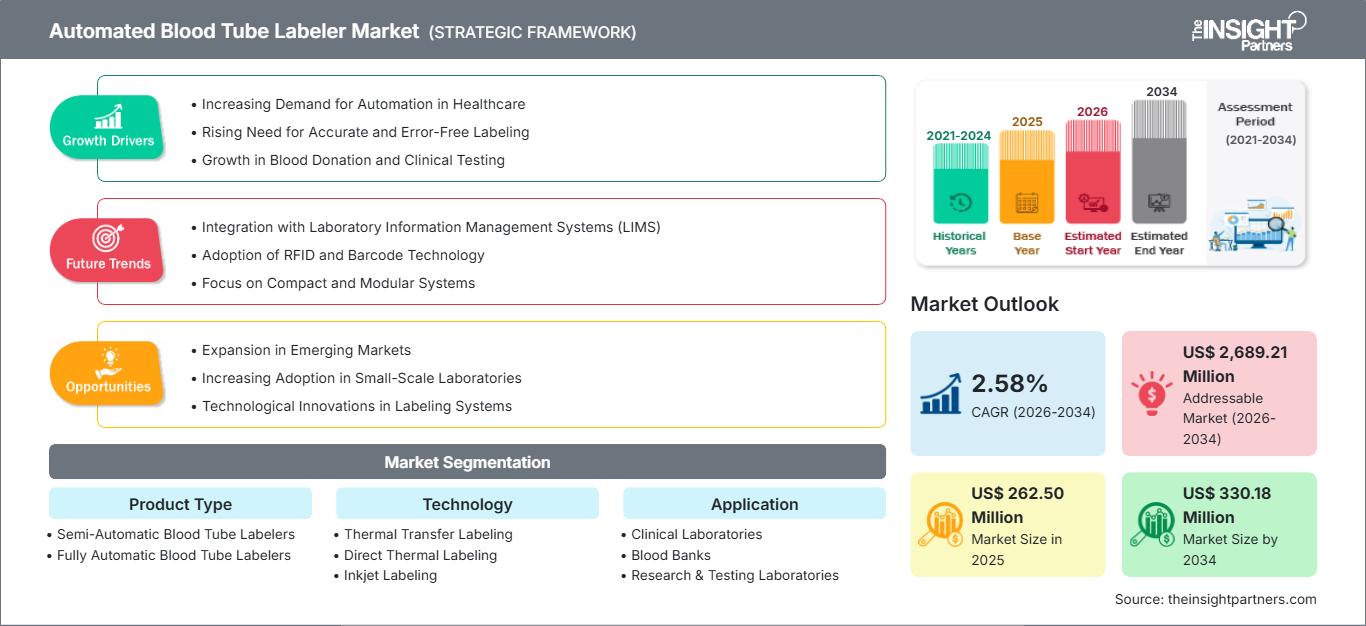
The adoption of automated blood tube labeling solutions is transforming laboratory workflows by improving sample traceability, reducing manual intervention, and enhancing patient safety. Healthcare providers are increasingly investing in advanced labeling technologies to improve operational efficiency and meet growing diagnostic demands. As laboratories process higher sample volumes and regulatory requirements become more stringent, automation has become a strategic priority.
The Automated Blood Tube Labeler Market Trends indicate steady expansion, with the industry projected to grow from US$ 262.50 million in 2025 to US$ 330.18 million by 2034, registering a CAGR of 2.58% during the forecast period. Growing adoption across hospitals, blood banks, and research laboratories is supported by advancements in thermal printing, barcode technology, and laboratory automation platforms. The market is segmented by product type, technology, application, and geography, reflecting diverse demand patterns across healthcare systems worldwide.
Get Sample PDF @ https://www.theinsightpartners.com/sample/TIPRE00040168
Growing Automation in Healthcare Strengthens Industry Growth
Healthcare organizations continue to automate laboratory operations to improve productivity and reduce operational costs. Automated blood tube labelers eliminate many of the challenges associated with manual labeling, including transcription mistakes and sample misidentification. These systems improve workflow efficiency while supporting compliance with stringent quality and patient safety standards.
The rising number of diagnostic procedures, chronic disease monitoring programs, and blood donation initiatives is creating sustained demand for reliable sample labeling solutions. Large hospitals and diagnostic laboratories increasingly rely on automated systems capable of handling high sample volumes with consistent accuracy.
Fully automatic blood tube labelers are witnessing growing adoption because they provide faster throughput and seamless integration with existing laboratory equipment. Semi-automatic systems also remain relevant for laboratories seeking cost-effective automation while maintaining operational flexibility.
Technology Innovations Enhance Operational Efficiency
Technological advancements continue to redefine automated blood tube labeling solutions. Manufacturers are integrating sophisticated printing technologies, including thermal transfer, direct thermal, and inkjet labeling, to improve label durability, print quality, and processing speed.
One of the most significant developments is the integration of automated labelers with Laboratory Information Management Systems (LIMS). This enables real time sample tracking, minimizes manual data entry, and improves traceability throughout the diagnostic workflow.
Another emerging trend is the increasing use of RFID and barcode technologies. These technologies strengthen inventory management, simplify specimen identification, and improve data accuracy across laboratories, blood banks, and healthcare institutions.
Manufacturers are also focusing on compact and modular system designs that require less installation space while remaining compatible with existing laboratory infrastructure. These solutions make automation more accessible for medium sized and smaller healthcare facilities.
Emerging Markets Create New Growth Opportunities
Healthcare modernization across Asia Pacific, Latin America, and the Middle East is generating attractive opportunities for automated blood tube labeler manufacturers. Governments and private healthcare providers continue investing in laboratory infrastructure to support expanding diagnostic services and improve healthcare accessibility.
Small and medium sized laboratories are increasingly adopting automated labeling systems as affordable, compact products become available. This transition from manual processes to automation is expected to contribute significantly to long term industry expansion.
Continuous innovation also presents future opportunities. Manufacturers are exploring artificial intelligence driven predictive maintenance, intelligent error detection, and enhanced software integration to improve system reliability and reduce downtime. These innovations are expected to increase operational efficiency while strengthening laboratory quality management.
Competitive Landscape
Industry participants continue investing in product development, strategic partnerships, and technology integration to strengthen their competitive positions. Companies are focusing on improving automation capabilities, expanding regional presence, and delivering flexible solutions tailored to different laboratory environments.
Key players include:
- Zebra Technologies
- SATO Holdings Corporation
- Toshiba Tec Corporation
- Panasonic Corporation
- Barcoding, Inc.
- Grifols S.A.
- Labelling Systems Limited
- Markem-Imaje (Dover Corporation)
- Mettler Toledo International Inc.
- Honeywell International Inc.
These companies continue introducing innovative labeling technologies while expanding their product portfolios to address the evolving requirements of healthcare providers worldwide.
Regional Analysis and Segment Outlook
North America remains a leading regional contributor due to advanced healthcare infrastructure, high laboratory automation adoption, and increasing diagnostic testing volumes. The United States continues to drive demand through investments in healthcare technology and patient safety initiatives.
Europe maintains steady growth, supported by strict regulatory standards and widespread implementation of laboratory automation solutions. Meanwhile, Asia Pacific is expected to experience the fastest expansion as healthcare spending increases across China, India, Japan, and other developing economies.
By product type, fully automatic blood tube labelers are expected to gain greater market share due to higher efficiency and scalability. Thermal transfer labeling technology continues to dominate because of its durability and print quality, while clinical laboratories represent the largest application segment owing to rising diagnostic workloads.
Interested in Purchasing this Report? Click here @ https://www.theinsightpartners.com/buy/TIPRE00040168
Future Outlook
The outlook for the global Automated Blood Tube Labeler Market remains positive as healthcare providers continue prioritizing laboratory automation, patient safety, and operational efficiency. Although the industry is projected to expand at a moderate CAGR of 2.58% through 2034, increasing demand for accurate specimen identification, integration with digital laboratory systems, and continued technological innovation will sustain long term growth.
Related Report:
1) Defibrillator Market Key Players and Forecast by 2031
2) Infection Control Market Analysis by Size, Share & Growth 2031
3) Laboratory Water Distiller Market Size, Share & Demand by 2034
About Us –
The Insight Partners provides comprehensive syndicated and tailored market research services in the healthcare, technology, and industrial domains. Renowned for delivering strategic intelligence and practical insights, the firm empowers businesses to remain competitive in ever-evolving global markets.
Contact Us:
Ankit Mathur | The Insight Partners
E-mail: ankit.mathur@theinsightpartners.com
Phone: +1-646-491-9876
