High Altitude Aeronautical Platform Stations (HAAPS) often referred to as atmospheric satellites or high-altitude pseudo-satellites (HAPS) operate in the stratosphere, typically at altitudes between 18 and 50 kilometers above sea level. Functioning significantly higher than commercial air traffic and below orbital satellites, these platforms offer a unique combination of broad coverage, low latency, rapid deployment capabilities, and cost efficiency. As demand surges for persistent surveillance, non-terrestrial telecommunication networks, environmental monitoring, and disaster response infrastructure, the HAAPS market is positioning itself as a vital layer in global connectivity and defense frameworks.
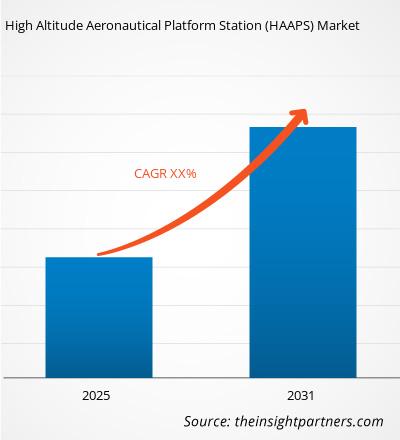
The High Altitude Aeronautical Platform Station (HAAPS) Market size is expected to reach US$ 16.1 Billion by 2034 from US$ 6.73 Billion in 2025. The market is estimated to record a CAGR of 10.19% from 2026 to 2034.
Key Market Drivers
Expanding Telecommunications and Broadband Access: Providing high-speed broadband to remote, underserved, or geographically challenging regions remains a priority for governments and telecom operators. HAAPS act as floating cell towers or base stations, facilitating 5G/6G non-terrestrial networks (NTN) and delivering high-capacity backhaul without the capital expenditure required for land-based infrastructure or traditional satellite constellations.
Defense, Intelligence, and Border Security: The military and homeland security sectors represent a major end-user market. HAAPS provide persistent Intelligence, Surveillance, and Reconnaissance (ISR) capabilities over large geographic areas. Unlike low Earth orbit (LEO) satellites that move rapidly, or traditional unmanned aerial vehicles (UAVs) with limited flight times, stratospheric platforms can linger over target areas for months, delivering continuous real-time data streams.
Disaster Management and Earth Observation: During natural disasters, terrestrial communication networks are frequently disrupted or destroyed. HAAPS can be deployed within hours to re-establish emergency communication links for first responders. Additionally, equipped with high-resolution imaging sensors and radar, these stations assist in tracking wildfires, monitoring atmospheric pollution, and providing crucial environmental analytics.
Get a PDF Sample– https://www.theinsightpartners.com/sample/TIPRE00019764
Platform Insights
The market comprises several main platform types:
Unmanned Aerial Vehicles (UAVs) / Fixed-Wing Aircraft: Dominated by lightweight, solar-powered designs, fixed-wing solar UAVs are capable of long-endurance flights using photovoltaic panels charged during the day and high-density energy storage for night operations.
Airships and Stratospheric Balloons: Offering significant payload capacities, zero-emission profiles, and prolonged stationary hovering, airships and balloons provide stable coverage over localized geographic regions.
Key Players
The global HAAPS landscape features prominent aerospace, defense, and specialized technology organizations driving platform innovation, autonomous flight controls, payload miniaturization, and advanced battery storage. Key industry players include:
AeroVironment, Inc.
Airbus S.A.S.
Aurora Flight Sciences (Boeing)
Composite Technology Team
Elektra Solar GmbH
ILC Dover LP
Lockheed Martin Corporation
Raven Industries, Inc.
Thales Group
Zero 2 Infinity S.L.
Get Full Copy of This Report- https://www.theinsightpartners.com/buy/TIPRE00019764
Future Outlook
The future of the High Altitude Aeronautical Platform Station market is defined by rapid technological maturation and deeper integration into terrestrial and space-based communication networks. Over the coming decade, breakthroughs in high-efficiency solar cells, solid-state and lithium-sulfur battery densities, lightweight carbon-composite structures, and AI-driven autonomous flight controllers will dramatically extend mission endurance from weeks to years. As international aviation authorities and spectrum management bodies establish clearer regulatory frameworks for stratospheric operations, HAAPS will transition from trial deployments into mainstream infrastructure. This evolution will bridge global digital divides, power next-generation 6G non-terrestrial networks, and redefine intelligence-gathering and climate-monitoring capabilities worldwide.
Related Reports-
About Us
The Insight Partners is a one-stop industry research provider of actionable intelligence. We help our clients in getting solutions to their research requirements through our syndicated and consulting research services. We specialize in industries such as Semiconductor and Electronics, Aerospace and Defense, Automotive and Transportation, Biotechnology, Healthcare IT, Manufacturing and Construction, Medical Devices, Technology, Media, and Telecommunications, as well as chemicals and Materials.
Contact Us
If you have any queries about this report or if you would like further information, don’t hesitate to get in touch with us:
Contact Person: Ankit Mathur
E-mail: ankit.mathur@theinsightpartners.com
