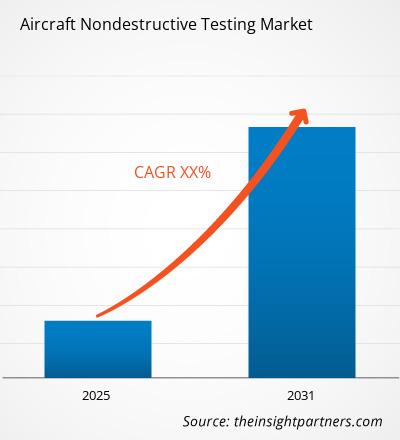
Aircraft Nondestructive Testing (NDT) comprises a set of critical inspection techniques used by aerospace manufacturers and Maintenance, Repair, and Overhaul (MRO) service providers to evaluate structural components, engines, and airborne systems without altering or damaging them. As commercial passenger numbers rebound globally and defense modernizations gain momentum worldwide, guaranteeing operational safety and structural integrity has become an imperative requirement for airliners and defense fleets.
The Aircraft Nondestructive Testing Market size is expected to reach US$ 5.57 Billion by 2034 from US$ 2.6 Billion in 2025. The market is estimated to record a CAGR of 8.84% from 2026 to 2034.
The primary catalysts driving the global market expansion include mandatory regulatory mandates from international aviation authorities such as the Federal Aviation Administration (FAA) and the European Union Aviation Safety Agency (EASA) along with the rapid introduction of complex, advanced materials into modern aircraft. Composite structures, lightweight alloys, and 3D-printed metal components require highly sophisticated testing techniques, including phased-array ultrasonic testing, digital radiography, and eddy current array testing, to uncover micro-defects, subsurface delamination, and fatigue cracks.
Key Market Segmentations and Technological Shift
The market is broadly classified into two primary offerings: equipment and services. Advanced inspection equipment such as portable ultrasonic detectors, digital radiographic systems, handheld videoscopes, and eddy current instruments accounts for a substantial share of total investments. However, the demand for third-party NDT inspection and certification services continues to expand rapidly as airlines and maintenance providers seek specialized expertise and cost efficiency without inflating internal capital expenditures.
By technology, Ultrasonic Testing (UT) and Radiographic Testing (RT) continue to dominate the commercial and defense aviation sectors. Ultrasonic techniques are widely favored for evaluating complex airframes, wing structures, and composite materials. Meanwhile, Radiography, Liquid Penetrant, Eddy Current, and Magnetic Particle inspections remain indispensable for inspecting engine turbine blades, landing gear, and high-stress structural joints.
Get a PDF Sample– https://www.theinsightpartners.com/sample/TIPRE00019896
Key Players in the Global Market
The market landscape is defined by continuous product innovations, strategic acquisitions, and global service expansions by key industry participants. Notable key players leading the Aircraft Nondestructive Testing Market include:
Arise Global Pte. Ltd.
FLIR Systems, Inc.
FLTechnics
Intertek Group plc
MISTRAS Group, Inc.
Nikon Metrology NV
OLYMPUS CORPORATION
SGS SA
TEAM Inc.
TÜV Rheinland
These key players are increasingly investing in next-generation automated inspection units, advanced sensors, and portable handheld instruments that enable technicians to execute swift, accurate evaluations directly in maintenance hangars, thereby minimizing aircraft down-times.
Get Full Copy of This Report- https://www.theinsightpartners.com/buy/TIPRE00019896
Regional Dynamics
Geographically, North America leads the global aerospace NDT landscape, owing to its dense network of leading aircraft OEMs, robust defense expenditures, and extensive MRO infrastructure. Simultaneously, the Europe region maintains a dominant presence driven by strict airworthiness directives and major civil aircraft manufacturing hubs.
The Asia-Pacific region is projected to experience the fastest growth rate through 2034. Growing middle-class populations, accelerating air passenger travel across countries such as China and India, rising fleet sizes, and expanding localized MRO hubs across Southeast Asia are generating a high volume of demand for continuous NDT solutions.
Future Outlook
The future of the Aircraft Nondestructive Testing Market is set to be redefined by digital transformation, artificial intelligence (AI), and autonomous technologies. Over the forecast period, the integration of AI and machine learning algorithms into NDT software will enable automated defect recognition, significantly reducing human error and accelerating inspection turnaround times. Furthermore, the deployment of autonomous crawlers, inspection drones, and Industrial Internet of Things (IIoT) sensors will allow continuous, remote structural health monitoring. As the aerospace sector steadily pivots toward predictive maintenance frameworks and digital twin integrations, non-destructive testing will transition from a periodic compliance check into an active, real-time data contributor for aircraft lifecycle management.
Related Reports-
About Us
The Insight Partners is a one-stop industry research provider of actionable intelligence. We help our clients in getting solutions to their research requirements through our syndicated and consulting research services. We specialize in industries such as Semiconductor and Electronics, Aerospace and Defense, Automotive and Transportation, Biotechnology, Healthcare IT, Manufacturing and Construction, Medical Devices, Technology, Media, and Telecommunications, as well as chemicals and Materials.
Contact Us
If you have any queries about this report or if you would like further information, don’t hesitate to get in touch with us:
Contact Person: Ankit Mathur
E-mail: ankit.mathur@theinsightpartners.com
