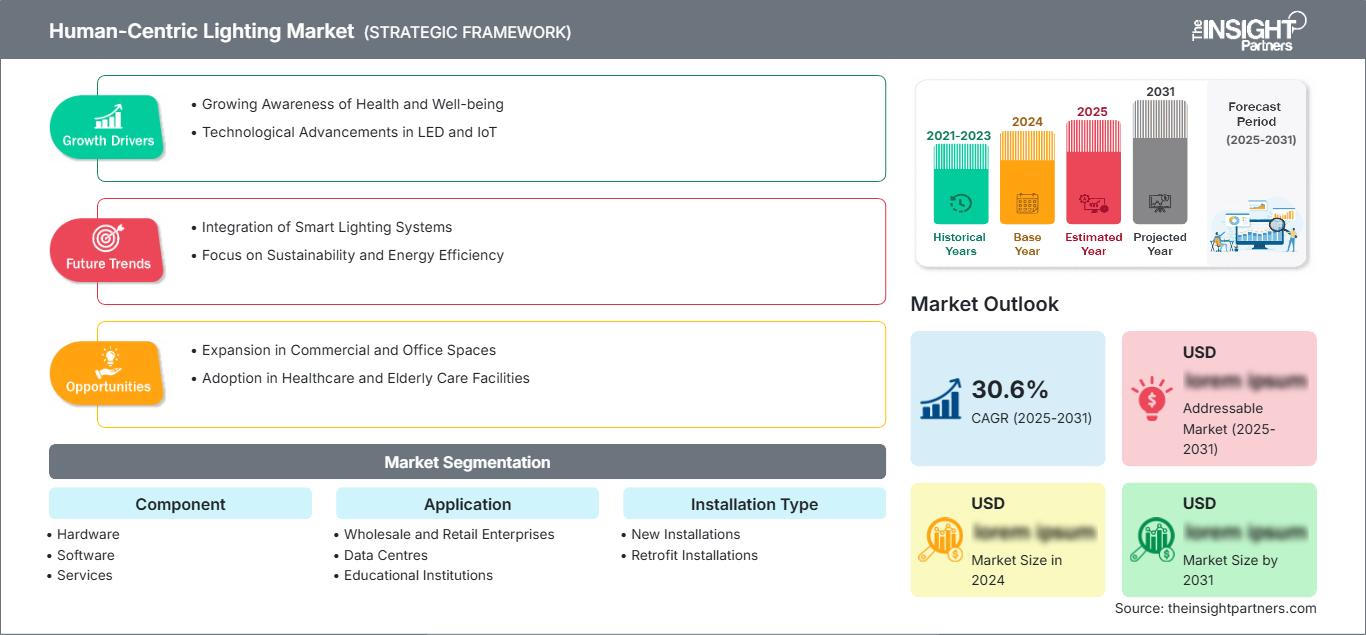
The increasing focus on health, productivity, and well-being in modern environments is transforming the way lighting systems are designed and adopted. Businesses, healthcare facilities, educational institutions, and residential users are shifting toward advanced lighting solutions that replicate natural daylight patterns and support human comfort. This growing preference for personalized and adaptive illumination is accelerating the adoption of human-centric lighting solutions across various applications.
The Human-Centric Lighting Market is witnessing significant transformation as organizations recognize the impact of lighting on human performance, sleep cycles, mood, and overall wellness. Unlike traditional lighting systems, these solutions integrate intelligent controls, sensors, and automation technologies to adjust brightness, color temperature, and intensity according to user requirements and environmental conditions. The rising integration of smart buildings, Internet of Things (IoT) technologies, and energy-efficient lighting systems is further supporting industry expansion.
Get a sample PDF of the Report: https://www.theinsightpartners.com/sample/TIPRE00004804
Human-Centric Lighting Market Overview and Forecast Through 2031
Key insights highlighting the growth trajectory and future opportunities include:
- The Human-Centric Lighting Market is expected to experience strong growth through 2031 due to increasing awareness about circadian lighting and workplace wellness.
- Growing investments in smart infrastructure and connected building technologies are creating new opportunities for advanced lighting solutions.
- Increasing adoption in commercial offices, healthcare centers, educational institutions, and hospitality spaces is driving market penetration.
- Rising demand for energy-efficient lighting technologies is encouraging the transition from conventional systems to intelligent lighting platforms.
- Integration of artificial intelligence, automation, and sensor-based controls is expected to enhance lighting personalization and operational efficiency.
- The future of the industry will be shaped by sustainable building initiatives and growing emphasis on human-centered architectural designs.
Key Trends Influencing Human-Centric Lighting Market Growth
One of the major trends influencing the industry is the increasing adoption of smart lighting ecosystems. Building owners and facility managers are implementing connected lighting networks that enable automatic adjustments based on occupancy, daylight availability, and user preferences. These systems improve energy management while creating healthier indoor environments.
Another important trend is the growing application of human-centric lighting in healthcare facilities. Hospitals and wellness centers are adopting adaptive lighting systems to create comfortable spaces for patients and support recovery processes. Lighting solutions designed around natural biological rhythms are becoming an important element of patient-centric healthcare infrastructure.
The commercial sector is also contributing significantly to industry development. Companies are increasingly investing in workplace environments that improve employee satisfaction, concentration, and productivity. Human-centric lighting solutions are becoming a strategic component of modern office designs focused on employee wellness and sustainable operations.
Market Analysis and Growth Opportunities
The Human-Centric Lighting Market is benefiting from several technological and environmental factors that are reshaping the global lighting landscape.
- Increasing awareness regarding the relationship between lighting and human health is encouraging adoption across multiple sectors.
- Growing government initiatives supporting energy conservation and sustainable infrastructure are promoting advanced lighting technologies.
- Expansion of smart city projects is creating demand for intelligent and connected lighting systems.
- Advancements in LED technology are improving efficiency, reliability, and customization capabilities.
- Rising demand for automated building management systems is increasing the integration of adaptive lighting solutions.
- Growing preference for personalized environments in residential and commercial spaces is creating new business opportunities.
Global and Regional Analysis
North America is expected to remain a prominent region in the Human-Centric Lighting Market due to early adoption of smart building technologies and increasing awareness about workplace wellness solutions. The region has witnessed strong demand from commercial buildings, healthcare facilities, and educational institutions seeking advanced lighting systems that improve energy efficiency and occupant experience.
Europe is also experiencing steady growth due to strict energy efficiency regulations and increasing investments in sustainable building infrastructure. Countries across the region are focusing on green buildings and environmentally responsible technologies, encouraging the adoption of intelligent lighting solutions.
Asia Pacific is anticipated to witness significant growth opportunities owing to rapid urbanization, expanding construction activities, and increasing adoption of smart technologies. Growing investments in commercial infrastructure, residential projects, and smart city developments are supporting the deployment of advanced lighting systems.
The Middle East, Africa, and South and Central America are gradually adopting human-centric lighting solutions as organizations focus on improving building efficiency, enhancing user experiences, and implementing modern infrastructure technologies.
Human-Centric Lighting Market Share and Industry Landscape
The competitive landscape is characterized by continuous innovation, strategic partnerships, product launches, and technological advancements. Leading companies are focusing on developing integrated lighting platforms that combine LED technology, automation, connectivity, and data-driven controls.
Key players operating in the Human-Centric Lighting Market include:
- Signify N.V.
- Acuity Brands Lighting, Inc.
- OSRAM GmbH
- Zumtobel Group AG
- Cree Lighting
- GE Current, a Daintree company
- Glamox AS
- Lutron Electronics Co., Inc.
- Legrand S.A.
- Fagerhult Group
These companies are investing in research and development activities to introduce advanced solutions that support energy savings, smart building integration, and personalized lighting experiences.
Recent Industry Developments and Market News
The lighting industry is experiencing rapid technological advancements as manufacturers continue to introduce intelligent solutions designed for modern environments. Companies are increasingly developing connected lighting platforms that integrate wireless communication, cloud-based monitoring, and automated controls.
Recent developments indicate a growing focus on partnerships between lighting providers, technology companies, and building automation specialists. These collaborations aim to create comprehensive solutions that combine lighting control, environmental monitoring, and smart infrastructure management.
Additionally, increasing adoption of sustainable building certifications is encouraging developers and architects to incorporate human-centric lighting designs into new construction and renovation projects. The shift toward environmentally responsible buildings is expected to create long-term opportunities for industry participants.
Get the Premium Research Report @ https://www.theinsightpartners.com/buy/TIPRE00004804
Future Outlook
The future outlook for the Human-Centric Lighting Market remains highly promising as businesses and consumers continue prioritizing wellness, sustainability, and intelligent environments. The integration of advanced technologies such as artificial intelligence, IoT connectivity, and automated control systems will further enhance the capabilities of modern lighting solutions. As smart buildings become more widespread and organizations focus on creating healthier indoor spaces, human-centric lighting is expected to become an essential component of future architectural and infrastructure development through 2031.
Home Energy Management System Market Regional Share, Trend, and Growth Opportunity
Vision Transformers Market Regional Share, Trend, and Growth Opportunity
Differential-Pressure Mass Flow Controller Market Regional Share, Trend, and Growth Opportunity
About The Insight Partners
The Insight Partners is a leading market research and consulting firm delivering actionable insights through in-depth industry analysis and strategic intelligence. The firm supports clients across various industries in making informed business decisions by providing comprehensive market forecasts, competitive assessments, and growth opportunities.
Contact Us:
If you have any queries about this report or if you would like further information, please contact us:
Contact Person: Ankit Mathur
E-mail: sales@theinsightpartners.com
Phone: +1-646-491-9876
Also Available in :
Korean | German | Japanese | French | Chinese | Italian | Spanish
