The Industrial Metaverse is emerging as one of the most transformative segments within the digital industrial ecosystem. By combining advanced technologies such as digital twins, artificial intelligence (AI), augmented reality (AR), virtual reality (VR), Industrial Internet of Things (IIoT), blockchain, edge computing, and high-speed connectivity.
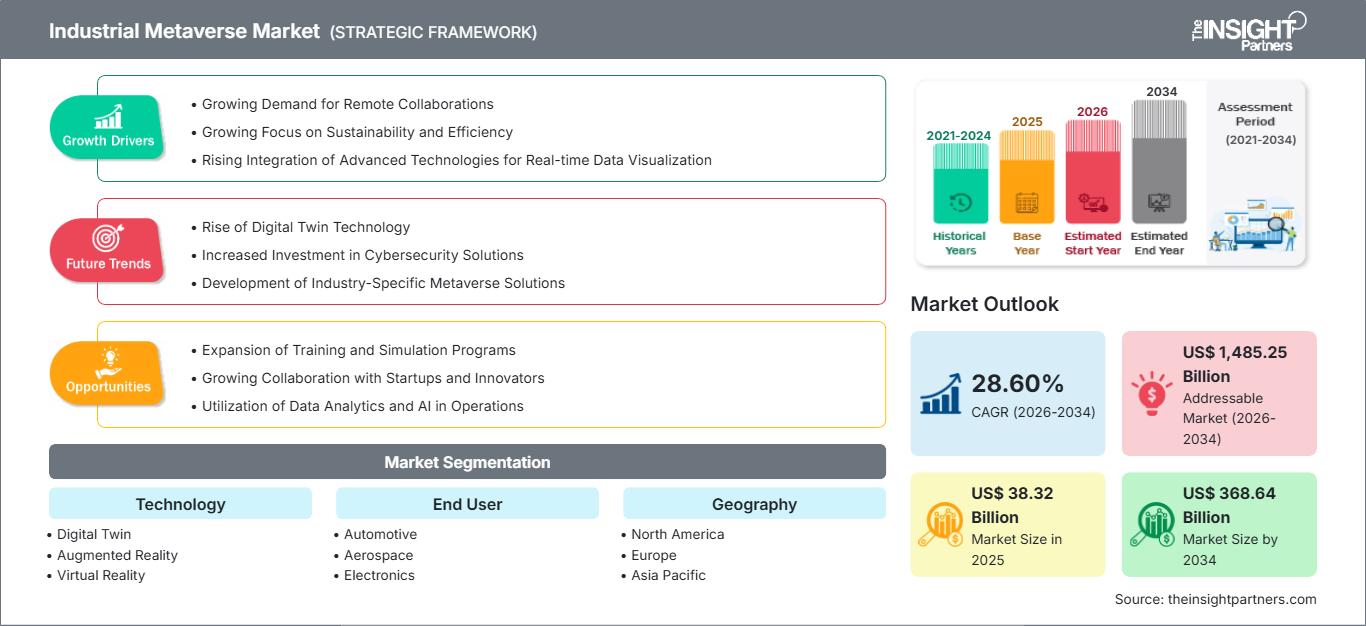
The Industrial Metaverse market size is expected to reach US$ 368.64 Billion by 2034 from US$ 38.32 Billion in 2025. The market is anticipated to register a CAGR of 28.6% during the forecast period 2026–2034.
Market Overview
The Industrial metaverse solutions provide organizations with persistent virtual environments where engineers, operators, designers, and management teams can collaborate regardless of geographical location. Through immersive visualization and real-time analytics, businesses gain deeper insights into manufacturing processes and operational performance.
Key Market Drivers
- Growing Adoption of Digital Twins:-Digital twin technology has become the foundation of industrial metaverse applications. Digital replicas of machines, factories, and production processes enable organizations to simulate different operational scenarios before implementing physical modifications.
- Rising Demand for Remote Collaboration:-The increasing acceptance of hybrid work environments has accelerated investments in remote collaboration technologies. Industrial metaverse platforms allow engineers, maintenance teams, and production managers to collaborate within shared virtual environments regardless of physical location.
- Increasing Industrial Automation:-Automation remains a primary growth driver for the industrial metaverse market. Manufacturers are integrating robotics, AI, machine vision, and IoT sensors into virtual production environments to improve production planning and optimize manufacturing workflows.
- Expansion of High-Speed Connectivity:-The deployment of private 5G networks, edge computing, and cloud infrastructure has improved the performance of industrial metaverse platforms. High-speed, low-latency communication enables seamless synchronization between physical assets and their digital counterparts.
Emerging Market Trends
- AI-Powered Industrial Intelligence:-Artificial intelligence is transforming industrial metaverse platforms by enabling intelligent automation, predictive maintenance, quality inspection, and process optimization.
- Integration of Extended Reality:-Augmented reality and virtual reality technologies are becoming essential components of industrial metaverse ecosystems. Engineers use AR devices for equipment maintenance, while VR enables immersive employee training without interrupting production operations.
- Smart Manufacturing Adoption:-Manufacturers worldwide are implementing smart factories where physical assets communicate continuously with digital systems. Industrial metaverse platforms serve as centralized environments for monitoring, controlling, and optimizing manufacturing operations in real time.
- Sustainability Initiatives:-Industrial organizations are increasingly using metaverse technologies to improve resource efficiency and reduce carbon emissions. Virtual simulations help optimize production layouts, minimize waste, improve energy efficiency, and support sustainable manufacturing practices.
Get Sample PDF of the report @ https://www.theinsightpartners.com/sample/TIPRE00039475
Market Challenges
Despite promising growth prospects, several challenges continue to affect market expansion.
High implementation costs remain a significant concern, particularly for small and medium-sized enterprises. Developing comprehensive industrial metaverse environments requires investments in advanced hardware, software, cloud infrastructure, AI systems, and cybersecurity solutions.
Data privacy and cybersecurity also represent major concerns. Since industrial metaverse platforms process sensitive operational and manufacturing information, organizations must implement robust security frameworks to protect critical infrastructure.
Another challenge involves interoperability among different industrial software platforms. Many organizations operate multiple legacy systems that require seamless integration with emerging metaverse technologies.
Additionally, the shortage of skilled professionals experienced in AI, XR, digital twins, blockchain, and industrial simulation continues to limit rapid deployment across certain industries.
Market Segmentation
The Industrial Metaverse market can be segmented based on technology, component, deployment model, application, end user, and geography.
By Technology
- Digital Twin
- Artificial Intelligence
- Augmented Reality
- Virtual Reality
- Blockchain
- Edge Computing
- Private 5G
By Component
- Hardware
- Software
- Services
By Deployment
- Cloud
- On-Premise
By Application
- Product Design
- Manufacturing
- Remote Maintenance
- Workforce Training
- Predictive Maintenance
- Supply Chain Optimization
By End User
- Automotive
- Aerospace
- Electronics
- Healthcare
- Manufacturing
- Energy and Utilities
- Logistics
- Others
Get the Premium Research Report @ https://www.theinsightpartners.com/buy/TIPRE00039475
Regional Analysis
- North America:-North America maintains a leading position in the industrial metaverse market due to strong adoption of Industry 4.0 technologies, advanced digital infrastructure, and significant investments in AI, cloud computing, and digital twin technologies.
- Europe:-European industries continue investing heavily in digital manufacturing and sustainability initiatives. Germany, France, and the United Kingdom remain key contributors through widespread adoption of smart factories and industrial automation.
- Asia-Pacific:-Asia-Pacific represents the fastest-growing regional market. China, Japan, South Korea, and India are investing extensively in advanced manufacturing technologies, robotics, AI, and private 5G infrastructure.
- Middle East & Africa:-Industrial diversification initiatives, smart city projects, and investments in advanced manufacturing are creating new opportunities across the Middle East and Africa.
- South & Central America:-Growing industrial modernization and increasing digital transformation across manufacturing industries are expected to support steady market expansion in South and Central America.
Competitive Landscape
The industrial metaverse market is characterized by continuous innovation and strategic partnerships among technology providers, cloud vendors, industrial automation companies, and software developers.
- NVIDIA Corporation
- Microsoft
- Siemens
- Amazon Web Services, Inc.
- IBM
- Meta
- HTC Corporation
- ABB
- Dassault Systèmes
- GE Vernova
Future Outlook
The future of the Industrial Metaverse market appears highly promising as organizations increasingly prioritize operational efficiency, automation, and digital transformation. Advances in AI, spatial computing, robotics, and immersive technologies are expected to further enhance industrial metaverse capabilities.
Related Report
About The Insight Partners
The Insight Partners is a global leader in market research, delivering comprehensive analysis and actionable insights across diverse industries. The company empowers decision-makers with data-driven intelligence to navigate evolving markets and accelerate growth.
Contact Us:
- Contact Person: Ankit Mathur
- E-mail: ankit.mathur@theinsightpartners.com
- Phone: +1-646-491-9876
Also Available in :
Korean German Japanese French Chinese Italian Spanish

- Alternate Fuel Aircraft Market Size to Reach US$ 99.97 Billion by 2034, Growing at a CAGR of 57.67% - 2026-07-24
- Screw Fastener Market Size to Reach USD 74.87 Billion by 2034, Growing at a CAGR of 3.80% - 2026-07-24
- Rotary Hammer Drill Market to Reach US$ 2.21 Billion by 2034, Growing at a 3.80% CAGR - 2026-07-24