The immersive entertainment is experiencing unprecedented growth as digital technologies redefine how audiences engage with games, films, concerts, live events, museums, and interactive storytelling. Immersive entertainment leverages technologies such as Virtual Reality (VR), Augmented Reality (AR), Mixed Reality (MR), Artificial Intelligence (AI), spatial computing, haptic feedback, 3D audio, and advanced graphics to create highly engaging and interactive experiences.
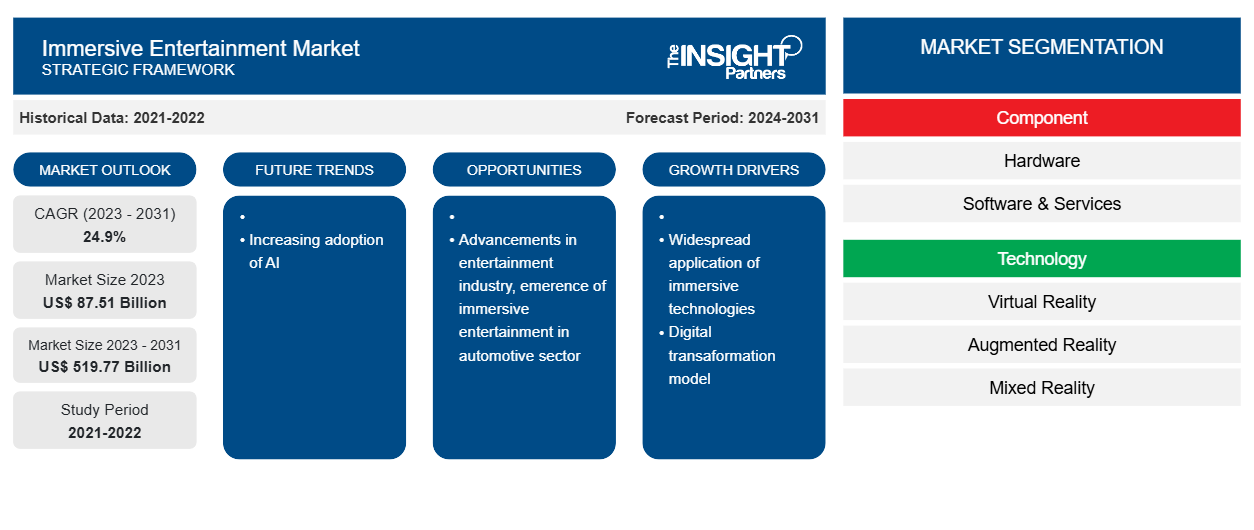
According to industry analysis, The immersive entertainment market size is expected to reach US$ 519.77 billion by 2031 from US$ 87.51 billion in 2023. The market is estimated to record a CAGR of 24.9% from 2023 to 2031. The rising demand for cloud computing is likely to remain a key market trend.
Market Overview
The Immersive entertainment has evolved from being a niche technology into a mainstream entertainment platform. Consumers today demand engaging experiences that go beyond passive viewing, driving the popularity of VR gaming, AR-enhanced mobile applications, immersive concerts, interactive museums, and metaverse-based social platforms.
Technological innovations have made immersive devices more affordable and accessible than ever before. Modern VR headsets, AR-enabled smartphones, wearable devices, motion sensors, and AI-powered content generation tools are enabling entertainment providers to deliver realistic experiences with greater interactivity.
The entertainment industry is also embracing immersive technologies to improve audience engagement, increase revenue streams, and differentiate content offerings. Streaming platforms, gaming companies, sports organizations, and event organizers continue investing in immersive content to strengthen customer loyalty and create premium experiences.
Major Market Drivers
- Rising Adoption of Virtual and Augmented Reality:-The widespread availability of VR and AR devices has significantly expanded immersive entertainment applications. Consumers are increasingly purchasing standalone VR headsets and AR-enabled mobile devices to experience gaming, virtual tourism, education, and live entertainment.
- Digital Transformation Across Entertainment Industry:-Media companies are rapidly adopting digital transformation strategies to remain competitive in an evolving market. Streaming platforms, movie studios, gaming publishers, and sports organizations are integrating immersive technologies into their digital ecosystems to deliver engaging content experiences.
- Growing Popularity of Interactive Gaming:-Gaming remains one of the largest contributors to immersive entertainment market growth. Players increasingly demand realistic graphics, motion-controlled gameplay, multiplayer virtual worlds, and AI-driven personalization.
- Increasing Consumer Demand for Experiential Entertainment:-Consumers are shifting spending toward memorable experiences rather than traditional media consumption. Immersive concerts, interactive exhibitions, themed attractions, escape rooms, and mixed-reality performances have become increasingly popular among younger audiences seeking social and personalized entertainment.
Emerging Market Trends
- Artificial Intelligence Integration:-AI is becoming a core technology for immersive entertainment by enabling intelligent NPCs, procedural content generation, personalized recommendations, speech recognition, and adaptive storytelling.
- Cloud-Based Immersive Experiences:-Cloud computing allows users to access high-quality immersive experiences without requiring expensive local hardware. Cloud rendering reduces processing requirements while enabling multiplayer collaboration and real-time content delivery across devices.
- Expansion of Mixed Reality Applications:-Mixed Reality combines digital and physical environments to create more natural interactions. MR is increasingly being adopted in gaming, education, tourism, museums, retail, and live performances, enabling users to interact with virtual objects in real-world settings.
- Growth of the Metaverse:-The emergence of metaverse platforms continues driving investment across immersive entertainment. Virtual worlds enable social interaction, digital commerce, gaming, education, and entertainment experiences within persistent virtual environments.
Get Sample PDF of the report @ https://www.theinsightpartners.com/sample/TIPRE00038939
Market Segmentation
By Component
Hardware:-Hardware represents the largest market segment due to growing sales of VR headsets, AR smart glasses, sensors, cameras, wearable devices, controllers, and high-performance computing systems.
Software and Services:-Software includes immersive applications, content development platforms, simulation engines, AI tools, cloud platforms, and maintenance services. Increasing demand for customized immersive applications supports strong software market growth.
By Technology
- Virtual Reality (VR)
- Augmented Reality (AR)
- Mixed Reality (MR)
- Others
Virtual Reality currently dominates the market due to extensive adoption in gaming and simulations. However, Augmented Reality is witnessing rapid growth because of smartphone penetration and enterprise applications.
By End User
- IT and Telecommunications
- BFSI
- Healthcare
- Government
- Manufacturing
- Others
Although gaming and entertainment remain primary adoption areas, immersive technologies are increasingly being utilized across healthcare, education, manufacturing, and enterprise collaboration.
Get the Premium Research Report @ https://www.theinsightpartners.com/buy/TIPRE00038939
Regional Analysis
- North America:-North America holds the largest share of the immersive entertainment market due to strong technology infrastructure, high consumer spending, widespread adoption of VR devices, and the presence of leading technology companies.
- Europe:-Europe continues witnessing significant adoption across museums, cultural institutions, education, gaming, and live entertainment. Government initiatives supporting digital innovation further contribute to regional market expansion.
- Asia Pacific:-Asia Pacific represents the fastest-growing regional market. Countries including China, Japan, South Korea, and India are investing heavily in gaming, 5G infrastructure, smart devices, and immersive technologies.
- Middle East & Africa:-Increasing investments in smart cities, tourism, entertainment infrastructure, and digital transformation initiatives are creating new opportunities for immersive entertainment providers.
- South & Central America:-Improving internet connectivity, growing gaming communities, and increasing smartphone adoption continue supporting gradual market development across the region.
Competitive Landscape
The immersive entertainment market is highly competitive, with global technology companies focusing on innovation, strategic partnerships, acquisitions, and product development.
Major companies operating in the market include:
- Microsoft Corp
- Qualcomm Inc
- Google LLC
- Sony Group Corp
- Infosys Ltd
- HTC Corp
- Samsung Electronics Co Ltd
- Apple Inc
- Magic Leap, Inc.
- Salesforce Inc
These companies continue investing in advanced hardware, software platforms, AI capabilities, cloud infrastructure, and developer ecosystems to strengthen their competitive positions.
Opportunities for Future Growth
Several emerging opportunities are expected to accelerate market expansion over the coming years:
- Expansion of spatial computing platforms
- Commercialization of next-generation wearable devices
- Growth of immersive education and training
- Integration of AI-generated virtual environments
- Increasing adoption of digital twins
- Development of metaverse commerce
- Expansion of immersive sports broadcasting
- Growth in virtual tourism experiences
- Enhanced healthcare simulations
- Enterprise collaboration through mixed reality
The rollout of 5G and future 6G networks will further improve immersive content delivery by reducing latency and enabling higher-quality real-time experiences.
Challenges Facing the Market
Despite strong growth prospects, several challenges remain:
- High costs of advanced immersive hardware
- Privacy and cybersecurity concerns
- Limited interoperability between platforms
- Motion sickness and user comfort issues
- Complex content development processes
- Large computing and storage requirements
- Regulatory uncertainty surrounding virtual environments
Addressing these challenges through technological innovation and industry collaboration will support long-term market sustainability.
Future Outlook
The future of immersive entertainment appears exceptionally promising as digital experiences become increasingly integrated into everyday life. Continuous improvements in AI, extended reality technologies, cloud computing, edge computing, and spatial computing will transform how consumers interact with entertainment content.
About The Insight Partners
The Insight Partners is a global leader in market research, delivering comprehensive analysis and actionable insights across diverse industries. The company empowers decision-makers with data-driven intelligence to navigate evolving markets and accelerate growth.
Contact Us:
- Contact Person: Ankit Mathur
- E-mail: ankit.mathur@theinsightpartners.com
- Phone: +1-646-491-9876
Also Available in :
Korean German Japanese French Chinese Italian Spanish

- Alternate Fuel Aircraft Market Size to Reach US$ 99.97 Billion by 2034, Growing at a CAGR of 57.67% - 2026-07-24
- Screw Fastener Market Size to Reach USD 74.87 Billion by 2034, Growing at a CAGR of 3.80% - 2026-07-24
- Rotary Hammer Drill Market to Reach US$ 2.21 Billion by 2034, Growing at a 3.80% CAGR - 2026-07-24