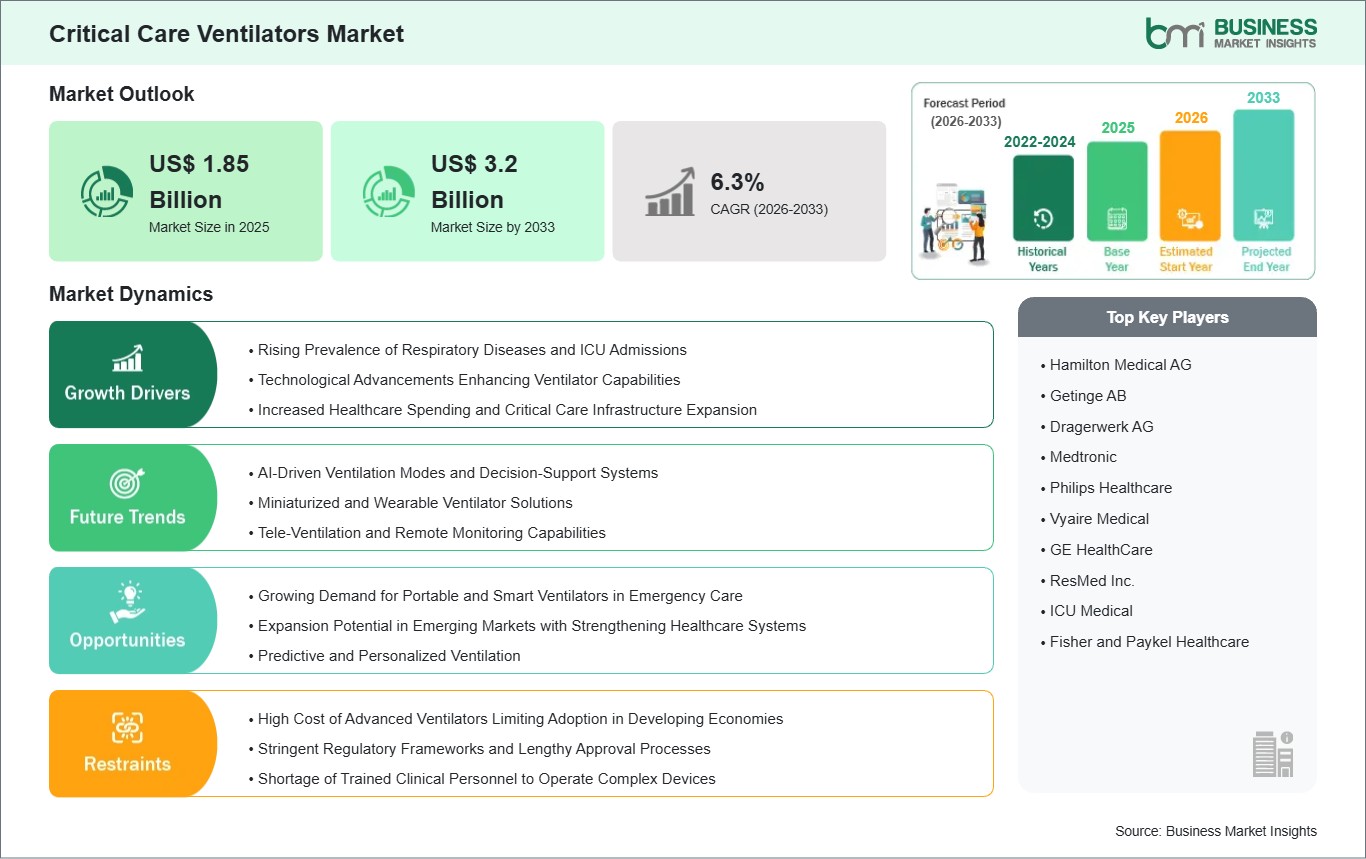
The global Critical Care Ventilators Industry is experiencing robust growth, driven by ICU modernization, the rise in the incidence of chronic and acute respiratory disorders, an aging population, and continuous investments in healthcare facilities across regions.
According to Business Market Insights, the global Critical Care Ventilators Market size is expected to reach US$ 3.2 Billion by 2033 from US$ 1.85 Billion in 2025. The market is estimated to record a CAGR of 7.09% from 2026 to 2033.
Technological advancement is shaping the industry landscape, with a major opportunity to grow by bringing in the newest technologies like artificial intelligence (AI), the Internet of Things (IoT), and tele-ICU platforms to ventilator systems. The rise in healthcare expenditure and insurance coverage is enhancing critical care access, while respiratory health awareness among clinicians and patients is also contributing to the adoption of new veantilator technologies.
Download Sample Report : https://www.businessmarketinsights.com/sample/BMIPUB00033214
What Are Critical Care Ventilators?
Critical care ventilators are advanced life-support machines designed to assist or replace spontaneous breathing for patients in intensive care units (ICUs) who cannot breathe adequately on their own. Primarily manufactured with high-precision sensors and robust software, their fundamental purpose is to deliver oxygen to the lungs, remove carbon dioxide, and reduce the work of breathing for critically ill patients.
The technology offers immense clinical flexibility, providing various modes of ventilation that can be tailored to a patient’s specific physiological needs. Modern critical care ventilators are precision-engineered to integrate seamlessly with hospital IT networks, enabling real-time remote monitoring and predictive analytics that significantly enhance patient safety and clinical decision-making during severe respiratory distress.
Market Drivers
One of the major factors that influence the growth of the market for critical care ventilators is the worldwide rising trend of chronic and acute respiratory diseases like chronic obstructive pulmonary disease (COPD), acute respiratory distress syndrome (ARDS), pneumonia, and other life-threatening respiratory conditions. These diseases often require mechanical ventilation, thereby sustaining the demand for advanced respiratory support devices.
The expanding emphasis on ICU modernization acts as another major driver. Healthcare facilities globally are continually upgrading their critical care infrastructure to meet rising patient volumes and prepare for sudden surges in ICU admissions. This modernization includes the procurement of sophisticated ventilators that offer better lung protection and patient comfort.
Furthermore, rapid demographic shifts, specifically the globally aging population, are accelerating market adoption. Older adults are highly susceptible to severe respiratory illnesses and complications from other chronic diseases, leading to higher hospitalization rates and a greater reliance on critical care ventilators for life support.
Get More Details: https://www.businessmarketinsights.com/buy/BMIPUB00033214
Market Segmentation
By Type
- Invasive Ventilators: The dominant segment, holding the largest share of the market in 2025, widely used for severe respiratory failure requiring endotracheal intubation.
- Non-Invasive Ventilators: A rapidly growing segment that provides respiratory support via masks, reducing the risks associated with intubation.
- Portable Ventilators: Highly utilized for transporting critically ill patients within hospitals or during emergency medical services.
By Mode of Ventilation
- Pressure-Controlled Ventilation: The dominant segment, holding the largest share in 2025, as it enhances patient comfort, reduces lung injury risk, and offers better lung protection compared to other modes.
- Volume-Controlled Ventilation: A traditional mode ensuring a preset tidal volume is delivered to the patient.
- Dual Modes: Combining features of pressure and volume control to optimize respiratory support.
- Adaptive Ventilation Modes: Utilizing intelligent algorithms to automatically adjust settings based on patient feedback.
- Other Mode of Ventilation: Including specialized spontaneous breathing support modes.
By End User
- Hospitals and Clinics: The dominant end-user segment in 2025, driven by their infrastructure, higher patient volumes, and regulatory procurement making them the primary buyers globally.
- Emergency Medical Services: Essential for providing immediate respiratory support during transit to medical facilities.
- Ambulatory Surgical Centers: Utilizing advanced ventilators for critical support during complex outpatient procedures.
- Other End Users: Encompassing specialized long-term care facilities and home healthcare settings.
Regional Insights
- Asia-Pacific is experiencing robust growth due to a variety of factors such as demographics, expanding healthcare infrastructure, and disease burden, which together will always keep the demand for advanced respiratory support high.
- North America maintains a significant market position, characterized by well-established medical facilities, high healthcare expenditure, and the early adoption of AI-driven ventilation technologies.
- Europe represents a highly strategic market, where major healthcare modernization initiatives and a large geriatric population heavily drive the continuous demand for critical care equipment.
- Middle East & Africa is experiencing reliable growth, fueled by rising government investments in upgrading hospital ICUs and expanding emergency medical services.
- South & Central America is witnessing steady market adoption as regional healthcare systems invest in critical care infrastructure to address the increasing incidence of respiratory ailments.
Technological Innovations
Integration of advanced technologies and tele-ICU capabilities represents a significant opportunity in the market. Manufacturers are bringing in the newest technologies like artificial intelligence (AI) and the Internet of Things (IoT) to ventilator systems. These AI-powered ventilation platforms provide predictive monitoring, allowing clinicians to anticipate respiratory complications before they become critical and adjust therapies dynamically.
Furthermore, interoperability has become a major focus. Modern critical care ventilators are now software-integrated systems designed to communicate effortlessly with central hospital electronic health records (EHRs). This seamless data exchange supports tele-ICU setups, where a centralized team of intensivists can monitor and manage ventilator settings for multiple patients across different geographic locations simultaneously.
Future Market Outlook
The future outlook for the Critical Care Ventilators Market is highly optimistic, linking sustained volume demand to global ICU expansion, an aging demographic, and the increasing incidence of chronic respiratory disorders through 2033. The rapid adoption of AI-driven data analytics and tele-ICU solutions will continue to shape progressive product development.
Market leadership in the upcoming decade will be defined by technological integration, patient safety features, and clinical adaptability. Organizations capable of supplying advanced, software-integrated ventilators that improve lung protection and patient comfort while reducing the burden on healthcare staff will secure a definitive competitive edge in the global medical technology landscape.
Frequently Asked Questions (FAQs)
What is the projected size of the Critical Care Ventilators Market by 2033?
The global market is projected to reach US$ 3.2 Billion by 2033, rising from US$ 1.85 Billion in 2025.
What is the CAGR for the Critical Care Ventilators Market?
The market is expected to grow at a CAGR of 7.09% from 2026 to 2033.
Which type segment is dominant?
The Invasive Ventilators segment held the largest share of the market in 2025.
Which mode of ventilation is most preferred?
The Pressure-Controlled Ventilation segment held the largest market share in 2025 as it enhances patient comfort, reduces lung injury risk, and offers better lung protection.
Which region is expected to grow robustly?
Asia-Pacific is experiencing robust growth due to demographic shifts, expanding healthcare infrastructure, and a high disease burden.
Browse More Reports:
https://www.businessmarketinsights.com/reports/digital-signal-processors-market
https://www.businessmarketinsights.com/reports/critical-communication-market
https://www.businessmarketinsights.com/reports/agricultural-mulch-films-market
About Us
Business Market Insights is a market research platform that provides subscription service for industry and company reports. Our research team has extensive professional expertise in domains such as Electronics & Semiconductor; Aerospace & Defense; Automotive & Transportation; Energy & Power; Healthcare; Manufacturing & Construction; Food & Beverages; Chemicals & Materials; and Technology, Media, & Telecommunications.
Contact Us
If you have any questions about this report or would like further information, please contact us:
Contact person: Ankit Mathur
Email: sales@businessmarketinsights.com
Phone: +16467917070
