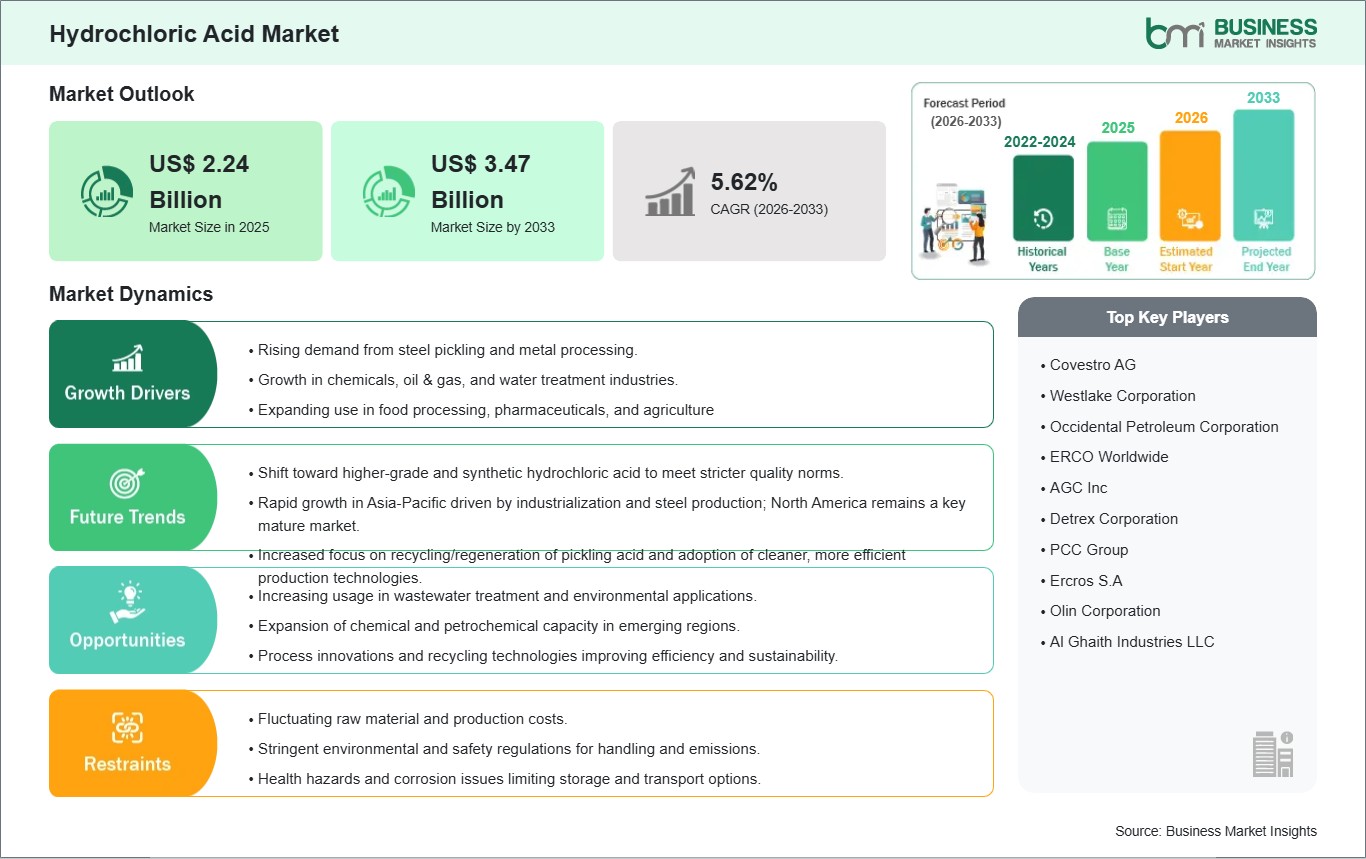
The global Hydrochloric Acid Industry is experiencing robust growth, propelled by the rising demand for steel pickling, expanding chemical synthesis, and increasing oil and gas well stimulation activities worldwide. As global industries expand and urbanization accelerates, the market is undergoing a significant expansion to support the maximization of production across heavy manufacturing and water treatment sectors.
According to Business Market Insights, the global Hydrochloric Acid Market size is expected to reach US$ 5.21 Billion by 2035 from US$ 2.76 Billion in 2025. The market is estimated to record a CAGR of 6.03% from 2026 to 2035.
Technological advancement is shaping the industry landscape, with major chemical manufacturers heavily focusing on developing advanced acid regeneration systems and high-purity production methods. This evolution enables industrial operators to meet strict environmental standards by recycling spent pickle liquor and recovering chlorine. Strong ecosystem collaboration between chemical suppliers, metallurgy sectors, and environmental regulatory bodies is streamlining supply chains and accelerating the commercial scale of sustainable chemical processing.
Download Sample Report : https://www.businessmarketinsights.com/sample/BMIPUB00032547
What Is Hydrochloric Acid?
Hydrochloric acid (HCl) is a highly corrosive, strong mineral acid defined as the aqueous solution of hydrogen chloride gas. Primarily manufactured as a massive co-product during the chlorination of organic chemicals or via direct synthesis, its fundamental purpose is to act as an essential reagent in various critical industrial applications, including metal processing, chemical synthesis, and pH regulation.
The chemical offers immense operational flexibility, with classifications separated broadly into synthetic and by-product grades. Modern hydrochloric acid production is precision-engineered to meet demanding industrial parameters, ranging from standard industrial grades for steel pickling to ultra-high-purity (UHP) grades required for sub-5 nm semiconductor fabrication. These customized properties ensure optimal reactive efficiency, excellent thermal stability, and unparalleled processing benefits across diverse heavy manufacturing operations.
Market Drivers
A primary driver of the Hydrochloric Acid Market is the surging global demand within the steel industry, specifically for the pickling of carbon steel. The acid serves as an indispensable agent for removing rust, scale, and impurities from metal surfaces, making it essential for preparing steel for subsequent processing in the rapidly expanding construction and automotive sectors.
The expanding emphasis on oil and gas well-stimulation acts as the second major driver. High-performance hydrochloric acid plays a vital role in oil well acidizing operations, where its unique capacity to rapidly dissolve carbonate rock formations significantly enhances reservoir permeability and maximizes resource extraction efficiency in unconventional shale plays.
Furthermore, tightening municipal water treatment mandates and hygiene requirements in food processing are accelerating product adoption. Industries are increasingly favoring high-quality aqueous hydrochloric acid for pH control and ion-exchange resin regeneration, ensuring compliance with strict environmental regulations and safeguarding global water infrastructure.
Get More Details: https://www.businessmarketinsights.com/buy/BMIPUB00032547
Market Segmentation
By Grade
- By-Product: The fastest-growing and dominant grade segment in 2025, accounting for the largest market revenue share due to high-volume availability from chlorinated hydrocarbon production and lower cost positions.
- Synthetic: A critical segment produced by directly synthesizing hydrogen and chlorine gases, highly valued for applications requiring precise concentration control and purity, such as pharmaceuticals and cosmetics.
By Form
- Liquid: The dominant form segment with approximately 83.2% share in 2025, widely preferred for convenience of handling and direct use in steel pickling, oil refining, and water treatment processes.
- Solid: The fastest-growing segment, highly utilized by remote industrial facilities needing longer storage life and precise concentration control.
By Application
- Steel Pickling: The largest application segment with an approximate 36.5% share in 2025, characterized by high demand for efficient scale removal and surface preparation solutions in global steel manufacturing.
- Oil Well Acidizing: The fastest-growing segment, crucial for upstream energy extraction and utilizing the acid to stimulate mature reservoirs and shale formations.
- Chemical Synthesis: Essential for producing vital organic and inorganic compounds such as polyurethanes, polyvinyl chloride (PVC), and fertilizers.
- Water Treatment: Utilizing the chemical for pH adjustment, neutralization, and regenerating resins used in industrial and municipal water purification.
- Others: Including food processing, ore processing (hydrometallurgy), and pool sanitation.
By End User Industry
- Steel Industry: The dominant end-user segment with approximately 31.8% share in 2025, a critical consumer utilizing bulk quantities to maintain continuous operation in heavy manufacturing and galvanizing plants.
- Chemicals: The fastest-growing end-user segment, relying on HCl for the mass synthesis of intermediate and final chemical products.
- Oil and Gas: Leveraging large volumes for well stimulation and drilling efficiency.
- Food and Beverage: Utilizing food-grade HCl for pH regulation, gelatin production, and fructose processing.
- Pharmaceuticals: Focused on extracting active ingredients and synthesizing pharmaceutical intermediates using high-purity grades.
Regional Insights
- Asia-Pacific is projected to be the fastest-growing region, registering a nearly 6.4% CAGR, supported by rapid industrialization, massive steel production in China and India, and booming semiconductor fabrication investments requiring ultra-high-purity acid.
- North America maintains a dominant market position with approximately 35.1% of global revenues in 2025, characterized by well-established petrochemical clusters along the Gulf Coast and sustained demand for oil and gas well acidizing in shale basins.
- Europe represents a highly regulated and technically advanced market, where stringent environmental standards and a strong emphasis on industrial cleaning chemicals for automotive steel processing heavily drive adoption.
- Middle East & Africa is experiencing reliable growth, fueled by vast energy extraction operations and expanding infrastructure development projects requiring treated steel.
- South & Central America is witnessing steady market adoption as the region capitalizes on its agricultural and mining sectors, driving demand for chemical synthesis and ore processing.
Top Players in the Hydrochloric Acid Market
The competitive landscape features integrated global chemical technology giants and specialized regional manufacturers focused on sustainable production, closed-loop recycling systems, and expansive global distribution networks.
- Olin Corporation
- Dow Chemical Company
- Westlake Chemical Corporation
- Occidental Petroleum Corporation (OxyChem)
- Eastman Chemical Company
- BLEACHTECH L.L.C.
- ANSA McAL Limited
Leading companies are actively expanding their footprints by investing in advanced electrolysis technologies to recover chlorine from by-product streams and securing long-term contracts with major semiconductor fabs.
Technological Innovations
Chemical engineering breakthroughs are transforming the market through the development of advanced acid regeneration systems (ARS). By utilizing specialized thermal decomposition and filtration technologies, modern manufacturing facilities can efficiently recover and reuse spent pickle liquor. This closed-loop approach drastically reduces hazardous waste disposal costs and raw material consumption, aligning heavy industrial processes with stringent circular economy mandates.
In the electronics sector, ultra-high-purity (UHP) refining processes are revolutionizing semiconductor manufacturing. Chemical producers are implementing state-of-the-art distillation and filtration systems capable of reducing trace metal contaminants to parts-per-trillion levels. These extreme purity standards are absolutely critical for sub-5 nm wafer etching and cleaning, enabling the next generation of high-performance microchips.
Future Market Outlook
The future outlook for the Hydrochloric Acid Market is highly optimistic, linking sustained volume demand to global infrastructural mega-projects, advanced electronics manufacturing, and strict water quality regulations through 2035. The rapid adoption of AI-driven logistics and digital process optimization in chemical plants will continue to shape efficient product distribution.
Market leadership in the upcoming decade will be defined by supply chain resilience, purity control, and environmental sustainability. Organizations capable of balancing volatile by-product availability with the production of eco-friendly, high-grade synthetic acid will secure a strong position across the global chemical landscape.
Frequently Asked Questions (FAQs)
What is the projected size of the Hydrochloric Acid Market by 2035?
The market is projected to reach US$ 5.21 Billion by 2035, rising from US$ 2.76 Billion in 2025.
What is the CAGR for the Hydrochloric Acid Market?
The market is expected to grow at a steady CAGR of 6.03% from 2026 to 2035.
Which application segment is dominant?
The Steel Pickling segment holds a dominant market share of 36.5% due to the immense global demand for rust and scale removal in construction and automotive steel manufacturing.
Which region is expected to lead global market growth?
Asia-Pacific is projected to exhibit the most robust growth, driven by aggressive infrastructure development, massive regional steel production, and expanding semiconductor fabrication facilities.
What is the primary factor driving demand?
The primary catalysts are the rising global demand for processed steel, increasing oil and gas well stimulation activities, and the expanding need for vital organic compound synthesis.
Browse More Reports:
https://www.businessmarketinsights.com/reports/soil-conditioners-market
https://www.businessmarketinsights.com/reports/wound-care-market
https://www.businessmarketinsights.com/reports/iv-equipment-market
About Us
Business Market Insights is a market research platform that provides subscription service for industry and company reports. Our research team has extensive professional expertise in domains such as Electronics & Semiconductor; Aerospace & Defense; Automotive & Transportation; Energy & Power; Healthcare; Manufacturing & Construction; Food & Beverages; Chemicals & Materials; and Technology, Media, & Telecommunications.
Contact Us
If you have any questions about this report or would like further information, please contact us:
Contact person: Ankit Mathur
Email: sales@businessmarketinsights.com
Phone: +16467917070

- Nerve Monitoring Systems Market Insights: Key Drivers, Competitive Landscape, and Growth Forecast - 2026-07-24
- Semiconductor Foundry Market Growth Driven by AI Chips and Advanced Manufacturing - 2026-07-24
- AI Adaptive Radio Market Growth Driven by Cognitive Communications and AI Spectrum Intelligence - 2026-07-24