Automated sortation systems have become a critical component of modern logistics and warehouse operations by enabling high-speed identification, routing, sorting, and distribution of parcels, cartons, totes, and other products. These systems improve operational efficiency by reducing manual handling, increasing throughput, enhancing order accuracy, and optimizing fulfillment processes across e-commerce, retail, parcel delivery, food distribution, pharmaceuticals, manufacturing, and airport cargo facilities. Continuous advancements in machine vision, robotics, RFID, artificial intelligence, and warehouse execution software are transforming automated sortation systems into intelligent logistics solutions capable of handling increasingly complex supply chain operations.
Market Overview
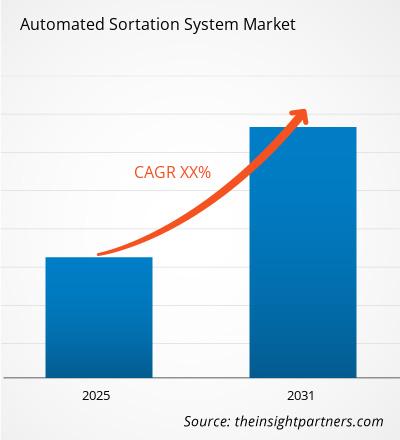
The Automated Sortation System Market was valued at US$ 10.37 Billion in 2025 and is projected to reach US$ 21.96 Billion by 2034, registering a CAGR of 8.69% during the forecast period 2026–2034. Market growth is driven by expanding e-commerce activities, increasing warehouse automation, rising parcel volumes, labor shortages, and growing investments in intelligent logistics infrastructure. The adoption of advanced sorting technologies across retail fulfillment centers, transportation hubs, and industrial distribution networks continues to support sustained market expansion.
Key Market Insights
- Market Size (2025): US$ 10.37 Billion
- Forecast Market Size (2034): US$ 21.96 Billion
- CAGR (2026–2034): 8.69%
- Key Growth Driver: Rising demand for automated parcel handling, warehouse optimization, and high-speed logistics operations
- Major Trend: Integration of artificial intelligence, machine vision, robotics, and warehouse execution software
- Forecast Period: 2026–2034
Get a Sample PDF of the Report: https://www.theinsightpartners.com/sample/TIPRE00014070
Market Drivers
Rapid Growth of E-commerce
Increasing online shopping volumes are encouraging retailers, logistics providers, and parcel carriers to invest in automated sortation technologies that improve throughput and delivery efficiency.
Warehouse Automation Initiatives
Companies are modernizing warehouses and distribution centers with intelligent automation solutions to address labor shortages, improve operational productivity, and reduce fulfillment costs.
Expansion of Parcel and Courier Networks
Growing parcel shipments and same-day delivery services are increasing demand for scalable sorting systems capable of handling high-volume logistics operations.
Demand for Supply Chain Efficiency
Organizations are adopting automated sortation systems to improve inventory management, minimize manual errors, optimize warehouse space, and accelerate order fulfillment.
Market Trends
Artificial Intelligence and Machine Vision
Manufacturers are integrating artificial intelligence, barcode recognition, RFID, and machine vision technologies to improve sorting accuracy and operational intelligence.
Predictive Maintenance
Advanced monitoring platforms use real-time equipment analytics and predictive maintenance capabilities to reduce downtime and maximize operational availability.
Modular and Scalable System Design
Suppliers are introducing modular sortation solutions that allow warehouses to expand capacity as business requirements evolve without extensive infrastructure changes.
Digital Twin Integration
Digital twin technologies enable warehouse operators to simulate, optimize, and monitor sortation system performance before implementing operational changes.
Get the Premium Research Report @ https://www.theinsightpartners.com/buy/TIPRE00014070
Regional Analysis
North America
North America accounted for approximately 29%–33% of the global market in 2025 and is projected to grow at a CAGR of 7.9%–9.9% during 2026–2034. Market growth is supported by parcel hub modernization, omnichannel retail expansion, warehouse automation, airport cargo upgrades, and increasing investments in domestic logistics infrastructure. The US represented approximately 80%–85% of North America’s market in 2025 and is expected to register a CAGR of 8.1%–10.1%, driven by e-commerce fulfillment, grocery logistics, pharmaceutical distribution, and advanced parcel delivery networks.
Europe
Europe held approximately 23%–27% of the market in 2025 and is anticipated to grow at a CAGR of 7.2%–9.2%. Germany, the UK, France, Italy, and Spain continue strengthening regional demand through warehouse modernization, industrial automation, retail logistics, and transportation infrastructure development.
Asia-Pacific
Asia-Pacific captured approximately 31%–35% of the global market in 2025 and is projected to register the fastest regional growth with a CAGR of 9.8%–11.8% during 2026–2034. China, Japan, South Korea, India, and Australia continue expanding e-commerce, manufacturing, logistics automation, and smart warehouse infrastructure, supporting robust regional market growth.
Middle East and Africa
The Middle East and Africa are steadily investing in logistics modernization, airport cargo infrastructure, smart warehouses, and regional distribution networks, creating new growth opportunities for automated sortation system providers.
Segment Analysis
By System Type
The Linear Sortation segment accounted for approximately 55%–60% of the market in 2025 and is projected to grow at a CAGR of 7.6%–9.6% through 2034. High throughput, operational simplicity, and widespread deployment across distribution centers and parcel handling facilities continue supporting the segment’s market leadership.
By System Type
The Loop Sortation segment represented approximately 40%–45% of the market in 2025 and is expected to register the fastest growth with a CAGR of 9.2%–11.2%. Increasing demand for flexible, high-capacity sorting systems capable of handling diverse product types continues accelerating adoption across advanced logistics facilities.
Competitive Landscape
The Automated Sortation System Market remains highly competitive as logistics automation providers, warehouse technology companies, and industrial automation manufacturers continue investing in intelligent material handling systems, robotics, machine vision, artificial intelligence, and warehouse execution software. Companies are strengthening their competitive positions through innovations in cross-belt sorters, tilt-tray systems, conveyor technologies, predictive maintenance platforms, digital twins, and integrated warehouse management solutions. Strategic collaborations with logistics providers, retailers, airport operators, and manufacturing companies continue accelerating automation deployment across global supply chains.
Key Players
- Bastian Solutions, LLC
- BEUMER Group GmbH & Co. KG
- Daifuku Co., Ltd.
- Dematic GmbH
- Honeywell Intelligrated
- Interroll Holding AG
- KNAPP AG
- Murata Machinery, Ltd.
- Siemens AG
- TGW Logistics Group GmbH
Emerging Trends
The automated sortation system industry is advancing through artificial intelligence-powered warehouse automation, robotic loading systems, machine vision, RFID-enabled tracking, digital twin technologies, predictive maintenance, warehouse execution software, cross-belt sorters, tilt-tray systems, intelligent induction systems, and cloud-based logistics analytics. Manufacturers are developing next-generation sortation platforms that deliver higher throughput, improved sorting accuracy, greater operational flexibility, enhanced energy efficiency, and seamless integration with warehouse management systems. These technological advancements are expected to create significant growth opportunities across e-commerce, parcel logistics, retail distribution, airport cargo operations, pharmaceuticals, food logistics, and industrial manufacturing throughout the forecast period.
Future Outlook
The future outlook for the Automated Sortation System Market remains highly promising as organizations continue investing in warehouse automation, digital supply chains, intelligent logistics, and high-speed fulfillment infrastructure. Increasing adoption of smart sorting technologies, robotics, artificial intelligence, and integrated warehouse software is expected to support sustained market growth through 2034.
Related Market Research Reports
Supercapacitor Market Size 2031 | Drivers and Opportunities
Smart Textile Market Size & Share with Growth Scope and Analysis 2031
Surface Acoustic Wave (SAW) Device Market Trends, Share & Demand by 2034
Cordless Phone Market Size, Trends & Growth by 2034
About The Partners
The Insight Partners is a Insight global leader in market research, delivering comprehensive analysis and actionable insights across diverse industries. The company empowers decision-makers with data-driven intelligence to navigate evolving markets and accelerate growth.
Contact Us:
- Contact Person: Ankit Mathur
- E-mail: ankit.mathur@theinsightpartners.com
- Phone: +1-646-491-9876
Also Available in :
