Modern defense strategies are undergoing a fundamental transformation as armed forces worldwide shift their focus toward achieving electromagnetic spectrum (EMS) superiority. Electronic warfare (EW) capabilities encompassing Electronic Attack (EA), Electronic Protection (EP), and Electronic Warfare Support (ES) have transitioned from situational combat accessories to critical core components of national defense doctrine. The growing reliance on interconnected military platforms, satellite communication networks, radar systems, and precision-guided weaponry makes control over the signal landscape essential for operational victory.
escalating geopolitical conflicts, border standoffs, and non-state threats have accelerated defense modernization budgets globally. Militaries are prioritizing investments in software-defined, adaptive EW systems capable of neutralizing complex threat vectors ranging from stealth aircraft to weaponized commercial drones.
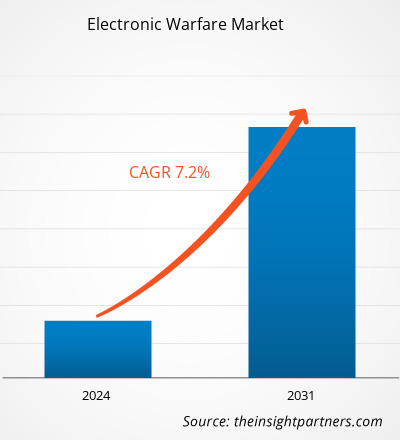
The Electronic Warfare Market size is expected to reach US$ 34.44 Billion by 2034 from US$ 21.74 Billion in 2025. The market is anticipated to register a CAGR of 5.25% during the forecast period 2026–2034.
Major Market Drivers and Technological Trends
1. Proliferation of Unmanned Aerial Systems (UAS) and Counter-UAS Demands
The rapid proliferation of low-cost, highly maneuverable unmanned vehicles across land, sea, and air domains has fundamentally reshaped the battlefield. Armed forces require persistent EW solutions to jam communication links, spoof navigation systems, and intercept localized telemetry. As counter-UAS capabilities become vital to military infrastructure, demand for lightweight, miniaturized electronic warfare payloads mounted on tactical platforms continues to surge.
2. Cognitive Electronic Warfare and Artificial Intelligence
Traditional EW systems relied heavily on static, pre-programmed threat libraries that required manual updates to recognize adversarial radar and radio signals. Modern battlefields feature rapidly evolving, agile signals that require cognitive EW solutions. By integrating Artificial Intelligence (AI) and Machine Learning (ML) algorithms, modern EW suites can analyze unknown electromagnetic signatures in real time, automatically determining the optimal countermeasure or jamming sequence.
3. Convergence of Cyber Warfare and Electronic Warfare
The boundaries between physical spectrum operations and digital network exploitation are increasingly blurred. Cyber-Electromagnetic Activities (CEMA) enable military operators to inject malicious payloads directly into adversary networks via RF signals. This convergence offers tactical advantages, allowing forces to degrade enemy radar networks, disrupt command structures, and neutralize target sensors without relying solely on kinetic weaponry.
Get a PDF Sample– https://www.theinsightpartners.com/sample/TIPTE100000942
Key Market Players
The global electronic warfare industry is characterized by high capital intensity, strategic joint ventures, and long-term government defense contracts. Key industry players leading the development of next-generation EW solutions include:
L3Harris Technologies, Inc. – Renowned for its advanced airborne jamming pods, tactical communications, and broad-spectrum threat warning systems.
Raytheon Technologies Corporation – A premier developer of airborne electronic attack systems, radar jamming technologies, and missile defense EW suites.
Lockheed Martin Corporation – Leading integrator of multi-domain EW architectures for fifth-generation fighter jets, naval combatants, and land systems.
Saab AB – Specializes in self-protection systems, radar jamming, and countermeasure dispenser suites tailored for naval and airborne platforms.
BAE Systems – Provides software-defined electronic warfare capabilities, threat detection sensors, and adaptive signal processing technologies.
Thales Group – Focuses on naval, air, and ground-based electronic countermeasure systems, naval decoys, and high-frequency communication protection.
Northrop Grumman Corporation – Pioneer in cognitive EW, radar jamming pods, and integrated cyber-electronic defense capabilities.
Cobham Limited – Key provider of specialized microwave components, antenna solutions, and RF subsystems critical for EW integration.
Leonardo S.p.A. – Innovator in defensive aids suites, electronic support measures, and tactical radar warning receivers.
Textron Inc. – Offers specialized uncrewed platforms and electronic warfare support solutions designed for tactical electronic attack missions.
Market Segmentation Highlights
By Capability: Electronic Protection (EP) holds a commanding market share, driven by the requirement to safeguard friendly radar, communication systems, and personnel against enemy jamming. However, Electronic Attack (EA) capabilities are expected to record fast growth as offensive spectrum dominance becomes a top priority.
By Platform: Airborne platforms (manned jets, helicopters, and drones) currently lead overall market expenditure due to high integration costs and mission criticalities. Ground and naval platform deployments are simultaneously gaining traction for border monitoring, convoy protection, and maritime fleet defense.
By Region: North America remains the dominant revenue contributor, backed by high defense expenditure and advanced R&D programs. The Asia-Pacific region is projected to register the fastest growth rate, fueled by aggressive defense modernization initiatives in emerging economies.
Get Full Copy of This Report- https://www.theinsightpartners.com/buy/TIPTE100000942
Future Outlook
The future of the Electronic Warfare market will be characterized by modular, open-architecture designs and high-level autonomy across multi-domain operations. As electromagnetic spectrum environments grow more crowded and contested, success will depend on real-time signal adaptability, cognitive decision-making, and seamless cross-platform interoperability. Moving forward, the integration of quantum sensing, space-based EW capabilities, and deep-learning signal processing will redefine modern warfare, providing defense forces with the tactical edge required to dominate the connected battlefields of tomorrow.
Related Reports-
Network Centric Warfare Market
About Us
The Insight Partners is a one-stop industry research provider of actionable intelligence. We help our clients in getting solutions to their research requirements through our syndicated and consulting research services. We specialize in industries such as Semiconductor and Electronics, Aerospace and Defense, Automotive and Transportation, Biotechnology, Healthcare IT, Manufacturing and Construction, Medical Devices, Technology, Media, and Telecommunications, as well as chemicals and Materials.
Contact Us
If you have any queries about this report or if you would like further information, don’t hesitate to get in touch with us:
Contact Person: Ankit Mathur
E-mail: ankit.mathur@theinsightpartners.com
