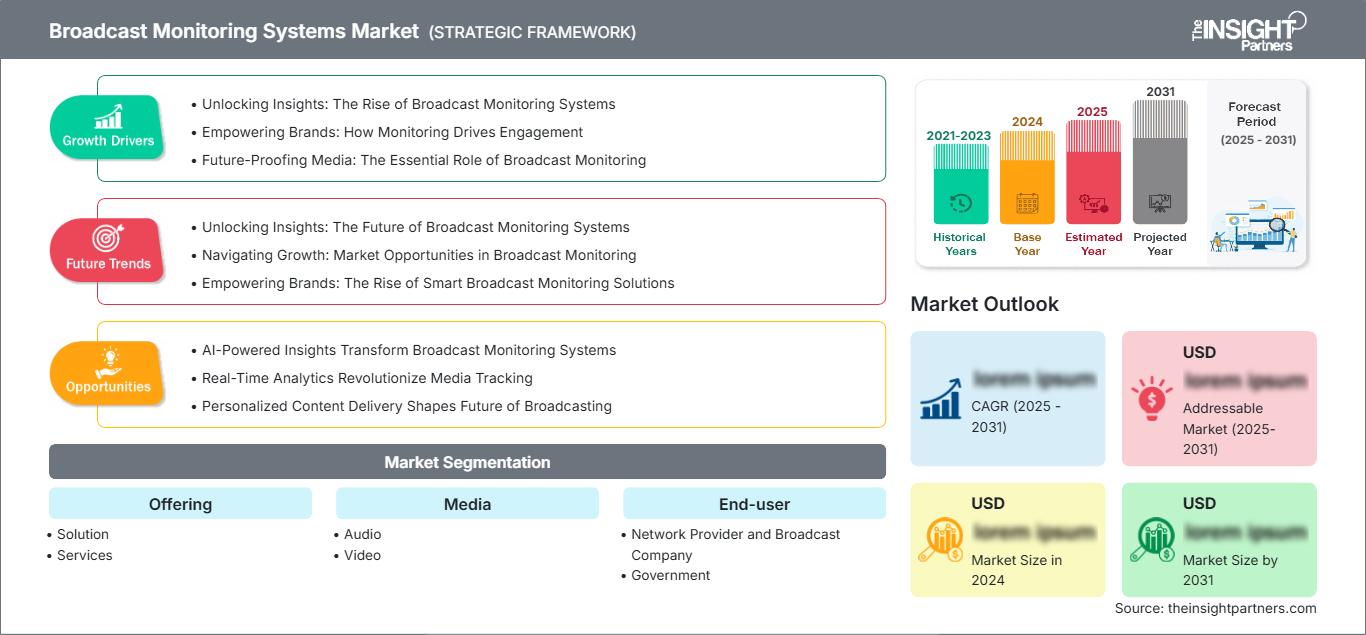
The broadcast industry is undergoing a significant transformation as media companies, broadcasters, and content providers modernize their operations with cloud technologies, artificial intelligence, and IP based broadcasting infrastructure. The Broadcast Monitoring Systems Market is becoming an essential part of this transformation by enabling real time monitoring, compliance verification, signal quality management, and operational efficiency across television, radio, OTT, and digital broadcasting networks.
Get a sample PDF of the Report: https://www.theinsightpartners.com/sample/TIPRE00018373
With broadcasters handling increasing volumes of live and on demand content, organizations are investing in intelligent monitoring solutions capable of delivering uninterrupted service quality and automated issue detection. Advanced monitoring platforms now integrate AI driven analytics, remote monitoring capabilities, cloud deployment, and multi platform compatibility, helping media organizations improve viewer experience while reducing operational complexity. Industry experts expect these technological advancements to shape the future of the Broadcast Monitoring Systems Market through 2031.
The increasing adoption of IP based workflows, virtualization, and software defined broadcasting has accelerated demand for advanced monitoring systems across global media organizations. Modern broadcasters require centralized platforms that continuously monitor content quality, transmission reliability, regulatory compliance, and service availability across multiple delivery channels. As broadcasting ecosystems become more distributed, monitoring solutions are evolving into intelligent operational platforms powered by automation and predictive analytics.
Market Highlights by 2031
• Market Size: Expected to witness substantial expansion by 2031
• Market Share: Cloud based monitoring solutions continue gaining significant industry adoption
• Market Trends: Growing integration of AI, automation, and predictive monitoring technologies
• Market Analysis: Increasing investments in IP broadcasting and digital media infrastructure are driving demand
• Market Forecast: Strong opportunities expected across television, OTT, radio, sports broadcasting, and live event production through 2031
Growing Need for Intelligent Broadcast Monitoring
As content consumption expands across linear television, streaming services, FAST channels, and mobile platforms, broadcasters face increasing operational complexity. Monitoring every transmission path manually is no longer practical. Modern broadcast monitoring systems provide centralized dashboards that identify faults instantly, reduce downtime, and maintain consistent audio and video quality.
Artificial intelligence has become a key differentiator in the latest generation of monitoring platforms. AI powered systems automatically detect signal degradation, black screens, frozen frames, captioning issues, loudness violations, and transmission failures before they impact viewers. Predictive analytics further help engineering teams prevent service interruptions rather than simply reacting to failures.
Cloud deployment is another major industry trend. Broadcasters increasingly prefer cloud native monitoring platforms that support remote operations, distributed production environments, and scalable infrastructure. These capabilities are especially valuable for live sports, news broadcasting, and international media operations where continuous monitoring is essential.
Regional Analysis
North America
North America continues to represent one of the leading regions for the Broadcast Monitoring Systems Market due to rapid technology adoption, advanced broadcasting infrastructure, widespread OTT services, and continuous investment in AI powered media operations. Major television networks, sports broadcasters, and streaming companies continue upgrading monitoring capabilities to improve operational resilience and viewer experience.
Europe
European broadcasters are investing heavily in digital transformation initiatives while ensuring compliance with evolving broadcasting standards and content regulations. The increasing migration toward cloud based production workflows is encouraging adoption of intelligent monitoring solutions across both public and private broadcasters.
Asia Pacific
Asia Pacific is expected to experience remarkable growth owing to expanding digital television networks, rising internet penetration, increasing live streaming activities, and government investments in broadcasting infrastructure. Countries including China, India, Japan, and South Korea continue modernizing their media ecosystems.
Middle East, Africa, and South America
Growing investments in media infrastructure, sports broadcasting, entertainment channels, and digital television services are creating new opportunities across emerging economies. Expanding broadband connectivity and digital broadcasting projects continue supporting long term demand for advanced monitoring technologies.
Updated Industry News
Recent industry developments demonstrate how broadcast monitoring technologies are evolving alongside AI and cloud innovation.
Software based monitoring platforms are increasingly replacing traditional hardware intensive monitoring systems as broadcasters migrate toward IP infrastructure and cloud based operations. Vendors are introducing AI assisted quality control, intelligent multiviewers, automated alerting, and predictive monitoring capabilities to simplify complex broadcasting workflows.
The broader observability sector is also witnessing increased investment. Palo Alto Networks recently expanded its observability capabilities through the acquisition of Embrace and introduced enhanced application monitoring technologies, highlighting the growing importance of intelligent monitoring solutions across digital operations.
Additionally, updated broadcasting standards continue influencing monitoring requirements. The Advanced Television Systems Committee recently expanded audio loudness recommendations to include streaming services, reflecting the industry’s growing focus on consistent content quality across traditional broadcasting and digital streaming platforms.
Key Growth Drivers
The Broadcast Monitoring Systems Market continues to benefit from several industry trends including:
• Rapid migration toward IP based broadcasting
• Expansion of OTT and streaming platforms
• Increasing deployment of AI driven monitoring solutions
• Rising demand for automated quality assurance
• Growing cloud adoption across broadcasting infrastructure
• Increasing regulatory compliance requirements
• Higher investments in remote production technologies
• Expansion of live sports and entertainment broadcasting
Market Challenges
Despite promising opportunities, the industry also faces several challenges including:
• Complex integration with legacy broadcasting infrastructure
• High implementation costs for advanced enterprise deployments
• Growing cybersecurity concerns across cloud broadcasting environments
• Requirement for highly skilled technical professionals
• Continuous technology upgrades across rapidly evolving media ecosystems
Key Players
Leading companies operating in the Broadcast Monitoring Systems Market include:
• Actus Digital
• Mediaproxy
• Evertz Microsystems
• Rohde & Schwarz
• Bridge Technologies
• TAG Video Systems
• Interra Systems
• Qligent
• Skyline Communications
• Tektronix
Competitive Landscape
Technology providers are focusing on expanding software defined monitoring platforms capable of supporting hybrid broadcasting environments. Strategic investments in AI, machine learning, automation, cloud native architecture, and advanced analytics continue strengthening competitive positioning. Companies are also enhancing interoperability with OTT platforms, virtualized production environments, and multi cloud deployments to address evolving customer requirements.
Get the Premium Research Report @ https://www.theinsightpartners.com/buy/TIPRE00018373
Future Outlook
The future of the Broadcast Monitoring Systems Market appears highly promising as broadcasters continue embracing digital transformation and software defined media operations. Artificial intelligence, cloud native monitoring, predictive analytics, and automation will remain the primary technologies shaping the next generation of broadcast monitoring solutions. As content delivery becomes increasingly distributed across television, streaming, mobile, and digital platforms, demand for intelligent monitoring systems capable of ensuring uninterrupted service quality, regulatory compliance, and operational efficiency is expected to accelerate through 2031. Organizations investing in scalable, AI enabled monitoring infrastructure will be well positioned to support future broadcasting innovations while delivering superior audience experiences.
Related Reports –
Home Energy Management System Market Regional Share, Trend, and Growth Opportunity
Vision Transformers Market Regional Share, Trend, and Growth Opportunity
Differential-Pressure Mass Flow Controller Market Regional Share, Trend, and Growth Opportunity
About The Insight Partners
The Insight Partners is a leading market research and consulting firm delivering actionable insights through in-depth industry analysis and strategic intelligence. The firm supports clients across various industries in making informed business decisions by providing comprehensive market forecasts, competitive assessments, and growth opportunities.
Contact Us:
If you have any queries about this report or if you would like further information, please contact us:
Contact Person: Ankit Mathur
E-mail: sales@theinsightpartners.com
Phone: +1-646-491-9876
Also Available in :
Korean | German | Japanese | French | Chinese | Italian | Spanish
