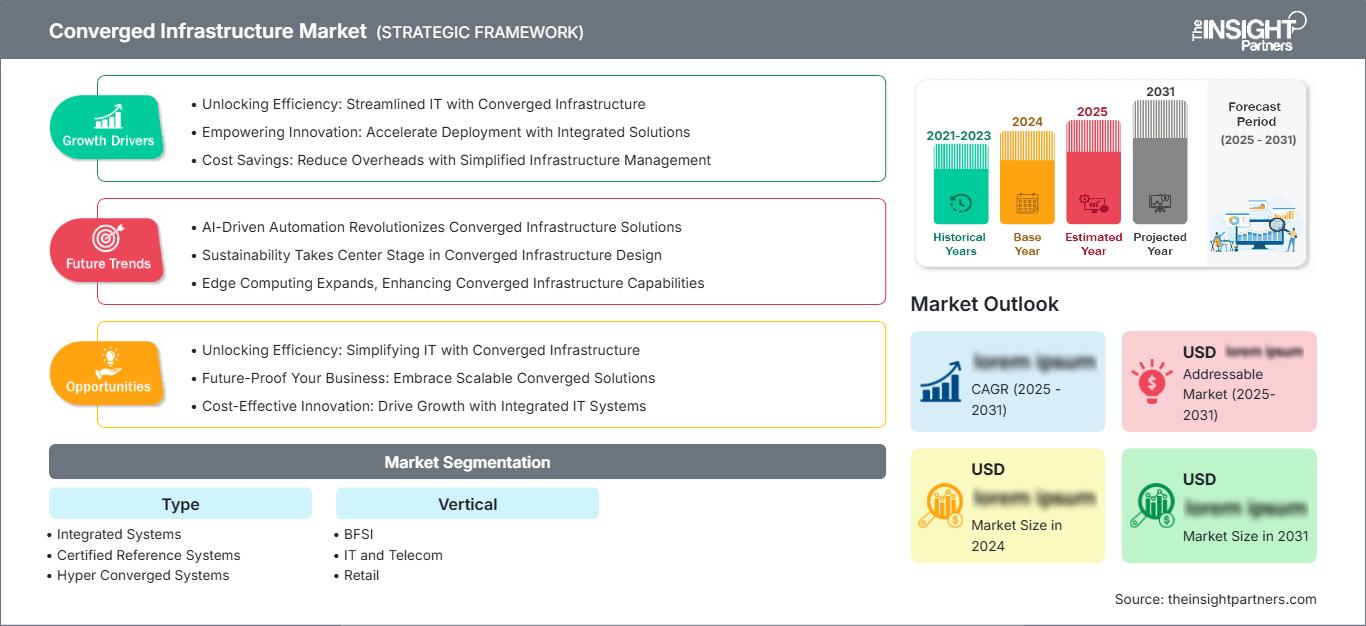
The global Converged Infrastructure (CI) market is witnessing significant growth as organizations increasingly seek integrated IT solutions that simplify data center management, improve operational efficiency, and reduce infrastructure complexity. Converged infrastructure combines compute, storage, networking, virtualization, and management software into a single optimized platform, enabling enterprises to deploy applications faster while minimizing operational costs.
According to the report, The Converged Infrastructure market size is expected to reach US$ 43.66 Billion by 2034 from US$ 19.42 Billion in 2025. The market is anticipated to register a CAGR of 9.42% during the forecast period 2026–2034.
Growing Demand for Simplified Data Center Operations
Modern enterprises manage increasingly complex IT environments consisting of physical infrastructure, virtual machines, cloud services, and edge devices. Managing these diverse environments independently often increases operational costs and administrative burden. Converged infrastructure offers a unified approach by integrating hardware and software components into a single platform.
This integrated architecture enables IT teams to deploy new workloads quickly while reducing compatibility issues among storage, networking, and compute systems. Organizations also benefit from simplified lifecycle management, automated updates, and centralized monitoring, allowing IT departments to focus more on innovation rather than routine maintenance.
The increasing adoption of hybrid cloud environments is another major factor driving converged infrastructure deployment. Businesses require seamless connectivity between on-premises infrastructure and public cloud services while maintaining security, performance, and compliance standards.
Digital Transformation Accelerating Market Growth
Digital transformation initiatives across industries are significantly boosting the adoption of converged infrastructure solutions. Companies are investing heavily in technologies such as artificial intelligence, Internet of Things (IoT), machine learning, blockchain, and advanced analytics, all of which require highly scalable and reliable infrastructure.
Converged infrastructure provides organizations with the flexibility to scale computing resources without extensive redesign of existing IT environments. Enterprises can rapidly provision resources for new business applications while maintaining consistent performance and reducing deployment times.
Cloud-native applications and containerized workloads are also creating demand for highly flexible infrastructure capable of supporting dynamic workloads. Integrated infrastructure solutions help organizations respond quickly to changing business requirements while improving resource efficiency.
Get Sample PDF of the report @ https://www.theinsightpartners.com/sample/TIPRE00012065
Increasing Adoption Across Multiple Industry Verticals
The converged infrastructure market is expanding across numerous industries as organizations modernize their IT operations.
Banking, Financial Services, and Insurance (BFSI) institutions utilize converged infrastructure to support digital banking platforms, cybersecurity operations, and real-time transaction processing.
Healthcare organizations leverage integrated infrastructure for electronic medical records, telemedicine platforms, medical imaging storage, and healthcare analytics.
Manufacturing companies deploy converged infrastructure to support Industry 4.0 initiatives, smart factories, industrial IoT, predictive maintenance, and production automation.
Retail businesses use these solutions for omnichannel commerce, customer analytics, inventory optimization, and point-of-sale systems.
The Public Sector increasingly adopts converged infrastructure to improve digital government services, citizen engagement platforms, and secure data management.
Technology Trends Shaping the Market
Several emerging technologies are transforming the converged infrastructure landscape.
Artificial intelligence is being integrated into infrastructure management platforms to automate monitoring, workload optimization, predictive maintenance, and capacity planning. AI-powered management significantly reduces downtime while improving operational efficiency.
Edge computing continues to gain momentum as enterprises process increasing amounts of data closer to end users. Converged infrastructure enables organizations to deploy compact, scalable edge data centers supporting low-latency applications.
Automation and software-defined infrastructure are also becoming essential components of modern converged systems. Automated provisioning, policy-based management, and intelligent orchestration simplify IT operations and accelerate service delivery.
Sustainability is another growing trend. Vendors are designing energy-efficient infrastructure systems that reduce power consumption, optimize cooling requirements, and lower operational costs while supporting corporate sustainability goals.
Market Segmentation
According to the report, the converged infrastructure market is segmented based on Type and Vertical.
By Type
- Integrated Systems
- Certified Reference Systems
- Hyper Converged Systems
Integrated systems continue to attract strong enterprise demand due to their pre-tested configurations and simplified deployment. Hyper converged infrastructure (HCI) is also experiencing rapid adoption because it integrates compute, storage, virtualization, and networking into software-defined platforms, enabling greater scalability and flexibility.
By Vertical
- BFSI
- IT and Telecom
- Retail
- Manufacturing
- Healthcare
- Public Sector
Each industry benefits differently from converged infrastructure depending on workload requirements, compliance needs, and digital transformation strategies.
Get the Premium Research Report @ https://www.theinsightpartners.com/buy/TIPRE00012065
Regional Analysis
North America
North America represents one of the largest markets for converged infrastructure due to widespread cloud adoption, advanced IT infrastructure, significant investments in digital transformation, and the presence of major technology vendors. Enterprises across the United States and Canada continue to modernize their data centers to support AI, analytics, and hybrid cloud environments.
Europe
European organizations increasingly invest in integrated infrastructure to comply with data protection regulations while supporting enterprise modernization. Manufacturing, financial services, and healthcare sectors remain major contributors to regional growth.
Asia Pacific
Asia Pacific is expected to witness substantial growth driven by rapid digitalization, expanding cloud adoption, increasing enterprise IT spending, and government initiatives supporting digital economies. Countries including China, India, Japan, and Australia continue investing heavily in modern data center infrastructure.
Middle East & Africa
The region is gradually adopting converged infrastructure as governments and enterprises accelerate smart city initiatives, digital government services, and cloud transformation programs.
South & Central America
Growing enterprise modernization efforts, cloud adoption, and investments in digital infrastructure contribute to increasing demand for converged infrastructure solutions across the region.
Market Drivers
Several factors are driving the growth of the converged infrastructure market:
- Growing demand for simplified IT management.
- Increasing enterprise adoption of hybrid cloud environments.
- Rising investments in digital transformation initiatives.
- Expansion of virtualization technologies.
- Increasing deployment of AI and machine learning workloads.
- Growing requirement for scalable data center infrastructure.
- Need to reduce operational costs and improve resource utilization.
- Rising adoption of edge computing.
- Increasing cybersecurity and compliance requirements.
- Greater emphasis on business continuity and disaster recovery.
Challenges
Despite strong growth prospects, the market faces several challenges.
High initial deployment costs may discourage smaller organizations from adopting converged infrastructure solutions. Enterprises also face integration challenges while migrating from legacy infrastructure to modern converged platforms. Additionally, vendor lock-in concerns and the shortage of skilled IT professionals capable of managing advanced infrastructure environments may slow adoption in certain markets.
Organizations must also carefully evaluate workload requirements, scalability needs, and long-term infrastructure strategies before selecting appropriate converged infrastructure solutions.
Competitive Landscape
The converged infrastructure market remains highly competitive, with global technology companies continuously investing in product innovation, AI-driven infrastructure management, software-defined capabilities, and cloud integration.
Major companies operating in the market include:
- Cisco Systems, Inc.
- Dell Inc
- FUJITSU
- Hewlett Packard Enterprise Development LP
- Hitachi Ltd.
- Huawei Technologies Co., Ltd.
- IBM
- NetApp
- Oracle
- VMware, Inc
These companies continue expanding their portfolios through research and development, strategic partnerships, acquisitions, and integrated cloud solutions to strengthen their competitive positions.
Future Outlook
The future of the converged infrastructure market remains highly promising as enterprises continue investing in intelligent, scalable, and automated IT environments. The convergence of cloud computing, artificial intelligence, edge computing, software-defined infrastructure, and advanced virtualization technologies will continue reshaping enterprise data centers worldwide.
About The Insight Partners
The Insight Partners is a global leader in market research, delivering comprehensive analysis and actionable insights across diverse industries. The company empowers decision-makers with data-driven intelligence to navigate evolving markets and accelerate growth.
Contact Us:
- Contact Person: Ankit Mathur
- E-mail: ankit.mathur@theinsightpartners.com
- Phone: +1-646-491-9876
Also Available in :
Korean German Japanese French Chinese Italian Spanish

- Low-Carbon Propulsion Market to Reach US$ 173.19 Billion by 2034, Growing at a CAGR of 21.38% - 2026-07-27
- https://www.theinsightpartners.com/assets/rd-new-images/by_cagr/camera-technology-market-cagr.webp - 2026-07-27
- Sensor Signal Conditioner ICs Market to Reach US$ 7.76 Billion by 2034 from US$ 4.72 Billion - 2026-07-27