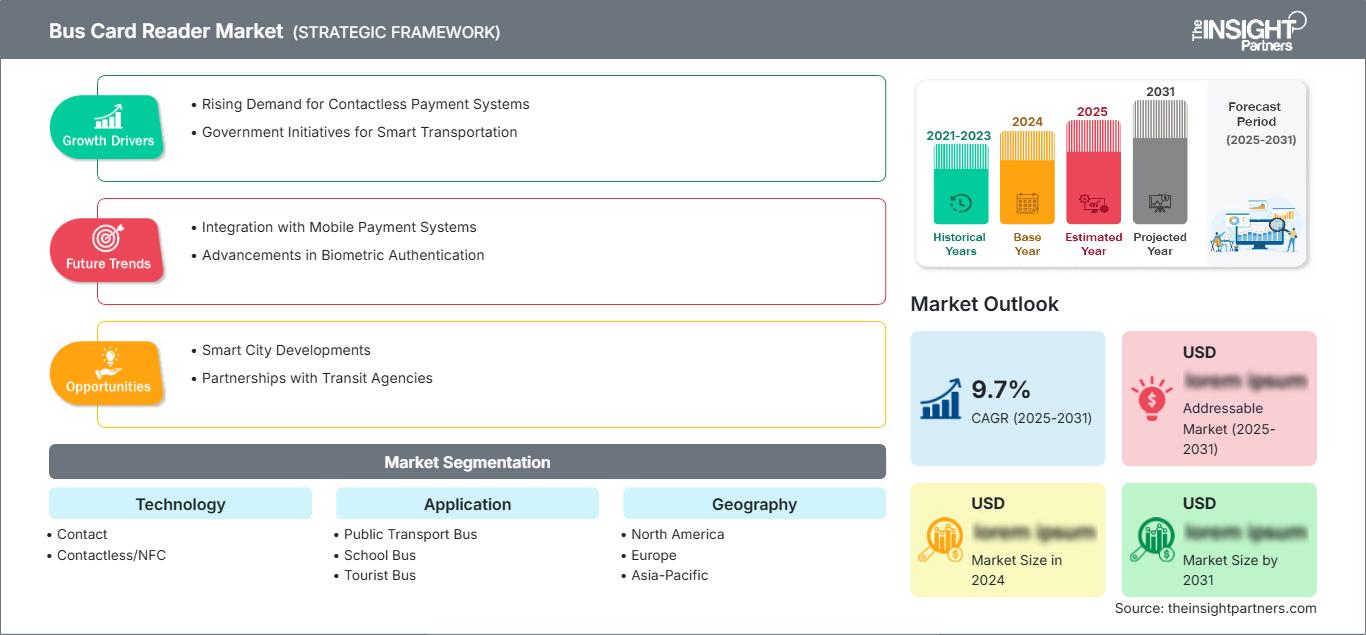
The global Bus Card Reader Market is witnessing significant momentum as public transportation authorities accelerate digital fare collection initiatives across urban and intercity transit networks. Growing investments in intelligent transportation systems, smart ticketing platforms, and contactless payment infrastructure are reshaping how passengers interact with public transport. Governments, transport operators, and technology providers are increasingly adopting automated fare collection solutions to improve passenger convenience, reduce operational complexity, and support sustainable urban mobility.
Get a sample PDF of the Report: https://www.theinsightpartners.com/sample/TIPRE00011123
The Bus Card Reader Market continues to evolve alongside the expansion of smart cities, digital payment ecosystems, and connected transportation networks. Modern bus card readers now support contactless smart cards, NFC-enabled smartphones, QR code payments, and integrated mobility platforms, enabling faster boarding and seamless fare validation. These technological advancements are encouraging transit agencies worldwide to modernize existing infrastructure while enhancing commuter experiences through secure and efficient payment solutions.
Transportation authorities are also leveraging cloud-based management platforms, real-time analytics, and IoT connectivity to optimize fleet operations and fare collection. The growing emphasis on interoperability between buses, metro systems, and multimodal transportation is further strengthening demand for advanced card reader technologies that simplify daily commuting and improve operational transparency.
Bus Card Reader Market Highlights Through 2031
• Market Size: Expected to witness steady expansion through 2031
• Market Share: Contactless and NFC-enabled solutions continue gaining wider adoption
• Market Trends: Increasing deployment of smart ticketing, digital payments, and cloud-connected fare collection
• Market Analysis: Rising investments in intelligent transportation infrastructure support long-term adoption
• Market Forecast: Continuous innovation in public transport automation is expected to create substantial opportunities through 2031
Industry Driving Factors
Urbanization continues to increase passenger volumes across public transportation systems, encouraging operators to invest in intelligent fare collection technologies. Traditional cash-based ticketing is gradually being replaced by secure digital payment systems that reduce boarding times and improve operational efficiency.
The rapid expansion of contactless payment technologies has become another major growth catalyst for the Bus Card Reader Market. Consumers increasingly expect convenient payment options that allow them to tap smart cards, smartphones, or wearable devices instead of purchasing paper tickets.
Government initiatives supporting smart city development are also creating favorable conditions for advanced transportation infrastructure. Digital mobility programs encourage integrated ticketing systems capable of connecting buses with metro rail, commuter trains, and other public transit services.
Additionally, transit operators are focusing on reducing fare leakage, improving revenue management, and gaining better passenger insights through real-time data collection, making intelligent bus card readers an essential component of modern transportation systems.
Global Market Analysis
The global Bus Card Reader Market continues to benefit from increasing investments in intelligent transportation infrastructure. Developed economies are upgrading legacy fare collection systems, while emerging markets are introducing digital ticketing as part of broader public transportation modernization strategies.
Technology providers are continuously introducing compact, secure, and multifunctional card readers capable of supporting multiple payment standards. Integration with cloud platforms, mobile applications, and centralized transport management systems is further enhancing operational efficiency.
The growing popularity of Mobility as a Service (MaaS) platforms is expected to accelerate demand for interoperable fare collection devices capable of supporting multiple transportation modes through a single payment ecosystem.
Regional Analysis
North America
North America continues to invest in smart transit infrastructure and digital payment modernization. Transit agencies across major metropolitan areas are deploying next-generation fare collection systems that improve passenger convenience while strengthening operational efficiency.
Europe
European countries remain leaders in sustainable urban mobility initiatives. Extensive public transportation networks, combined with strong digital payment adoption, continue supporting deployment of advanced bus card reader technologies.
Asia Pacific
Asia Pacific represents one of the fastest-evolving regions due to rapid urbanization, expanding metro cities, and government investments in smart transportation. Countries across the region continue implementing integrated ticketing systems and contactless payment infrastructure for buses and multimodal transit.
Middle East & Africa
Governments across the Middle East are investing heavily in smart city projects and intelligent transport systems, creating new opportunities for advanced automated fare collection technologies.
South & Central America
Growing investments in public transportation modernization and digital mobility initiatives are supporting gradual adoption of smart fare collection systems across regional transit networks.
Updated Market News
Recent developments across the transportation technology industry continue to demonstrate growing momentum for intelligent fare collection systems.
Recent deployments of upgraded bus card readers feature improved touch displays, enhanced passenger information capabilities, and better compatibility with account-based ticketing systems, reflecting ongoing innovation in public transport payment technology.
Several public transportation agencies are also introducing NFC-enabled payment acceptance and integrated tap-in/tap-out systems designed to improve commuter convenience while reducing manual ticket handling. Pilot implementations in various cities indicate increasing acceptance of digital transit payments.
Technology vendors continue expanding cloud-enabled management platforms that provide transport operators with real-time monitoring, remote software updates, enhanced cybersecurity, and operational analytics for fare collection infrastructure.
Competitive Landscape
The Bus Card Reader Market remains highly competitive, with manufacturers focusing on product innovation, payment security, interoperability, and software integration. Strategic collaborations with transportation authorities, payment solution providers, and smart city developers continue shaping competitive positioning across global markets.
Key Players
• Cubic Transportation Systems
• INIT GmbH
• Scheidt & Bachmann
• Conduent
• LG CNS
• Xerox Corporation
• Parkeon (Flowbird)
• Indra Sistemas
• GMV
• Hitachi Rail
Emerging Market Trends
Several long-term trends continue influencing the Bus Card Reader Market.
Artificial intelligence is improving passenger flow analysis and predictive maintenance.
Cloud connectivity enables centralized monitoring across entire transportation fleets.
Cybersecurity enhancements are becoming increasingly important as payment systems become more connected.
Integration with mobile wallets, wearable devices, and account-based ticketing platforms continues expanding payment flexibility.
Open-loop payment acceptance is gradually replacing closed transit card ecosystems in many regions, simplifying public transportation access for commuters.
Get the Premium Research Report @ https://www.theinsightpartners.com/buy/TIPRE00011123
Future Outlook
Looking ahead, the Bus Card Reader Market is expected to experience sustained growth as cities continue investing in intelligent transportation systems and digital mobility solutions through 2031. The convergence of contactless payments, cloud computing, artificial intelligence, and connected public transportation will continue driving product innovation. Transit agencies worldwide are expected to prioritize seamless passenger experiences, integrated multimodal ticketing, and data-driven fleet management, creating significant opportunities for technology providers operating within the global Bus Card Reader Market. As governments strengthen smart city initiatives and commuters increasingly prefer fast, secure, and cashless travel experiences, the industry is well positioned for continued technological advancement and long-term expansion.
Related Reports –
Home Energy Management System Market Regional Share, Trend, and Growth Opportunity
Vision Transformers Market Regional Share, Trend, and Growth Opportunity
Differential-Pressure Mass Flow Controller Market Regional Share, Trend, and Growth Opportunity
About The Insight Partners
The Insight Partners is a leading market research and consulting firm delivering actionable insights through in-depth industry analysis and strategic intelligence. The firm supports clients across various industries in making informed business decisions by providing comprehensive market forecasts, competitive assessments, and growth opportunities.
Contact Us:
If you have any queries about this report or if you would like further information, please contact us:
Contact Person: Ankit Mathur
E-mail: sales@theinsightpartners.com
Phone: +1-646-491-9876
Also Available in :
Korean | German | Japanese | French | Chinese | Italian | Spanish
