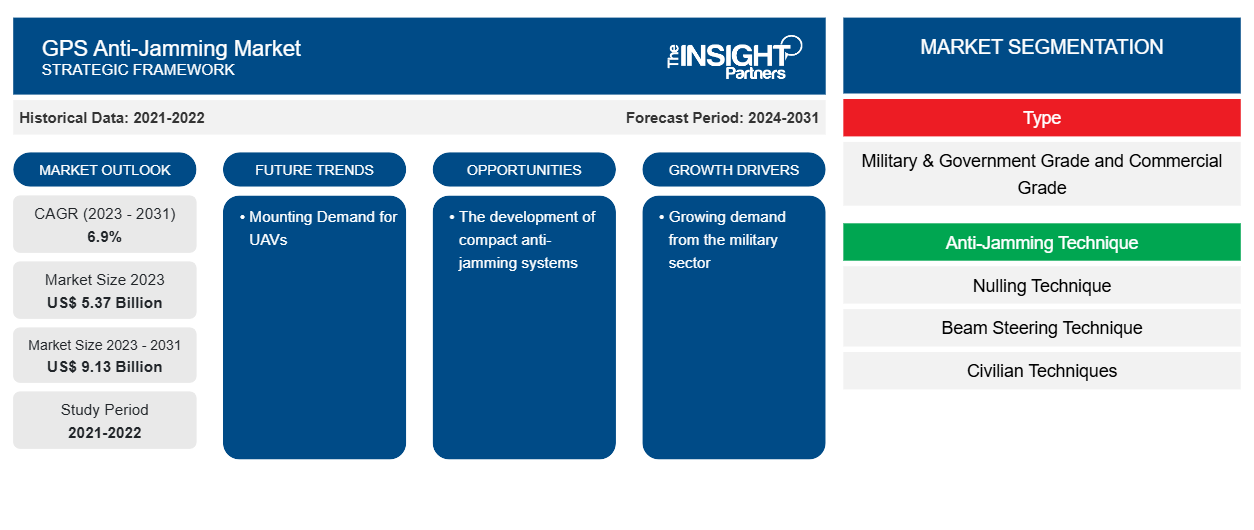
The global GPS Anti-Jamming Market is witnessing remarkable attention as governments, defense organizations, aviation authorities, and commercial industries prioritize resilient positioning, navigation, and timing technologies. Growing incidents of GPS interference, electronic warfare, and signal spoofing are encouraging organizations worldwide to invest in advanced anti-jamming technologies that ensure uninterrupted navigation and operational safety.
Get a sample PDF of the Report: https://www.theinsightpartners.com/sample/TIPRE00013796
As critical infrastructure, military platforms, autonomous vehicles, maritime transportation, drones, and aerospace applications become increasingly dependent on satellite navigation, the need for robust GPS protection continues to rise. The GPS Anti-Jamming Market is evolving rapidly with continuous innovation in multi-antenna systems, adaptive filtering, beam steering, and AI-enabled signal processing technologies.
Recent developments across the defense and aerospace sectors further highlight the increasing importance of GPS resilience. Governments are accelerating modernization programs, while technology companies are introducing next-generation anti-jamming solutions capable of operating effectively even in highly contested electromagnetic environments. These advancements are strengthening the outlook for the GPS Anti-Jamming Market throughout the forecast period.
Market Size, Share, Trends, Analysis and Forecast by 2031
- Growing adoption of secure satellite navigation across defense and aerospace
- Rising integration of anti-jamming technology into autonomous systems
- Increasing investments in electronic warfare protection technologies
- Higher demand from aviation, maritime, and critical infrastructure sectors
- Expansion of commercial GNSS protection applications
- Strong innovation in AI-powered signal authentication and interference detection
- North America expected to remain a leading regional contributor
- Asia Pacific anticipated to witness rapid adoption due to defense modernization
- Europe focusing on navigation resilience amid increasing GPS interference incidents
- Continuous product innovation expected to support long-term industry expansion
Growing Importance of Secure Navigation Systems
Satellite navigation has become an essential component of modern transportation, communication, emergency response, logistics, precision agriculture, and military operations. However, increasing electronic interference and intentional signal disruption have created significant challenges for reliable GPS operations.
The GPS Anti-Jamming Market addresses these challenges by delivering technologies that detect, reject, and mitigate interference while maintaining accurate positioning information. Advanced receivers, adaptive antennas, null steering systems, digital beamforming, and interference suppression algorithms are enabling uninterrupted navigation under demanding operational conditions.
Military organizations continue to represent one of the largest adopters of GPS anti-jamming technologies. Modern defense platforms require secure navigation capabilities for aircraft, naval vessels, missiles, armored vehicles, and unmanned systems operating in contested environments.
Commercial sectors are also embracing these technologies as industries recognize the operational risks associated with GPS outages and spoofing attacks.
Industry Trends Driving the GPS Anti-Jamming Market
Several major trends are reshaping the GPS Anti-Jamming Market.
Artificial intelligence is increasingly being incorporated into signal processing systems to identify interference patterns in real time. Machine learning algorithms are improving detection accuracy while minimizing false alarms.
Multi-constellation GNSS receivers supporting GPS, Galileo, GLONASS, BeiDou, and regional navigation systems are becoming more common, providing greater redundancy and operational reliability.
Software-defined radios and advanced digital processing architectures are enabling flexible upgrades without extensive hardware replacement.
Another important trend is the integration of anti-spoofing capabilities alongside anti-jamming technologies, allowing systems to defend against multiple forms of navigation attacks simultaneously.
Growing deployment of autonomous drones, connected vehicles, smart transportation infrastructure, and next-generation aviation systems is further expanding commercial demand.
Global and Regional Analysis
North America
North America continues to lead the GPS Anti-Jamming Market due to extensive defense investments, advanced aerospace manufacturing, strong research capabilities, and widespread deployment of satellite-based technologies.
Defense modernization initiatives across the United States continue to support adoption of advanced GPS protection systems for military aircraft, naval fleets, missile defense, and space-based assets.
Europe
Europe is witnessing increasing demand as governments strengthen navigation resilience amid growing electronic warfare concerns. Aviation safety agencies, defense organizations, and transportation authorities are investing in technologies capable of protecting critical navigation infrastructure from interference. Recent reports of widespread GPS spoofing across parts of Europe have intensified attention on resilient navigation systems.
Asia Pacific
Asia Pacific is emerging as one of the fastest-growing regions due to expanding defense budgets, indigenous satellite navigation programs, aerospace manufacturing growth, and increasing deployment of autonomous technologies.
Countries including India, Japan, South Korea, Australia, and China continue investing in advanced navigation capabilities for military and commercial applications. India’s planned upgrades to Su-30MKI fighter aircraft with anti-jamming, anti-spoofing navigation systems reflect this trend.
Middle East and Africa
The region is experiencing rising demand driven by defense modernization, border surveillance, critical infrastructure protection, and increasing adoption of unmanned aerial systems.
South America
Growing investments in aviation modernization, maritime security, and transportation infrastructure are supporting gradual adoption of GPS anti-jamming technologies.
Updated Market News
The GPS Anti-Jamming Market continues to benefit from several notable industry developments:
• Iridium has begun commercial sales of a GNSS jamming and spoofing prevention chip designed for avionics manufacturers, supporting secure navigation integration into future aircraft systems.
• India’s Ministry of Defence has initiated upgrades for its Su-30MKI fighter fleet with advanced anti-jamming and anti-spoofing GPS navigation systems to enhance resilience in contested environments.
• Research and regulatory attention have increased following reports of large-scale GPS spoofing and interference affecting parts of Europe, reinforcing demand for resilient navigation technologies.
Competitive Landscape
The GPS Anti-Jamming Market remains highly competitive as established defense contractors and navigation technology companies continue investing in innovation, strategic collaborations, and advanced product development.
Key Players
- BAE Systems
- Collins Aerospace
- Honeywell International Inc.
- Lockheed Martin Corporation
- L3Harris Technologies
- Raytheon Technologies
- Thales Group
- NovAtel Inc.
- Hexagon AB
- TUALCOM
- Mayflower Communications Company
- InfiniDome
These companies continue focusing on advanced antenna systems, electronic warfare capabilities, multi-frequency GNSS technologies, and integrated navigation security solutions.
Get the Premium Research Report @ https://www.theinsightpartners.com/buy/TIPRE00013796
Future Outlook
The future of the GPS Anti-Jamming Market appears highly promising as secure navigation becomes indispensable across military, aerospace, transportation, maritime, telecommunications, and autonomous mobility sectors. Continuous innovation in artificial intelligence, multi-constellation GNSS, adaptive antennas, software-defined navigation, and anti-spoofing technologies will further strengthen industry growth. Increasing geopolitical tensions, rising electronic warfare threats, expanding drone deployments, and growing dependence on precise positioning systems are expected to create sustained opportunities worldwide through 2031. Organizations that prioritize resilient navigation solutions and invest in next-generation GPS protection technologies are likely to remain at the forefront of this rapidly evolving industry.
Related Reports –
Home Energy Management System Market Regional Share, Trend, and Growth Opportunity
Vision Transformers Market Regional Share, Trend, and Growth Opportunity
Differential-Pressure Mass Flow Controller Market Regional Share, Trend, and Growth Opportunity
About The Insight Partners
The Insight Partners is a leading market research and consulting firm delivering actionable insights through in-depth industry analysis and strategic intelligence. The firm supports clients across various industries in making informed business decisions by providing comprehensive market forecasts, competitive assessments, and growth opportunities.
Contact Us:
If you have any queries about this report or if you would like further information, please contact us:
Contact Person: Ankit Mathur
E-mail: sales@theinsightpartners.com
Phone: +1-646-491-9876
Also Available in :
Korean | German | Japanese | French | Chinese | Italian | Spanish
