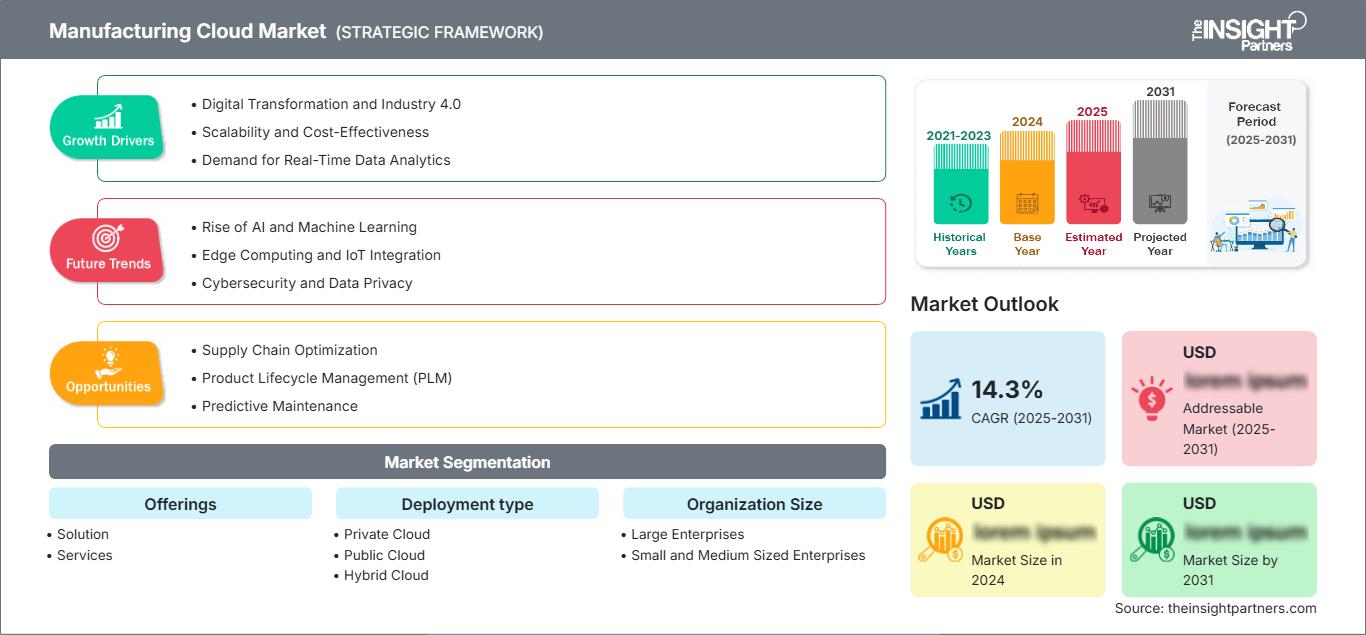
The global manufacturing cloud market is experiencing strong momentum as industrial enterprises transition from traditional legacy infrastructure to agile, cloud-native frameworks. Cloud manufacturing integrates cloud computing, the Industrial Internet of Things (IIoT), automation, and advanced data analytics to create interconnected, smart factory environments. By shifting operational management, supply chain orchestration, and production planning to cloud environments, manufacturers gain real-time visibility across global facilities.
The Manufacturing Cloud Market size is expected to reach US$ 198.69 Billion by 2031. The market is anticipated to register a CAGR of 14.1% during 2025-2031.
Key Drivers
- Industry 4.0 Modernization: The rapid digitization of production lines is accelerating the need to centralize data streams. Cloud platforms provide the scalable infrastructure required to aggregate and process vast quantities of industrial telemetry in real time.
- Proliferation of Industrial IoT (IIoT) Devices: As factories deploy thousands of connected sensors across assembly lines, cloud environments offer the storage and computing power necessary to run predictive maintenance and quality assurance models.
- Multi-Site Supply Chain Synchronization: Modern manufacturing networks span multiple geographical locations. Cloud systems allow distributed teams, suppliers, and logistics partners to collaborate on unified production schedules and inventory tracking.
- Lower Upfront IT Costs and Scalability: Shifting from capital-intensive on-premise servers to subscription-based Software-as-a-Service (SaaS) and Platform-as-a-Service (PaaS) models reduces capital expenditure while accelerating deployment times.
Download Sample Report@ https://www.theinsightpartners.com/sample/TIPRE00006790
Strategic Opportunities
- Integration of Industrial Artificial Intelligence (AI): The convergence of generative AI and machine learning with cloud platforms creates opportunities for predictive equipment servicing, automated yield optimization, and dynamic inventory management.
- SME Digital Transformation: Small and medium-sized enterprises (SMEs) are increasingly adopting affordable cloud-based MES and ERP solutions. This opens significant growth channels for cloud providers offering flexible, low-code tools.
- Hybrid and Sovereign Edge Cloud Architectures: As manufacturers balance computational speed with data privacy requirements, hybrid and edge-cloud solutions present a strategic avenue to retain low-latency processing on the factory floor while ensuring regulatory compliance.
Market Segmentation
The manufacturing cloud market is categorized into several primary segments:
- By Component: Software (including CRM, ERP, MES, PLM, and Supply Chain Management solutions) and Professional/Managed Services (system integration, consulting, and security management).
- By Deployment Model: Public Cloud, Private Cloud, and Hybrid Cloud (with hybrid deployment seeing accelerated adoption due to security and latency benefits).
- By Organization Size: Large Enterprises (representing the largest market share) and Small and Medium Enterprises (SMEs, expanding at a fast CAGR).
- By Industry Vertical: Discrete Manufacturing (Automotive, Aerospace & Defense, Electronics & Semiconductors, Industrial Machinery) and Process Manufacturing (Chemicals, Energy, Pharmaceuticals, Food & Beverage).
Market News and Recent Developments
Recent strategic initiatives highlight the ongoing expansion of cloud capabilities across industrial sectors:
- Strategic Partnerships: Cloud hyperscalers continue to forge alliances with industrial automation leaders to bridge the operational technology (OT) and information technology (IT) gap.
- Cloud-Native MES Solutions: Vendors are launching cloud-native execution platforms equipped with pre-built industrial connectors, reducing shop-floor integration timelines significantly.
- Sustainability and Carbon Tracking Features: Leading platforms are introducing integrated sustainability modules that help manufacturers track energy consumption, raw material usage, and carbon footprints directly from operational logs.
Market Analysis and Competitive Landscape
The market landscape is characterized by intense technological innovation and strategic investments from enterprise software giants, cloud hyperscalers, and specialized industrial automation vendors. Providers are focusing on sector-specific cloud suites that comply with industrial data governance standards while supporting heavy operational workloads.
Top Market Players
- Salesforce, Inc.: Offers Salesforce Manufacturing Cloud, unifying customer lifecycle data with production order visibility and commercial operations.
- Microsoft Corporation: Delivers Microsoft Cloud for Manufacturing, enabling end-to-end automation across IoT ecosystems, digital twins, and supply chains.
- Amazon Web Services (AWS): Provides scalable cloud storage, edge computing solutions, and industrial data services for connected factory environments.
- SAP SE: A leading provider of cloud-based ERP and supply chain management software connecting plant floor data to corporate strategy.
- Oracle Corporation: Delivers cloud-based ERP, SCM, and PLM solutions designed for complex discrete and process workflows.
- Siemens AG: Combines industrial automation with cloud platforms through Siemens Xcelerator, advancing digital twin applications.
- PTC Inc.: Provides ThingWorx IIoT and Windchill PLM platforms to streamline smart connected operations and product lifecycle tracking.
- Dassault Systèmes: Offers the 3DEXPERIENCE platform, integrating cloud-based design, virtual twin creation, and global production modeling.
Get Full Copy of This Report @ https://www.theinsightpartners.com/buy/TIPRE00006790
Future Outlook
Looking ahead to 2031, the manufacturing cloud market will remain a major catalyst for global industrial efficiency. The market is moving from basic infrastructure hosting toward fully autonomous, AI-driven smart ecosystems. As edge computing and high-speed industrial networks mature, manufacturers will achieve seamless data flow between shop-floor equipment and corporate systems. Industrial organizations that invest in secure, hybrid cloud architectures today will lead the next generation of flexible, sustainable, and highly efficient manufacturing operations.
About The Insight Partners
The Insight Partners provides comprehensive syndicated and tailored market research services in the healthcare, technology, and industrial domains. Renowned for delivering strategic intelligence and practical insights, the firm empowers businesses to remain competitive in ever-evolving global markets.
Contact Information
- Email: sales@theinsightpartners.com
- Website: theinsightpartners.com
- Phone: +1-646-491-9876
