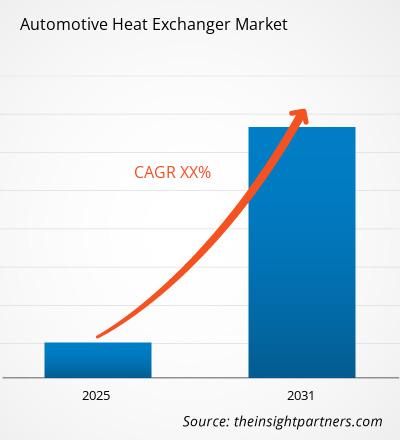
The global automotive industry is undergoing a significant transformation driven by advancements in vehicle thermal management, strict emission regulations, and the rapid shift toward electric and hybrid vehicles. Central to this evolution are automotive heat exchangers critical components designed to transfer heat efficiently between fluids or air to ensure optimal engine performance, battery health, and cabin comfort.
The global Automotive Heat Exchanger Market size is projected to reach US$ 13.38 billion by 2034 from US$ 10.24 billion in 2025. The market is anticipated to register a CAGR of 3.40% during the forecast period 2026-2034.
Key Market Drivers
Several key factors are accelerating the demand for high-performance thermal management solutions across the automotive sector:
Rising Production of Electric and Hybrid Vehicles: Unlike conventional Internal Combustion Engine (ICE) vehicles, Electric Vehicles (EVs) require sophisticated thermal management systems. Heat exchangers play a vital role in cooling battery packs, electric motors, and power electronics, preventing thermal runaway and extending battery lifespans.
Stringent Environmental and Fuel Efficiency Standards: Regulatory bodies globally continue to mandate reduced carbon emissions and better fuel economy. Advanced lightweight automotive heat exchangers help reduce overall vehicle weight, directly contributing to lowered fuel consumption and reduced greenhouse gas emissions.
Increasing Demand for Passenger Comfort: Modern consumer preferences lean heavily toward advanced HVAC (Heating, Ventilation, and Air Conditioning) systems that deliver rapid climate control in vehicle cabins. This demand drives the integration of more efficient radiators, condensers, and evaporators.
Market Segmentation Insights
The automotive heat exchanger market is broadly segmented based on type, design, vehicle type, and region:
By Design & Type: The market includes radiators, oil coolers, evaporators, condensers, intercoolers, and exhaust gas recirculation (EGR) coolers. Radiators and HVAC heat exchangers account for a substantial share due to their essential function in traditional and modern vehicle architectures. Plate-fin and tube-fin designs remain highly popular due to their high thermal efficiency and compact dimensions.
By Vehicle Type: Passenger cars dominate the market driven by high production volumes worldwide. However, commercial vehicles both light and heavy-duty are experiencing steady growth as logistics, long-haul transport, and fleet electrification expand globally.
By Region: Asia-Pacific continues to hold a leading position in the global market, fueled by robust automotive manufacturing hubs in China, Japan, India, and South Korea. Meanwhile, North America and Europe maintain significant market shares due to high EV adoption rates, strict environmental regulations, and ongoing technological innovation.
Get a PDF Sample– https://www.theinsightpartners.com/sample/TIPRE00007254
Key Market Players
The competitive landscape of the automotive heat exchanger market features prominent global manufacturers focusing on innovation, lightweight materials (such as aluminum alloys), and strategic partnerships with OEMs. Major key players shaping the industry include:
AKG Thermal Systems, Inc.
Dana Limited
Denso Corporation
Hanon Systems
MAHLE GmbH
Marelli Corporation
Nippon Light Metal Company, Ltd.
Sanden Holdings Corporation
T.RAD Co., Ltd.
Valeo SA
These industry leaders are investing heavily in research and development to engineer next-generation heat exchangers capable of meeting the complex cooling requirements of high-voltage battery systems and fast-charging infrastructure.
Technological Trends & Challenges
Aluminum continues to be the preferred material for manufacturing automotive heat exchangers due to its excellent thermal conductivity, corrosion resistance, and low weight compared to copper or stainless steel. Furthermore, modern additive manufacturing (3D printing) and braze welding technologies are enabling manufacturers to design complex, ultra-compact heat exchangers with maximized surface areas.
Despite steady growth, the market faces challenges such as fluctuating raw material prices (particularly aluminum and copper) and complex integration requirements in next-generation electric vehicle architectures. However, continuous R&D investments are mitigating these obstacles through optimized structural designs and automated manufacturing processes.
Get Full Copy of This Report- https://www.theinsightpartners.com/buy/TIPRE00007254
Future Outlook
The future of the automotive heat exchanger market remains firmly tied to the ongoing electrification and decarbonization of global transport. As the automotive industry accelerates its transition toward zero-emission mobility, heat exchangers will evolve from traditional engine-cooling components into integrated thermal management modules capable of simultaneously regulating high-capacity battery packs, electric drivetrains, fast-charging ports, and cabin climates. Companies that focus on modular, lightweight, and eco-friendly cooling solutions are well-positioned to capitalize on emerging opportunities across both developed and developing automotive markets worldwide through 2034 and beyond.
Related Reports-
About Us
The Insight Partners is a one-stop industry research provider of actionable intelligence. We help our clients in getting solutions to their research requirements through our syndicated and consulting research services. We specialize in industries such as Semiconductor and Electronics, Aerospace and Defense, Automotive and Transportation, Biotechnology, Healthcare IT, Manufacturing and Construction, Medical Devices, Technology, Media, and Telecommunications, as well as chemicals and Materials.
Contact Us
If you have any queries about this report or if you would like further information, don’t hesitate to get in touch with us:
Contact Person: Ankit Mathur
E-mail: ankit.mathur@theinsightpartners.com
