Automated 3D printing is reshaping advanced manufacturing by integrating robotics, artificial intelligence (AI), machine learning, industrial automation, and intelligent software into additive manufacturing workflows. These solutions automate every stage of the production cycle, including material handling, printer calibration, build monitoring, post-processing, quality inspection, and production scheduling. By enabling lights-out manufacturing, reducing human intervention, minimizing production errors, and improving throughput, automated 3D printing is becoming a cornerstone of Industry 4.0 and smart factory initiatives across aerospace, automotive, healthcare, electronics, and industrial manufacturing.
Market Overview
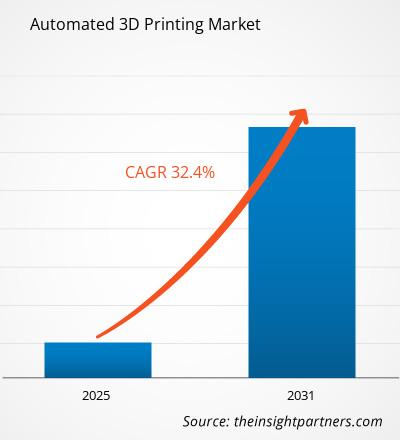
The Automated 3D Printing Market was valued at US$ 169.2 Million in 2025 and is projected to reach US$ 1,170.12 Million by 2034, registering a CAGR of 27.34% during the forecast period 2026–2034. Market growth is driven by increasing demand for scalable additive manufacturing, labor-efficient production, digital manufacturing transformation, and intelligent factory automation. Continuous advancements in robotics, AI-powered process monitoring, automated material handling, and integrated production management systems are accelerating the adoption of automated 3D printing technologies worldwide.
Key Market Insights
- Market Size (2025): US$ 169.2 Million
- Forecast Market Size (2034): US$ 1,170.12 Million
- CAGR (2026–2034): 27.34%
- Key Growth Driver: Rising adoption of automated additive manufacturing for high-efficiency, scalable production
- Major Trend: Integration of robotics, artificial intelligence, machine learning, and digital manufacturing platforms into 3D printing workflows
- Forecast Period: 2026–2034
Get a Sample PDF of the Report: https://www.theinsightpartners.com/sample/TIPRE00007113
Market Drivers
Growing Adoption of Smart Manufacturing
Manufacturers are increasingly implementing automated 3D printing systems to improve production flexibility, shorten lead times, reduce labor dependency, and support high-volume customized manufacturing.
Increasing Demand for Lights-Out Production
Automated production environments capable of operating with minimal human intervention are improving manufacturing efficiency while reducing operational costs and production downtime.
Expansion of Aerospace and Healthcare Applications
Industries requiring precision manufacturing, regulatory compliance, and customized production are rapidly adopting automated additive manufacturing technologies for complex components and medical devices.
Need for Supply Chain Resilience
Manufacturers are investing in localized, digitally connected additive manufacturing systems to strengthen supply chains, accelerate product development, and improve production agility.
Market Trends
AI-Driven Process Monitoring
Artificial intelligence is enabling real-time process optimization, defect detection, predictive maintenance, and automated quality assurance throughout additive manufacturing workflows.
Hybrid Manufacturing Cells
Manufacturers are integrating additive manufacturing with subtractive machining, heat treatment, inspection systems, and robotic automation within unified production platforms.
Cloud-Based Manufacturing Management
Cloud technologies provide centralized production scheduling, machine monitoring, digital workflow management, remote diagnostics, and manufacturing analytics across distributed facilities.
Sustainable Additive Manufacturing
Companies are investing in recyclable materials, closed-loop material recovery systems, energy-efficient equipment, and optimized production processes to reduce environmental impact.
Get the Premium Research Report @ https://www.theinsightpartners.com/buy/TIPRE00007113
Regional Analysis
North America
North America accounted for approximately 34%–38% of the global market in 2025 and is projected to grow at a CAGR of 25%–29% during 2026–2034. Market growth is supported by strong investments in aerospace, defense, healthcare manufacturing, industrial automation, and advanced manufacturing research. The US represented approximately 85%–88% of North America’s market in 2025 and is expected to register a CAGR of 26%–30%, driven by federal investments in advanced manufacturing, reshoring initiatives, and the presence of leading additive manufacturing technology providers.
Europe
Europe held approximately 26%–30% of the market in 2025 and is anticipated to grow at a CAGR of 24%–28%. Germany, the UK, and France continue investing in smart factories, sustainable manufacturing, industrial automation, aerospace production, and advanced automotive manufacturing technologies.
Asia-Pacific
Asia-Pacific captured approximately 24%–28% of the global market in 2025 and is projected to register the fastest regional growth with a CAGR of 30%–34% during 2026–2034. China, Japan, and South Korea continue accelerating industrial digitalization, government-supported automation programs, electronics manufacturing expansion, and advanced production technologies, creating significant opportunities for automated 3D printing solution providers.
Middle East and Africa
The Middle East and Africa are steadily increasing investments in industrial modernization, smart manufacturing, aerospace development, healthcare innovation, and digital transformation, supporting long-term adoption of automated additive manufacturing systems.
Segment Analysis
By Component
The Hardware segment accounted for approximately 52%–56% of the market in 2025 and is projected to grow at a CAGR of 26%–30% through 2034. Advanced 3D printers, robotic arms, sensors, automated material handling systems, and intelligent production equipment continue supporting the segment’s dominant market position.
By Component
The Services segment represented approximately 24%–28% of the market in 2025 and is expected to register the fastest growth with a CAGR of 28%–32%. Increasing demand for software subscriptions, predictive maintenance, workflow optimization, technical support, and managed additive manufacturing services continues driving rapid market expansion.
Competitive Landscape
The Automated 3D Printing Market remains highly competitive as additive manufacturing companies, industrial automation providers, robotics manufacturers, and software developers continue investing in intelligent production technologies. Companies are strengthening their competitive positions through innovations in AI-powered process monitoring, robotic automation, digital manufacturing platforms, predictive analytics, integrated quality inspection, and hybrid manufacturing systems. Strategic collaborations with aerospace companies, automotive manufacturers, healthcare organizations, research institutions, and industrial enterprises continue accelerating deployment across advanced manufacturing environments.
Key Players
- 3D Systems Corporation
- ABB Ltd.
- EOS GmbH
- Formlabs Inc.
- General Electric Company
- KUKA AG
- Materialise NV
- SLM Solutions Group AG
- Stratasys Ltd.
- The ExOne Company
Emerging Trends
The automated 3D printing industry is advancing through AI-driven process optimization, robotic post-processing, digital twins, edge computing, cloud-connected manufacturing, predictive maintenance, hybrid additive-subtractive production, automated quality inspection, closed-loop material recycling, and digital thread integration. Manufacturers are developing next-generation automated additive manufacturing systems that deliver higher productivity, improved dimensional accuracy, faster production cycles, enhanced traceability, reduced material waste, seamless interoperability, and scalable lights-out manufacturing capabilities. These technological advancements are expected to create significant growth opportunities across aerospace, healthcare, automotive, electronics, industrial equipment, defense, and consumer products throughout the forecast period.
Future Outlook
The future outlook for the Automated 3D Printing Market remains exceptionally strong as manufacturers continue accelerating investments in digital manufacturing, smart factories, and Industry 4.0 technologies. Continued innovation in robotics, artificial intelligence, cloud manufacturing, advanced materials, and autonomous production systems is expected to support sustained market growth through 2034.
Related Market Research Reports
Foldable Display Market Demand, Size & Forecast by 2034
District Cooling Market Growth, Share & Trends by 2034
DC Power Supplies Market Share, Growth & Forecast by 2034
CMOS Image Sensors Market Size, Trends & Demand by 2034
About The Partners
The Insight Partners is a Insight global leader in market research, delivering comprehensive analysis and actionable insights across diverse industries. The company empowers decision-makers with data-driven intelligence to navigate evolving markets and accelerate growth.
Contact Us:
