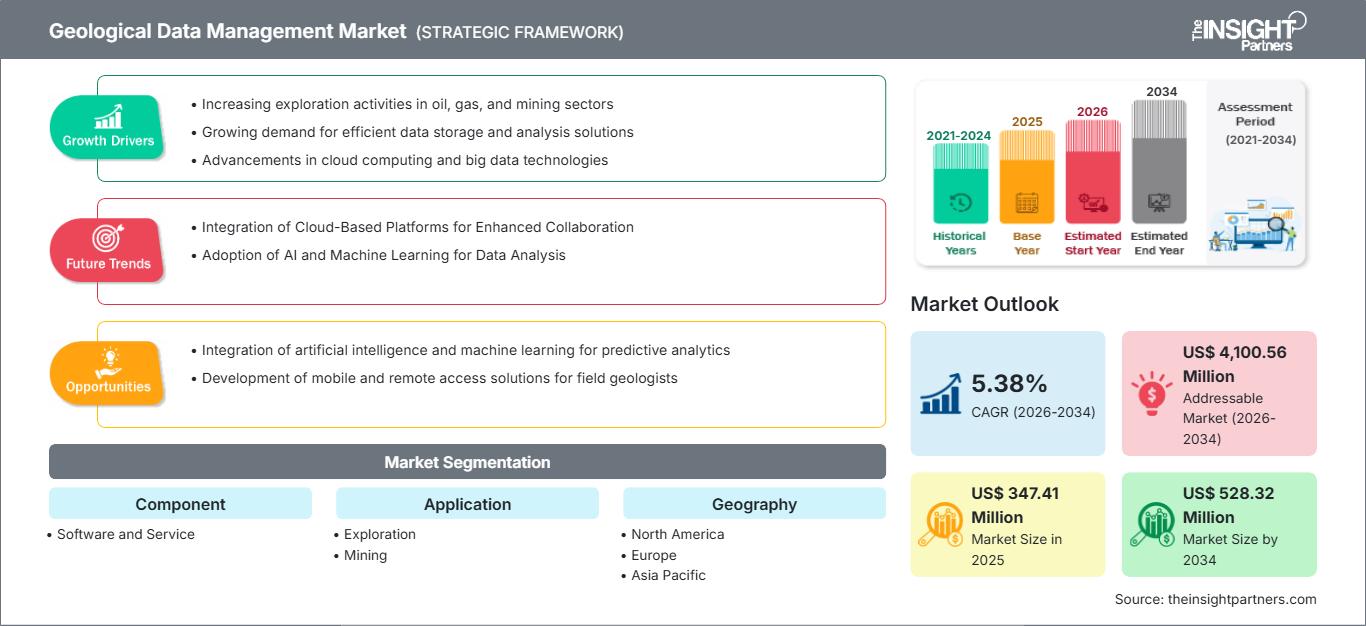
The global geological data management market is experiencing steady growth as resource extraction industries increasingly depend on sophisticated digital solutions. Geological data management refers to the systematic collection, storage, validation, organization, and retrieval of subsurface spatial, geophysical, and geochemical datasets.
The Geological Data Management Market size is expected to reach US$ 528.32 Million by 2034 from US$ 347.41 Million in 2025. The market is estimated to record a CAGR of 5.38% from 2026 to 2034.
Mining enterprises, oil and gas operators, and environmental engineering firms generate massive volumes of complex subsurface data during field surveys and exploratory drilling. Traditional data storage methods often result in fragmented silos, missing attributes, and high operational risks. Modern geological data management solutions bridge these gaps by providing centralized repositories that ensure data integrity, facilitate regulatory compliance, and support real-time decision-making for exploration teams worldwide.
Key Drivers Shaping Market Growth
- Surging Exploration Activities in Energy and Mining Sectors
The growing global demand for minerals, critical earths, natural gas, and oil is pushing exploration activities into increasingly remote and complex geological formations. Mining and energy corporations must handle petabytes of seismic data, core samples, assay records, and borehole imagery. Advanced geological data management software provides the necessary backbone to store, index, and analyze these expanding datasets efficiently.
- High Demand for Efficient Data Storage and Analytical Systems
Exploration projects involve multi-disciplinary teams ranging from field geologists to geophysicists and senior executives. Legacy spreadsheet systems and disparate offline databases struggle to handle high-resolution 3D models and geographic information system (GIS) files. Organizations are replacing fragmented systems with scalable data management platforms capable of processing multi-sourced data without compromising accuracy or access speed.
- Rapid Advancements in Cloud Computing and Big Data Technologies
Cloud platforms have revolutionized data infrastructure in the geosciences. Cloud-based geological data management tools eliminate physical storage limitations, reduce capital expenditure, and allow secure remote access to geological repositories. Big data architecture facilitates rapid processing and query handling for massive spatial and temporal datasets, enabling rapid subsurface interpretation.
Download Sample Report@ https://www.theinsightpartners.com/sample/TIPRE00023323
Strategic Market Opportunities
Integration of Artificial Intelligence and Machine Learning
The integration of artificial intelligence (AI) and machine learning (ML) algorithms into geological data management platforms represents a transformative market opportunity. AI-driven predictive analytics can automatically cross-reference historical drilling logs with current seismic data to identify potential mineral deposits or oil reservoirs. Automated pattern recognition helps geoscientists detect geological anomalies faster, significantly lowering exploration risks and optimizing expensive drilling programs.
Development of Mobile and Field-Ready Access Solutions
Field geologists working in harsh or isolated locations require seamless connectivity with central corporate databases. The development of specialized mobile software applications and remote access tools allows field teams to input core logging data, capture geo-referenced imagery, and run validation checks directly at the outcrop or rig site. This real-time synchronization drastically reduces turnaround times for geological mapping and laboratory assay verification.
Market Segmentation
The geological data management market is categorized across distinct segments based on component, application, and geography:
By Component
- Software: Encompasses centralized geological databases, core-logging applications, 3D modeling interfaces, GIS integration tools, and data QA/QC platforms. Software holds a substantial market share due to ongoing continuous licensing and cloud subscription models.
- Service: Includes consulting, system integration, database migration, training, and ongoing technical support provided by vendor specialists and third-party geoscience service firms.
By Application
- Exploration: Involves early-stage geophysical mapping, core sampling, seismic processing, and site feasibility studies aimed at discovering new mineral reserves and hydrocarbons.
- Mining: Focuses on active mine operations, grade control, resource estimation, geotechnical monitoring, and environmental reclamation management.
By Geography
The market spans key regional territories including North America (led by the US and Canada), Europe (including the UK, Germany, and France), Asia-Pacific (driven by Australia, China, and India), South and Central America (led by Brazil and Argentina), and the Middle East and Africa (supported by South Africa, Saudi Arabia, and the UAE).
Market News and Recent Developments
Industry players are actively expanding their software ecosystems through strategic partnerships, platform upgrades, and corporate acquisitions. Key developments shaping the landscape include:
- Cloud Native System Transitions: Software vendors are shifting toward microservice-based cloud architectures, allowing mining companies to integrate geological data directly into broader enterprise resource planning (ERP) platforms.
- Interoperability Standards: Industry consortia and lead developers are establishing standardized data formats to permit seamless data exchange between seismic interpretation tools, drill-hole software, and mine-planning platforms.
- Enhanced Geospatial Integration: Vendors continue to release updated modules that combine traditional tabular database structures with interactive spatial GIS mapping, delivering comprehensive visual dashboards for technical teams.
Competitive Landscape and Top Market Players
The global geological data management market features a blend of specialized geoscience software providers, engineering consultancies, and technology solution partners. Companies compete on parameters such as data security, system scalability, ease of field integration, and AI feature capability.
Top Market Players Include:
- Datamine
- Expedio
- GeoGRAFX Consulting
- Geologix Limited
- GeoSpark Consulting Inc
- maxgeo
- Micromine
- RMSI
- Seequent Limited
- Weir Consulting
Leading technology providers are focusing on collaborative product updates and cloud subscriptions to retain long-term client bases across major mining and energy hubs.
Get Full Copy of This Report @ https://www.theinsightpartners.com/buy/TIPRE00023323
Future Outlook
Looking ahead to 2034, the geological data management market is poised for sustained progression as digital transformation reshapes the energy and mining sectors. The transition toward cloud-native platforms, coupled with machine learning integration, will redefine how geoscientists store, interpret, and commercialize subsurface data. As sustainability goals, resource security, and critical mineral demand intensify global exploration, automated and secure geological data management infrastructure will remain an essential pillar of modern geoscience operations.
About The Insight Partners
The Insight Partners provides comprehensive syndicated and tailored market research services in the healthcare, technology, and industrial domains. Renowned for delivering strategic intelligence and practical insights, the firm empowers businesses to remain competitive in ever-evolving global markets.
Contact Information
- Email: sales@theinsightpartners.com
- Website: theinsightpartners.com
- Phone: +1-646-491-9876
