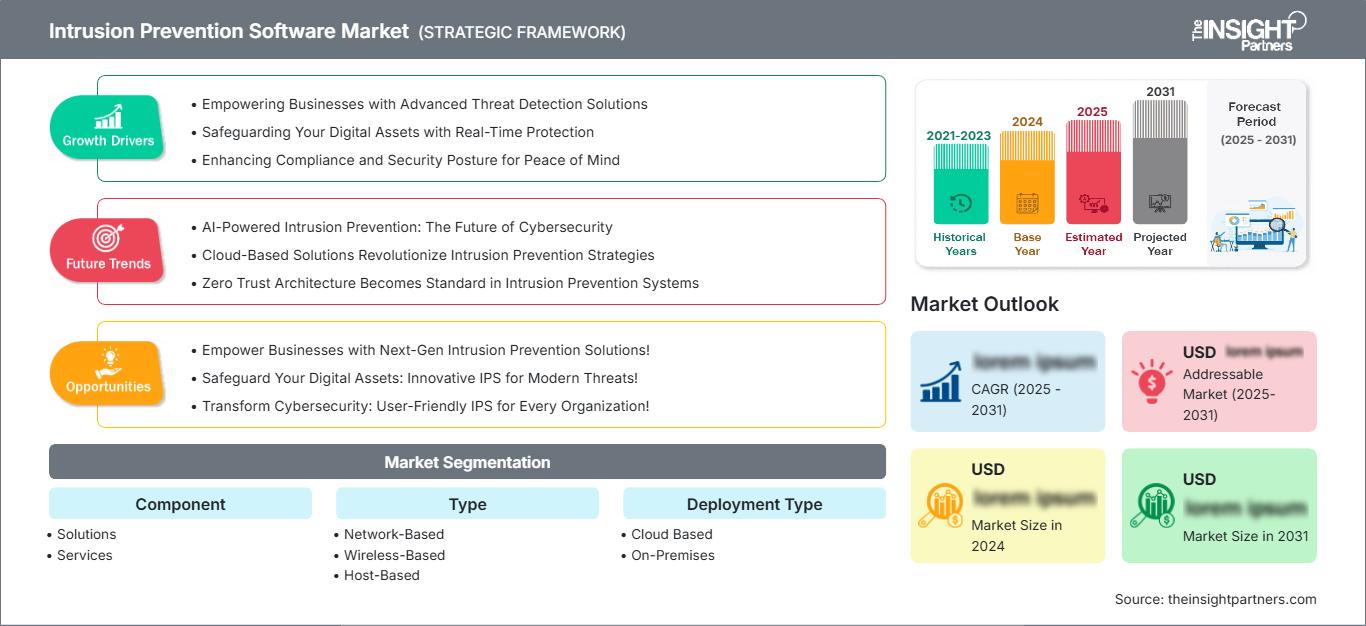
The global Intrusion Prevention Software Market is experiencing rapid expansion as enterprise digital infrastructure becomes more complex and vulnerable to cyber threats. Intrusion Prevention Systems (IPS) serve as a foundational layer in modern cybersecurity architectures. Unlike passive Intrusion Detection Systems (IDS) that only monitor and alert security teams, IPS solutions actively analyze network traffic flows to detect and block malicious activities in real time. Organizations across sectors such as finance, healthcare, and telecommunications are heavily investing in next generation IPS platforms to combat rising volumes of zero-day exploits, ransomware, and fileless malware.
The Intrusion Prevention Software Market size is expected to reach US$ 19.72 Billion by 2034 from US$ 7.1 Billion in 2025. The market is estimated to record a CAGR of 12.03% from 2026 to 2034.
Key Market Drivers
- Escalating Threat Sophistication: Cybercriminals are deploying increasingly sophisticated attack vectors, including automated botnets, living-off-the-land techniques, and AI-driven phishing schemes. Traditional boundary firewalls are no longer sufficient to stop these lateral movements, driving high demand for real-time intrusion prevention.
- Rapid Expansion of Hybrid and Multi-Cloud Environments: As enterprises migrate sensitive workloads to multi-cloud platforms, perimeter security boundaries become blurred. Intrusion prevention software provides decentralized, scalable visibility and enforcement across hybrid infrastructures.
- Strict Regulatory and Compliance Mandates: Stringent data protection regulations such as GDPR, HIPAA, CCPA, and PCI DSS explicitly mandate proactive security monitoring and real-time threat suppression. Compliance requirements urge organizations to implement automated IPS frameworks to avoid heavy non-compliance penalties.
Download Sample Report@ https://www.theinsightpartners.com/sample/TIPRE00024344
Key Opportunities
- Integration of Artificial Intelligence and Machine Learning: AI-powered behavior analytics enable intrusion prevention software to identify previously unknown zero-day vulnerabilities and anomalous activities, drastically reducing false positive rates.
- Surge in IoT and OT Security Demand: The proliferation of Internet of Things (IoT) devices and Operational Technology (OT) networks in smart manufacturing and utilities creates new attack surfaces. Dedicated IPS solutions customized for industrial control protocols represent a major growth vector.
- Adoption of Managed Detection and Response (MDR) Services: Small and medium-sized enterprises (SMEs) often lack dedicated in-house cybersecurity teams. Managed IPS and cloud-native software delivery models offer an accessible gateway for SMEs to secure their networks.
Market Segmentation
The Intrusion Prevention Software Market is segmented by type, deployment mode, and industry vertical:
- By Type:
- Network-Based Intrusion Prevention Systems (NIPS)
- Host-Based Intrusion Prevention Systems (HIPS)
- Wireless Intrusion Prevention Systems (WIPS)
- Network Behavior Analysis (NBA)
- By Deployment Mode:
- On-Premises
- Cloud-Based / Software-as-a-Service (SaaS)
- Hybrid
- By Industry Vertical:
- Banking, Financial Services, and Insurance (BFSI)
- Government and Defense
- IT and Telecommunications
- Healthcare
- Retail and E-commerce
- Manufacturing and Energy
Market News and Recent Developments
The cybersecurity sector is undergoing continuous technological consolidation and innovation. Leading vendors are prioritizing automated threat hunting and zero-trust framework integrations. Recent market developments highlight a clear shift toward unification, where IPS tools are embedded into broader Secure Access Service Edge (SASE) and Extended Detection and Response (XDR) suites.
Furthermore, key players are forging strategic partnerships with cloud service providers to offer native, low-latency IPS instances within public cloud environments. Continuous threat intelligence feed updates are also becoming standard, ensuring that intrusion prevention databases remain resilient against emerging ransomware variants.
Competitive Landscape and Top Players
The competitive landscape of the intrusion prevention software market is characterized by intense innovation and strategic mergers and acquisitions. Established cybersecurity giants compete with specialized cloud security innovators to deliver unified threat prevention capabilities.
Top Market Players Include:
- Cisco Systems, Inc.
- Palo Alto Networks, Inc.
- Fortinet, Inc.
- Trend Micro Incorporated
- IBM Corporation
- Check Point Software Technologies Ltd.
- McAfee, LLC
- Juniper Networks, Inc.
- FireEye, Inc.
- WatchGuard Technologies, Inc.
Major vendors focus on embedding machine learning algorithms into their appliances and software agents, enabling continuous learning and automatic rule updating without manual operator intervention.
Get Full Copy of This Report @ https://www.theinsightpartners.com/buy/TIPRE00024344
Future Outlook
The Intrusion Prevention Software Market is set for robust growth through 2034. As enterprises transition toward zero-trust architectures and expand their cloud footprints, automated threat blocking will remain a primary pillar of network defense. Vendors that offer lightweight, AI-driven, and multi-cloud compatible IPS solutions will capture significant market share over the coming decade.
About The Insight Partners
The Insight Partners provides comprehensive syndicated and tailored market research services in the healthcare, technology, and industrial domains. Renowned for delivering strategic intelligence and practical insights, the firm empowers businesses to remain competitive in ever-evolving global markets.
Contact Information
- Email: sales@theinsightpartners.com
- Website: theinsightpartners.com
- Phone: +1-646-491-9876
