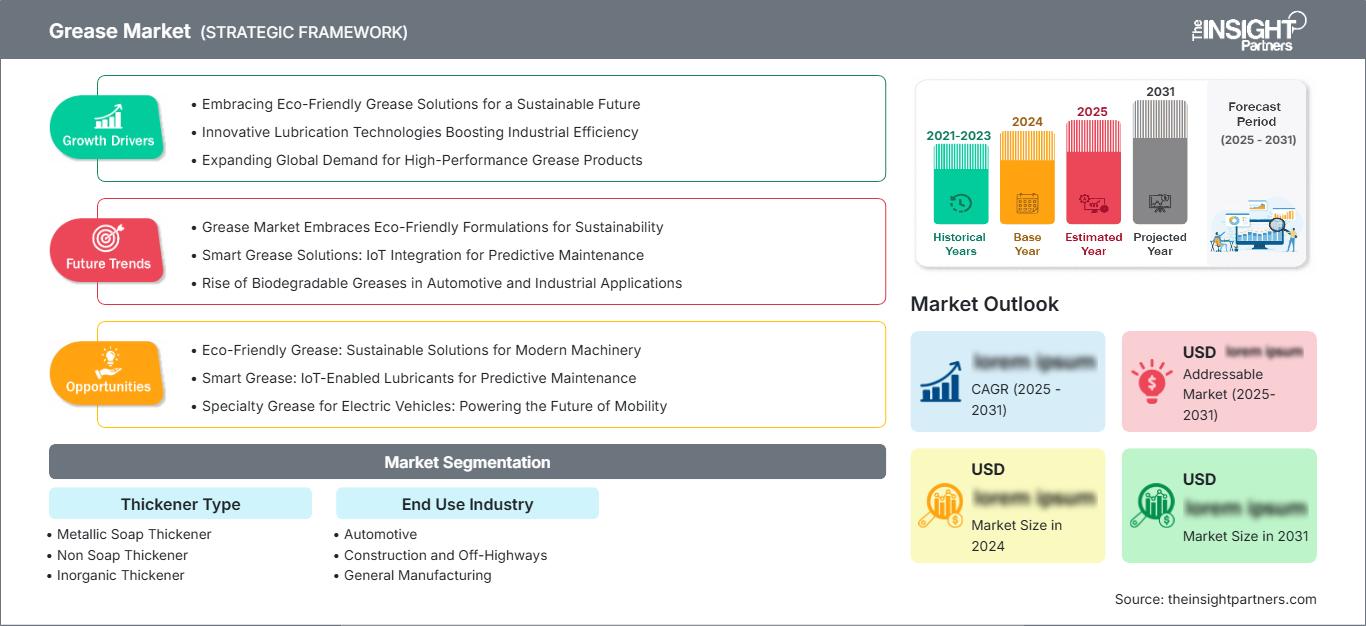
Industrial machinery runs quieter, lasts longer, and breaks down less often when the right lubricant sits between its moving parts, and grease has earned its place as one of the most trusted choices for that job. Valued at US$ 6.92 Billion in 2025, the Grease Market is expected to climb to US$ 9.44 Billion by 2034, expanding at a 3.97% CAGR across the 2026-2034 forecast period. That steady climb reflects how deeply grease is woven into automotive assembly lines, construction fleets, steel mills, and mining operations that simply cannot afford unplanned downtime.
What Is Grease?
Grease is a semi-solid lubricant made by combining a base oil, a thickening agent, and performance additives to reduce friction and wear between moving metal surfaces. Unlike liquid oils, it clings to components under load, resists washout from water or dust, and keeps working in conditions where conventional lubricants would simply drain away.
Request a Sample Copy of the Report: https://www.theinsightpartners.com/sample/TIPRE00005850
What Is Driving Demand for the Grease Market?
Automotive manufacturing sits at the centre of this growth story. Wheel bearings, chassis joints, and constant-velocity joints all depend on grease formulated for high loads and wide temperature swings, and as vehicle production ramps up across Asia Pacific and North America, so does consumption of automotive-grade grease. Electric vehicles have added a new wrinkle rather than reduced demand: EV drivetrains, motor bearings, and thermal management systems require specialised low-torque, high-purity greases that differ from those used in conventional engines, opening a fresh product category for formulators to chase.
Construction and off-highway equipment tell a similar story. Excavators, cranes, and loaders operate in dusty, wet, and often extreme environments where grease has to hold its structure and keep contaminants out of bearings and pins. Government-backed infrastructure spending across emerging economies, particularly road, rail, and housing projects, is pushing fleet operators to service equipment more frequently, and that translates directly into higher grease consumption. Beyond that, general manufacturing facilities running conveyors, gearboxes, and rotating machinery around the clock need consistent relubrication schedules to avoid costly line stoppages.
Steel and mining operations add another layer of demand. Rolling mills, continuous casters, and draglines run under punishing heat, pressure, and vibration, conditions that wear out lubricants quickly and require greases engineered for extended service intervals. What makes this particularly significant is that mining companies are increasingly adopting condition-based maintenance, using sensors to track bearing temperature and vibration, which is nudging demand toward premium, longer-lasting grease formulations rather than commodity products. So what is driving this acceleration beyond raw industrial output? A large part of it comes down to equipment operators recognising that the cost of a lubricant is trivial compared with the cost of a failed bearing on a production line.
Segmentation Overview
By Thickener Type: Metallic Soap Thickener grease remains the workhorse category thanks to its balance of cost and performance, while Non-Soap Thickener formulations are gaining ground in applications needing higher water resistance and thermal stability. Inorganic Thickener grease serves niche high-temperature uses, and the Others segment covers specialty and bio-based thickener systems.
By End Use Industry: Automotive continues to anchor volumes, supported by both original equipment manufacturing and aftermarket servicing. Construction and Off-Highways equipment relies on grease for exposed, high-load components. General Manufacturing spans a wide base of rotating and reciprocating machinery. Steel producers and Mining operators demand extreme-duty formulations, while the Others category covers marine, agriculture, and power generation uses.
By Geography: North America and Europe bring mature demand tied to established automotive and manufacturing bases, Asia Pacific leads on volume growth backed by industrial expansion, and South and Central America is emerging as a steady contributor on the back of mining and construction activity.
Key Market Players
- Exxon Mobil Corporation
- Chevron Corporation
- BP p.l.c.
- Shell plc
- TotalEnergies SE
- FUCHS SE
- Idemitsu Kosan Co., Ltd.
- ENEOS Corporation
- Axel Americas, LLC
- Petro-Canada Lubricants Inc.
- Klüber Lubrication München SE & Co. KG
- SKF AB
This list blends integrated energy majors with specialist lubricant manufacturers, a mix that shapes competition in distinct ways. Companies such as Exxon Mobil, Chevron, and Shell lean on global refining networks and established distribution channels to serve automotive and industrial customers at scale, while specialists like FUCHS SE and Klüber Lubrication compete on formulation expertise for demanding, high-value applications such as steel mills and precision bearings. SKF AB’s presence signals how closely grease selection is now tied to bearing design itself, with lubricant and component makers collaborating earlier in the product development cycle.
Sustainability and Innovation Trends
Bio-based and biodegradable grease formulations are moving from niche to mainstream, particularly in marine, agriculture, and forestry applications where accidental leakage into soil or water carries really environmental and regulatory consequences. Producers are also investing in synthetic base oils that extend relubrication intervals, cutting both material consumption and machine downtime. This is not just a trend, it is a structural shift toward lubricants that are judged as much on their environmental footprint as on their friction-reduction performance, and manufacturers that fail to adapt risk losing ground with industrial buyers under tightening sustainability mandates.
Buy Premium Report: https://www.theinsightpartners.com/buy/TIPRE00005850
Regional Outlook
Asia Pacific stands out as the fastest-growing region, propelled by expanding vehicle production, steel output, and infrastructure investment in economies such as China and India. North America maintains a strong base built on a mature automotive aftermarket and a well-established mining and industrial sector. Europe’s demand is shaped by stringent environmental standards, which are steering manufacturers toward biodegradable and long-life grease formulations. South and Central America, meanwhile, is benefiting from renewed mining investment and gradual industrial recovery, positioning it as a market worth watching over the coming decade.
Related Reports:
About The Insight Partners
The Insight Partners is among the leading market research and consulting firms in the world. We take pride in delivering exclusive reports along with sophisticated strategic and tactical insights into the industry. Reports are generated through a combination of primary and secondary research, solely aimed at giving our clientele a knowledge-based insight into the market and domain. This is done to assist clients in making wiser business decisions. A holistic perspective in every study undertaken forms an integral part of our research methodology and makes the report unique and reliable.
Contact Us:
If you have any queries about this report or if you would like further information, please contact us:
Phone: +1-646-491-9876
E-mail: sales@theinsightpartners.com
Also Available in: Korean | German | Japanese | French | Chinese | Italian | Spanish
