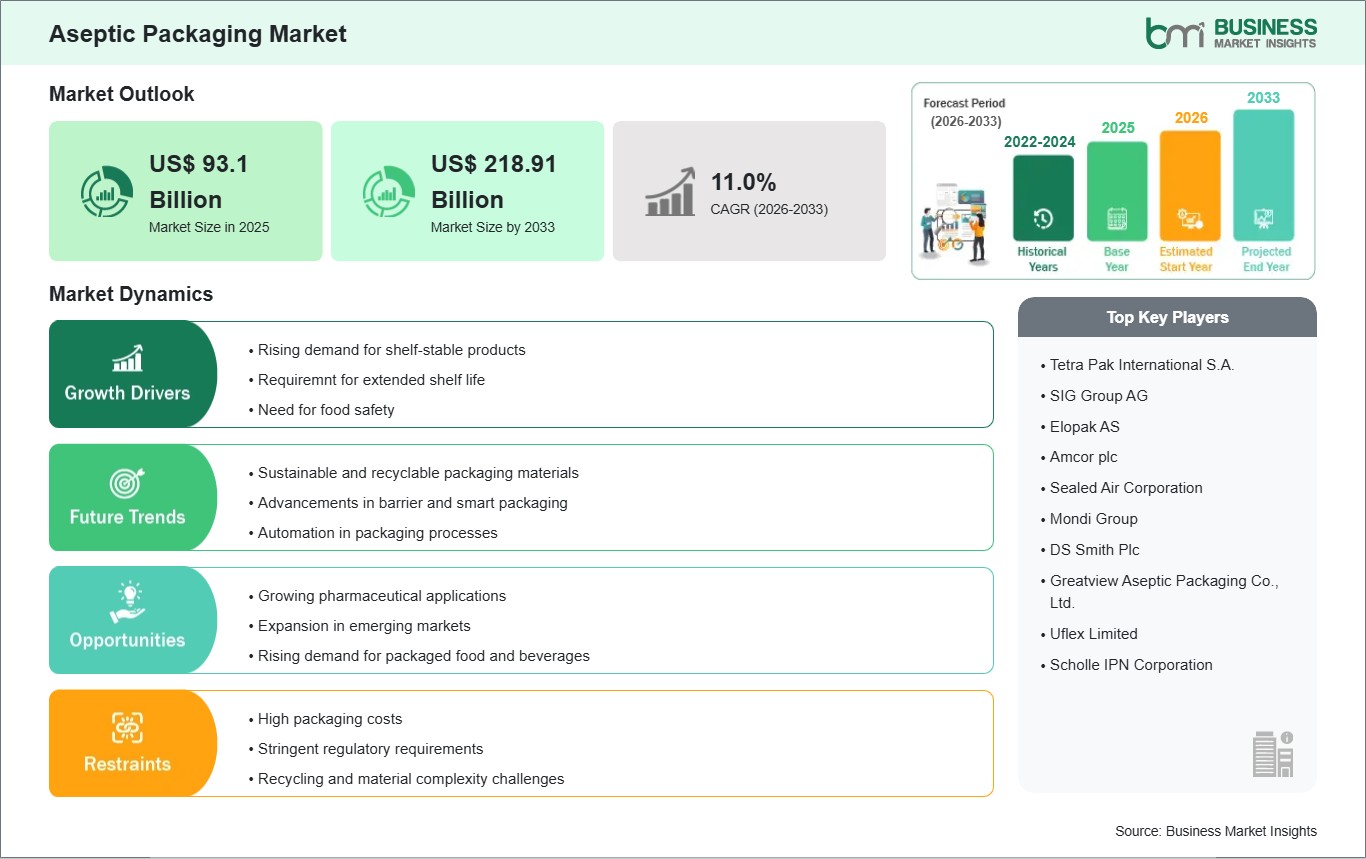
The global Aseptic Packaging Industry is experiencing significant expansion, driven by the surging demand for extended shelf-life products, preservative-free food and beverage options, and high-purity pharmaceutical packaging.
According to Business Market Insights, the global Aseptic Packaging Market size is expected to reach US$ 218.91 Billion by 2033 from US$ 93.1 Billion in 2025. The market is estimated to record a CAGR of 11.28% from 2026 to 2033.
Technological advancement is heavily shaping the industry landscape, with leading packaging solution providers focusing on electron-beam (e-beam) sterilization, recyclable barrier structures, and smart, connected aseptic cartons. This evolution enables food manufacturers and pharmaceutical companies to preserve nutritional content and active compound efficacy without relying on chemical preservatives or cold-chain logistics. Strategic collaborations between material scientists, beverage brands, and machinery manufacturers are accelerating the rollout of fully circular, fiber-based aseptic packaging formats across international markets.
Download Sample Report : https://www.businessmarketinsights.com/sample/BMIPUB00033774
What Is Aseptic Packaging?
Aseptic Packaging is a specialized manufacturing and packaging process where commercially sterile food, beverage, or pharmaceutical products are filled into pre-sterilized containers within a sterile environment, followed by hermetic sealing. Unlike traditional canning or post-packaging retort sterilization, aseptic processing treats the product and the container separately prior to combination.
The technology provides critical functional advantages, including the retention of natural taste, color, and nutritional value, complete elimination of artificial preservatives, and prolonged ambient shelf life without requiring continuous refrigeration. Modern aseptic structures range from multi-layer paperboard cartons and flexible pouches to sterile glass vials and plastic bottles, enabling cost-effective, long-distance distribution.
Market Drivers
A primary driver of the Aseptic Packaging Market is the massive global growth of the dairy, plant-based milk, and ready-to-drink (RTD) beverage sectors. Urbanization, busy lifestyles, and expanding retail infrastructure in developing regions drive high demand for shelf-stable liquid foods that can be stored and consumed without refrigeration.
The rapid expansion of the biopharmaceutical and injectable drug sector acts as another major catalyst. With the rise of complex biologics, vaccines, and targeted therapies sensitive to thermal degradation, sterile filling into aseptic ampoules, vials, and pre-filled syringes has become indispensable for drug stability and patient safety.
Furthermore, global initiatives aiming to reduce food waste and optimize supply chain energy consumption are fueling market adoption. Aseptic packaging allows brands to ship products via ambient logistics networks rather than energy-intensive cold chains, lowering transport costs and carbon footprints across global trade routes.
Get More Details: https://www.businessmarketinsights.com/sample/BMIPUB00033774
Market Segmentation
By Type / Packaging Format
- Cartons: A dominant segment, widely used for liquid dairy, fruit juices, and plant-based beverages due to their structural efficiency, stackability, and brand messaging surface area.
- Bags & Pouches: A rapidly growing flexible packaging segment favored for food service, bulk sauces, and single-serve liquid products.
- Bottles & Cans: Extensively utilized in RTD coffee, sports drinks, and nutritional supplements requiring rigid handling and resealability.
- Vials & Ampoules: Essential high-purity formats dedicated to sterile pharmaceutical injectables, vaccines, and diagnostic solutions.
By Material
- Paperboard: Represents the largest material segment by volume, providing the structural base for composite aseptic beverage cartons.
- Plastic: Widely applied in flexible films, closures, and blow-molded aseptic bottles.
- Glass & Metal: Crucial materials for pharmaceutical vials, specialized food cans, and premium beverage bottles.
By Application
- Food & Beverage: The largest overall application sector, encompassing dairy products, fruit juices, soups, sauces, and liquid eggs.
- Pharmaceuticals: Experiencing accelerated growth driven by strict regulatory standards for injectable therapies, biologics, and ophthalmic solutions.
- Others: Including cosmetics, personal care, and chemical specialty formulations.
Regional Insights
- Asia-Pacific is projected to be the largest and fastest-expanding region, propelled by massive population growth, expanding middle-class disposable income, rapid urbanization, and high consumption of dairy and packaged beverages in China and India.
- North America maintains a strong market position, supported by advanced biopharmaceutical manufacturing, strong demand for premium functional beverages, and rapid adoption of eco-friendly packaging technologies.
- Europe represents a highly strategic market, where stringent circular economy directives and consumer demand for aluminum-free, easily recyclable cartons drive innovation in sustainable barrier films.
- Middle East & Africa is experiencing reliable growth, driven by extreme climate conditions that necessitate shelf-stable, non-refrigerated beverage packaging for distribution across harsh terrains.
- South & Central America is witnessing steady market expansion as food processing hubs modernize their packaging lines to boost export capabilities.
Top Players in the Aseptic Packaging Market
The competitive landscape features leading global packaging converters, machinery engineering firms, and material science developers focused on high-speed filling machinery, barrier film development, and lightweight carton design.
- Tetra Pak (Tetra Laval Group)
- SIG Combibloc Group AG
- Greatview Aseptic Packaging Co., Ltd.
- Elopak ASA
- Amcor plc
- Krones AG
- SCHOTT AG
- Syntegon Technology GmbH
- Reynolds Group Holdings (Pactiv Evergreen)
- UFlex Limited
Technological Innovations
Breakthroughs in non-thermal sterilization such as electron-beam (e-beam) treatment and pulsed light technology are revolutionizing aseptic filling operations. Unlike traditional hydrogen peroxide baths, e-beam sterilizes packaging materials at ultra-high speeds using minimal energy and zero chemical residue, significantly lowering operational costs and environmental impact.
Additionally, material science innovations are tackling the recyclability challenges of traditional multi-layer cartons. Manufacturers are developing mono-material flexible barrier structures and replacing aluminum foil layers with micro-thin silicon oxide (SiOx) or nanocellulose coatings. These innovations create fully recyclable, high-barrier packaging that protects light- and oxygen-sensitive products while fitting seamlessly into municipal paper recycling streams.
Future Market Outlook
The future outlook for the Aseptic Packaging Market is exceptionally promising through 2033, reinforced by the continuous growth of ambient food distribution and pharmaceutical manufacturing. As regulatory pressure on single-use plastics intensifies, market growth will increasingly align with bio-based polymers, responsibly sourced paperboard, and circular packaging design.
Market leaders in the coming decade will be distinguished by their ability to offer fully integrated solutions combining ultra-efficient, low-footprint filling machinery with 100% recyclable, high-barrier packaging materials that safeguard product integrity from plant to consumer.
Frequently Asked Questions (FAQs)
What is the projected size of the Aseptic Packaging Market by 2033?
The global market is projected to reach US$ 78.50 Billion by 2033, expanding from US$ 39.20 Billion in 2025.
What is the CAGR for the Aseptic Packaging Market?
The market is estimated to record a CAGR of 9.07% from 2026 to 2033.
Which application segment dominates the aseptic packaging market?
The Food & Beverage segment holds the largest market share, driven by widespread demand for shelf-stable dairy, juices, and liquid food products.
Which region leads market growth?
Asia-Pacific is both the largest and fastest-growing regional market, supported by rising consumer spending, rapid urban development, and expanding beverage manufacturing networks.
What is the core benefit of aseptic packaging over traditional methods?
Aseptic packaging allows commercially sterile products to be stored at ambient temperatures for extended periods without requiring artificial preservatives or continuous refrigeration.
Browse More Reports:
https://www.businessmarketinsights.com/reports/compressor-oil-market
https://www.businessmarketinsights.com/reports/conductive-silicone-market
https://www.businessmarketinsights.com/reports/construction-films-market
About Us
Business Market Insights is a market research platform that provides subscription service for industry and company reports. Our research team has extensive professional expertise in domains such as Electronics & Semiconductor; Aerospace & Defense; Automotive & Transportation; Energy & Power; Healthcare; Manufacturing & Construction; Food & Beverage; Chemicals & Materials; and others.
Contact Us
If you have any questions about this report or would like further information, please contact us:
Contact person: Ankit Mathur
Email: sales@businessmarketinsights.com
Phone: +16467917070
