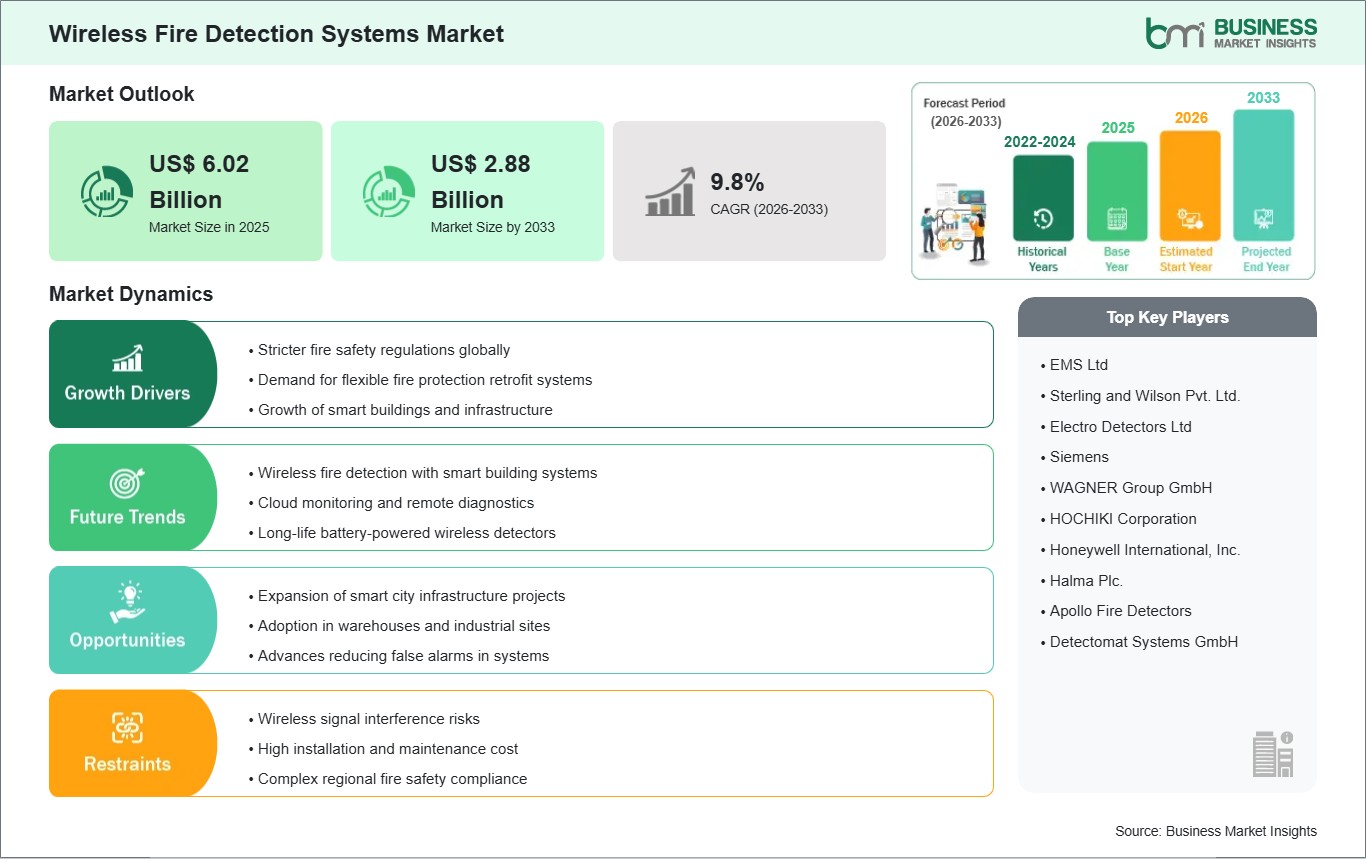
The global Wireless Fire Detection Systems Industry is experiencing rapid expansion, driven by the increasing need for reliable, flexible, and non-invasive fire safety solutions across commercial, industrial, and historical building infrastructure.
According to Business Market Insights, the global Wireless Fire Detection Systems Market size is expected to reach US$ 6.02 Billion by 2033 from US$ 2.88 Billion in 2025. The market is estimated to record a CAGR of 9.65% from 2026 to 2033.
Technological advancement is heavily shaping the industry landscape, with leading fire safety manufacturers focusing on secure mesh topologies, multi-criteria sensors, and cloud-connected control panels. This evolution allows safety engineers to deploy self-healing, highly redundant wireless networks that dramatically reduce false alarms and pinpoint fire origins instantly. Strategic partnerships between building automation providers, industrial facility operators, and regulatory bodies are streamlining compliance certification and driving the adoption of wireless safety infrastructure in both new constructions and occupied retrofit projects.
Download Sample Report : https://www.businessmarketinsights.com/sample/BMIPUB00033724
What Is a Wireless Fire Detection System?
A Wireless Fire Detection System is an advanced fire safety network that uses secure radio frequency (RF) signals, low-power wireless protocols, or proprietary mesh communication to connect smoke detectors, heat sensors, gas monitors, and manual call points directly to a central fire alarm control panel.
Unlike conventional hardwired systems, wireless solutions eliminate the requirement for extensive conduit and wiring infrastructure through walls and ceilings. The technology offers vital functional advantages, including fast zero-disruption installation, seamless scalability, battery-backed operational resilience, and direct integration into modern Building Management Systems (BMS) for centralized emergency response and remote diagnostics.
Market Drivers
A primary driver of the Wireless Fire Detection Systems Market is the surging demand for retrofit safety solutions in commercial, educational, and heritage buildings. Preserving structural integrity in historical or occupied facilities makes traditional wiring impractical or cost-prohibitive, turning wireless systems into the preferred alternative for rapid compliance upgrades.
The ongoing integration of IoT technology and smart building platforms acts as another major catalyst. Facility managers increasingly favor wireless networks equipped with AI-driven analytics and cloud telemetry, enabling continuous system health checks, battery monitoring, and instant mobile alerts during early-stage thermal or smoke events.
Furthermore, stringent national fire safety codes and mandates across industrial and commercial sectors are accelerating market adoption. Stricter standards regarding response times and system redundancy drive organizations to implement multi-sensor wireless detectors capable of distinguishing actual fire hazards from non-critical environmental dust or steam.
Get More Details: https://www.businessmarketinsights.com/buy/BMIPUB00033724
Market Segmentation
By System Model
- Fully Wireless Systems: A dominant segment utilizing battery-powered detection devices and wireless control units, offering maximum deployment flexibility and ease of maintenance.
- Hybrid Systems: A rapidly growing segment that combines hardwired primary backbones with wireless expansion loops, ideal for expanding existing fire alarm setups in large industrial plants.
By Component & Sensor Type
- Multi-Sensor Detectors: The fastest-growing segment, combining optical smoke, heat, and carbon monoxide (CO) sensing elements in a single wireless unit to drastically minimize false triggers.
- Smoke Detectors: A major segment, widely deployed across residential, office, and commercial properties for reliable early-stage fire alerts.
- Heat & Gas Detectors: Essential in specialized industrial settings, commercial kitchens, and laboratories where temperature spikes or combustible gases indicate imminent danger.
- Call Points & Fire Alarm Panels: Critical control hubs that manage RF channel communication, signal routing, and manual emergency activation.
By End User / Application
- Commercial & Corporate Offices: The largest market segment, requiring quick, clean installation without disrupting daily business operations.
- Industrial & Manufacturing Facilities: Experiencing robust growth due to the need for scalable detection across expansive warehouses and hazardous industrial zones.
- Heritage & Historical Structures: A major niche where non-destructive, wire-free installation is strictly required to preserve architectural integrity.
- Residential & Hospitality: Benefiting from modern, aesthetically discreet smart smoke alarms that seamlessly link with home automation hubs.
Regional Insights
- North America holds a dominant position in the global wireless fire detection systems market, backed by strict commercial fire safety enforcement, rapid IoT adoption in smart buildings, and early integration of automated building management standards.
- Asia-Pacific is projected to be the fastest-expanding market, driven by massive urbanization, massive commercial real estate development in China and India, and rising regulatory emphasis on workplace safety.
- Europe represents a highly strategic market, where strict preservation regulations for historical architecture and strong emphasis on green, energy-efficient building standards favor wireless retrofit solutions.
- Middle East & Africa is witnessing steady growth, supported by smart city initiatives, luxury hospitality expansion, and major infrastructure modernization projects in the Gulf Cooperation Council (GCC) region.
- South & Central America is experiencing reliable long-term growth as commercial sectors upgrade legacy infrastructure to conform to evolving regional fire codes.
Top Players in the Wireless Fire Detection Systems Market
The competitive landscape features leading global fire protection, building automation, and security technology leaders focused on improving battery life, developing anti-jamming RF protocols, and expanding modular system capabilities.
- Siemens AG
- Honeywell International Inc.
- Johnson Controls International plc
- Robert Bosch GmbH
- Halma plc (EMS Wireless / Apollo Fire Detectors)
- Hochiki Corporation
- Eurofyre Ltd
- Sterling Safety Systems
Technological Innovations
Innovations in short-range, low-power radio communication such as specialized Sub-GHz mesh networks are transforming wireless fire detection. These protocols penetrate thick concrete walls and structural steel barriers with minimal signal attenuation, resolving historic concerns regarding signal interference in dense industrial settings.
Additionally, advanced multi-criteria detection algorithm development is raising the bar for system precision. Modern wireless sensors analyze optical scatter, rate-of-temperature-rise, and chemical gas concentrations simultaneously. This multi-layered processing dramatically reduces false alarms caused by steam, dust, or cooking vapors while ensuring immediate trigger responses to real fire events.
Future Market Outlook
The future outlook for the Wireless Fire Detection Systems Market is exceptionally strong, supported by the global wave of smart building construction and commercial facility retrofits leading up to 2033. As wireless energy harvesting technologies mature and battery lifespans extend beyond 10 years, the operational overhead of wireless fire networks will drop significantly, further driving market penetration.
Market dominance over the coming decade will belong to safety providers that deliver seamless cloud interoperability, self-diagnostic wireless hardware, and robust cybersecurity protocols. System providers offering fully integrated safety platforms from early thermal detection to automated facility evacuation routing will capture significant market share in the modern safety ecosystem.
Frequently Asked Questions (FAQs)
What is the projected size of the Wireless Fire Detection Systems Market by 2033?
The global market is projected to reach US$ 6.02 Billion by 2033, expanding from US$ 2.88 Billion in 2025.
What is the CAGR for the Wireless Fire Detection Systems Market?
The market is estimated to record a CAGR of 9.65% from 2026 to 2033.
Which model segment holds a strong position in the market?
Fully Wireless Systems hold a major share due to their fast, non-invasive installation, ease of scalability, and minimal disruption during setup.
Which region is expected to grow the fastest?
Asia-Pacific is projected to expand at the fastest growth rate, fueled by rapid commercial construction, smart city projects, and rising awareness of industrial fire safety.
What is the main driver behind the adoption of wireless fire detection?
Key drivers include the rising demand for low-disruption smart building retrofits, integration with IoT-enabled building management platforms, and strict regulatory fire safety mandates globally.
Browse More Reports:
https://www.businessmarketinsights.com/reports/agricultural-packaging-market
https://www.businessmarketinsights.com/reports/amorphous-polyethylene-terephthalate-market
https://www.businessmarketinsights.com/reports/antimicrobial-powder-coatings-market
About Us
Business Market Insights is a market research platform that provides subscription service for industry and company reports. Our research team has extensive professional expertise in domains such as Electronics & Semiconductor; Aerospace & Defense; Automotive & Transportation; Energy & Power; Healthcare; Manufacturing & Construction; Food & Beverage; Chemicals & Materials; and others.
Contact Us
If you have any questions about this report or would like further information, please contact us:
Contact person: Ankit Mathur
Email: sales@businessmarketinsights.com
Phone: +16467917070
