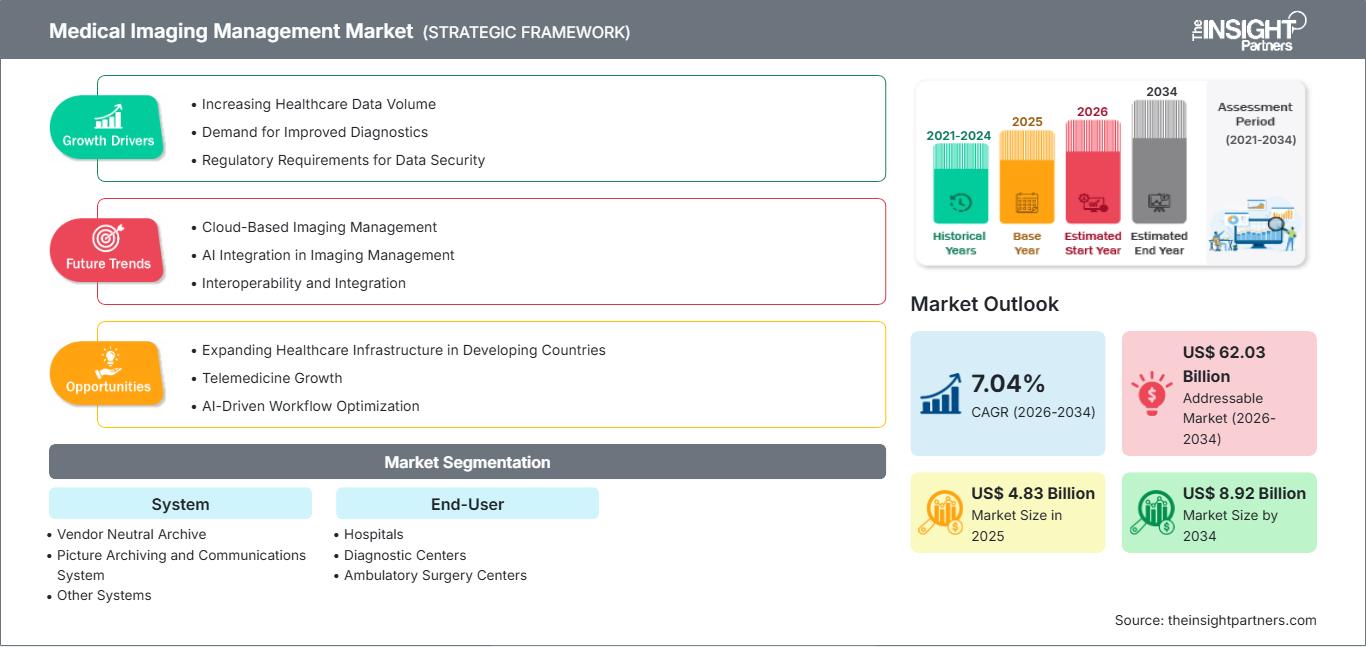
The global medical imaging management market size is projected to reach US$ 8.92 billion by 2034 from US$ 4.83 billion in 2025. The market is anticipated to register a CAGR of 7.04% during the forecast period 2026-2034.
The increasing adoption of picture archiving and communication systems (PACS), vendor-neutral archives (VNA), cloud-based imaging platforms, and integrated healthcare information systems is supporting market growth. Healthcare facilities are investing in modern imaging management technologies to enhance operational efficiency while improving patient outcomes.
Get Sample PDF – https://www.theinsightpartners.com/sample/TIPRE00040781
Market Drivers Supporting Industry Growth
Several factors are contributing to the expansion of the medical imaging management market. The growing prevalence of chronic diseases, rising number of diagnostic imaging procedures, and increasing demand for accurate clinical decision-making are creating sustained demand for advanced imaging management solutions.
Healthcare providers are generating enormous volumes of imaging data from modalities such as magnetic resonance imaging (MRI), computed tomography (CT), ultrasound, X-ray, mammography, and nuclear imaging. Efficient storage, retrieval, and secure sharing of these images have become critical for improving patient care and clinical productivity.
Government initiatives promoting healthcare digitization and electronic health record integration are further accelerating market adoption. Hospitals and diagnostic centers are increasingly implementing interoperable imaging management platforms to improve collaboration across multiple departments and healthcare networks.
Growing demand for telemedicine and remote diagnostics is also supporting market expansion by enabling clinicians to securely access imaging data from different locations for timely consultations and treatment planning.
Technological Advancements Enhancing Imaging Workflows
Technology continues to transform the medical imaging management market through innovations in artificial intelligence, cloud computing, machine learning, and advanced data analytics. Modern imaging management platforms offer automated image indexing, intelligent workflow optimization, and enhanced visualization tools that improve diagnostic efficiency.
Artificial intelligence is increasingly being integrated into imaging management systems to assist radiologists in image interpretation, anomaly detection, workflow prioritization, and report generation. These capabilities help reduce interpretation time while improving diagnostic accuracy.
Cloud-based imaging management solutions are gaining widespread acceptance due to their scalability, cost efficiency, secure data storage, and remote accessibility. Healthcare organizations benefit from simplified infrastructure management while ensuring seamless collaboration among healthcare professionals.
Cybersecurity has also become a major focus area as imaging systems handle large volumes of sensitive patient information. Vendors continue investing in advanced encryption technologies, secure authentication, and regulatory compliance to strengthen data protection.
Expanding Applications Across Healthcare Settings
Medical imaging management systems are extensively used across hospitals, diagnostic imaging centers, specialty clinics, ambulatory surgical centers, and research institutions. Hospitals remain the largest end users due to the high volume of imaging procedures performed across multiple specialties.
Radiology departments rely on imaging management platforms to efficiently organize patient studies, improve reporting workflows, and facilitate multidisciplinary collaboration. Cardiology, oncology, neurology, orthopedics, and emergency medicine departments also increasingly utilize integrated imaging solutions to support timely clinical decision-making.
Research organizations and academic medical centers are adopting advanced imaging management platforms to facilitate large-scale clinical research, image sharing, and collaborative medical education. The growing adoption of enterprise-wide imaging strategies continues expanding the role of centralized imaging management solutions.
Regional Market Insights
North America continues to dominate the medical imaging management market due to its advanced healthcare infrastructure, widespread adoption of healthcare IT solutions, and strong investments in digital transformation. High utilization of diagnostic imaging procedures, favorable regulatory initiatives, and the presence of leading healthcare technology companies continue supporting regional growth.
Europe represents another significant market driven by increasing healthcare digitization, expanding electronic health record implementation, and growing investments in medical imaging technologies. Strong emphasis on healthcare interoperability and patient-centered care further contributes to regional market development.
The Asia Pacific region is expected to witness significant growth during the forecast period owing to rapidly expanding healthcare infrastructure, increasing healthcare expenditure, rising adoption of digital healthcare technologies, and growing demand for advanced diagnostic services. Government initiatives supporting healthcare modernization are creating new opportunities for imaging management solution providers.
Latin America and the Middle East & Africa are gradually adopting advanced medical imaging management technologies as healthcare facilities modernize their digital infrastructure and improve diagnostic capabilities.
Competitive Landscape
The medical imaging management market remains highly competitive, with global technology providers focusing on innovation, strategic collaborations, cloud-based solutions, artificial intelligence integration, and product portfolio expansion. Companies continue investing in research and development to deliver scalable, secure, and interoperable imaging management platforms that address the evolving needs of healthcare providers.
Get Full Copy of This Report @ https://www.theinsightpartners.com/buy/TIPRE00040781
Key Players
- GE Healthcare
- Siemens Healthineers
- Philips Healthcare
- Agfa Healthcare
- Canon Medical Systems
- Carestream Health
- Sectra AB
- Fujifilm Holdings
- Merge Healthcare (IBM)
- IBM Watson Health
These leading companies continue strengthening their market presence through continuous technological innovation, global expansion strategies, advanced healthcare IT solutions, and partnerships with hospitals and diagnostic imaging providers.
Future Outlook
The future of the medical imaging management market remains highly promising through 2034 as healthcare systems continue accelerating digital transformation and enterprise imaging adoption. Ongoing advancements in artificial intelligence, cloud computing, data analytics, and interoperability will further improve imaging workflow efficiency and clinical decision-making. Increasing demand for remote diagnostics, integrated healthcare information systems, and secure image sharing will continue driving market growth. As healthcare providers focus on delivering faster, more accurate, and patient-centered diagnostic services, medical imaging management solutions are expected to play an increasingly vital role in supporting modern healthcare infrastructure and improving overall patient outcomes.
Related Reports @
Medical Imaging Phantoms Market Size, Demand & Growth by 2034
Adult Medical Imaging Market Share, Demand & Growth by 2034
About Us –
The Insight Partners provides comprehensive syndicated and tailored market research services in the healthcare, technology, and industrial domains. Renowned for delivering strategic intelligence and practical insights, the firm empowers businesses to remain competitive in ever-evolving global markets.
Contact Us:
Contact Person: Ankit Mathur
E-mail: ankit.mathur@theinsightpartners.com
Phone: +1-646-491-9876
