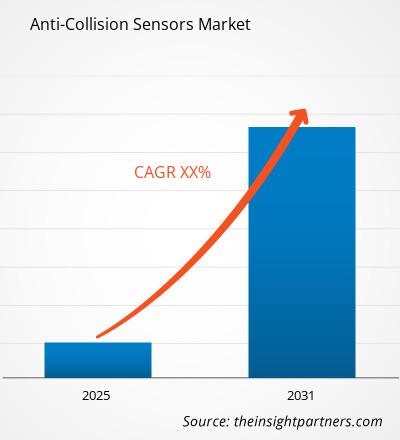
Anti-collision sensors are advanced perception technologies that enable vehicles to detect surrounding objects, pedestrians, road users, and obstacles to prevent or mitigate collisions. These sensors combine radar, LiDAR, cameras, ultrasonic sensors, and intelligent software to provide real-time environmental awareness for advanced driver assistance systems (ADAS) and automated driving applications. As vehicle safety regulations become more stringent and consumers increasingly prioritize intelligent safety features, anti-collision sensors have become essential components across passenger vehicles, commercial fleets, electric vehicles, and autonomous mobility platforms.
Market Overview
The Anti-Collision Sensors Market was valued at US$ 24.38 Billion in 2025 and is projected to reach US$ 78.42 Billion by 2034, registering a CAGR of 15.72% during the forecast period 2026–2034. Market growth is driven by mandatory vehicle safety regulations, increasing adoption of advanced driver assistance systems, rapid expansion of electric vehicles, and rising investments in autonomous driving technologies. Continuous advancements in radar, LiDAR, camera systems, sensor fusion, artificial intelligence, and centralized vehicle computing are accelerating market expansion worldwide.
Key Market Insights
- Market Size (2025): US$ 24.38 Billion
- Forecast Market Size (2034): US$ 78.42 Billion
- CAGR (2026–2034): 15.72%
- Key Growth Driver: Growing deployment of ADAS and mandatory vehicle safety technologies
- Major Trend: Integration of multi-sensor perception systems with artificial intelligence and software-defined vehicle platforms
- Forecast Period: 2026–2034
Get a Sample PDF of the Report: https://www.theinsightpartners.com/sample/TIPRE00022381
Market Drivers
Expansion of Advanced Driver Assistance Systems
Automakers are increasingly making collision warning, automatic emergency braking, adaptive cruise control, lane keeping assistance, and blind spot monitoring standard across new vehicle models.
Stringent Vehicle Safety Regulations
Governments and vehicle safety organizations continue introducing regulations and assessment protocols that encourage widespread adoption of advanced anti-collision technologies.
Growth of Electric and Autonomous Vehicles
Electric vehicles and next-generation autonomous driving platforms require advanced perception systems that combine multiple sensing technologies to improve driving safety and operational reliability.
Increasing Consumer Awareness
Vehicle buyers are placing greater emphasis on safety technologies that reduce accidents, improve driving confidence, and enhance overall driving experiences.
Market Trends
Multi-Sensor Fusion Platforms
Manufacturers are integrating radar, cameras, LiDAR, and ultrasonic sensors into unified perception systems that deliver higher detection accuracy and greater operational redundancy.
Artificial Intelligence-Based Perception
Artificial intelligence and machine learning algorithms are improving object recognition, driver assistance capabilities, and real-time environmental understanding.
Software-Defined Vehicle Architecture
Automotive manufacturers are increasingly adopting centralized computing platforms that simplify sensor integration, enable over-the-air software updates, and improve feature scalability.
High-Resolution Imaging Radar
The development of advanced imaging radar technologies is enhancing object classification, long-range detection, and all-weather operational performance.
Get the Premium Research Report @ https://www.theinsightpartners.com/buy/TIPRE00022381
Regional Analysis
North America
North America accounted for approximately 29%–33% of the global market in 2025 and is projected to grow at a CAGR of 14.8%–16.1% during 2026–2034. Market growth is supported by strong ADAS adoption, software-defined vehicle development, stringent vehicle safety regulations, and advanced automotive manufacturing. The US represented approximately 83%–87% of North America’s market in 2025 and is expected to register a CAGR of 14.9%–16.2%, driven by NHTSA safety initiatives, premium vehicle production, autonomous vehicle development, and high consumer demand for advanced safety features.
Europe
Europe held approximately 24%–28% of the market in 2025 and is anticipated to grow at a CAGR of 14.1%–15.4%. Germany, France, the UK, Italy, and Spain continue expanding vehicle safety technologies through Euro NCAP protocols, advanced automotive manufacturing, and increasing adoption of intelligent mobility solutions.
Asia-Pacific
Asia-Pacific captured approximately 34%–38% of the global market in 2025 and is projected to register the fastest regional growth with a CAGR of 16.7%–18.2% during 2026–2034. China, Japan, South Korea, India, and Australia continue expanding electric vehicle production, ADAS deployment, automotive semiconductor manufacturing, and autonomous mobility initiatives, creating significant opportunities for anti-collision sensor manufacturers.
Middle East and Africa
The Middle East and Africa are steadily investing in intelligent transportation systems, connected mobility infrastructure, commercial vehicle safety, and automotive modernization, supporting long-term demand for advanced anti-collision sensing technologies.
Segment Analysis
By Sensor Type
The RADAR segment accounted for approximately 36%–40% of the market in 2025 and is projected to grow at a CAGR of 15.1%–16.4% through 2034. Superior all-weather detection capabilities, long-range sensing, and broad adoption across ADAS applications continue supporting the segment’s dominant market position.
By Sensor Type
The LiDAR segment represented approximately 12%–16% of the market in 2025 and is expected to register the fastest growth with a CAGR of 21.5%–24.0%. Increasing deployment in Level 2+ driver assistance systems, autonomous vehicle development, high-resolution mapping, and advanced perception platforms continues driving rapid market expansion.
Competitive Landscape
The Anti-Collision Sensors Market remains highly competitive as automotive technology providers, semiconductor manufacturers, and Tier 1 suppliers continue investing in advanced sensing technologies and intelligent vehicle safety platforms. Companies are strengthening their competitive positions through innovations in radar systems, LiDAR technologies, automotive cameras, ultrasonic sensors, artificial intelligence, sensor fusion software, automotive-grade semiconductors, and centralized vehicle computing architectures. Strategic collaborations with automotive OEMs, electric vehicle manufacturers, software developers, and mobility technology providers continue accelerating deployment across global vehicle platforms.
Key Players
- Autoliv, Inc.
- Continental AG
- DENSO Corporation
- Murata Manufacturing Co., Ltd.
- NXP Semiconductors N.V.
- Robert Bosch GmbH
- Texas Instruments Incorporated
- TRW Automotive Holdings Corp.
- Wadeco Co., Ltd.
- ZF Friedrichshafen AG
- Aptiv PLC
- Valeo SE
- Magna International Inc.
Emerging Trends
The anti-collision sensors industry is advancing through high-resolution imaging radar, next-generation LiDAR technologies, artificial intelligence-powered perception, sensor fusion platforms, software-defined vehicle architectures, centralized computing systems, automotive cybersecurity, over-the-air software updates, advanced semiconductor integration, and intelligent driver assistance technologies. Manufacturers are developing next-generation sensing platforms that deliver greater detection accuracy, longer sensing range, improved object classification, lower latency, enhanced environmental awareness, superior all-weather performance, and seamless integration with automated driving systems. These technological advancements are expected to create significant growth opportunities across passenger vehicles, commercial fleets, electric vehicles, autonomous mobility platforms, logistics operations, and intelligent transportation systems throughout the forecast period.
Future Outlook
The future outlook for the Anti-Collision Sensors Market remains highly positive as governments, automotive manufacturers, and consumers continue prioritizing vehicle safety, intelligent mobility, and autonomous driving technologies. Continued innovation in radar, LiDAR, artificial intelligence, sensor fusion, and automotive software platforms is expected to support sustained market growth through 2034.
Related Market Research Reports
Wafer Back Grinding Tape Market Size, Growth & Demand by 2034
Cable Drum Market Size, Growth & Trends by 2034
Precision Source Measure Unit Market Growth, Share & Trends by 2034
Shuttle Blister Packaging Systems Market Size, Demand & Growth by 2034
About The Partners
The Insight Partners is a Insight global leader in market research, delivering comprehensive analysis and actionable insights across diverse industries. The company empowers decision-makers with data-driven intelligence to navigate evolving markets and accelerate growth.
Contact Us:
