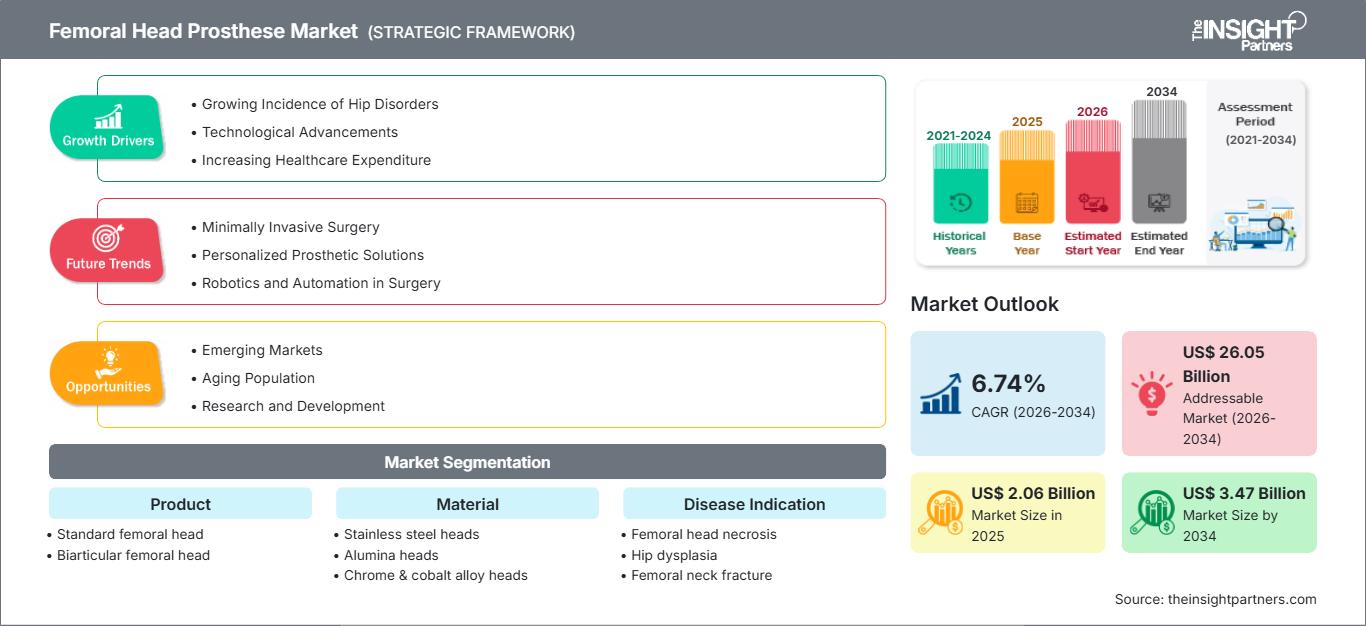
The Femoral Head Prosthese Market size is expected to reach US$ 3.47 Billion by 2034 from US$ 2.06 Billion in 2025. The market is estimated to record a CAGR of 6.74% from 2026 to 2034.
Increasing life expectancy and the growing number of elderly individuals requiring hip replacement procedures continue to drive demand for advanced femoral head prostheses. Healthcare providers are increasingly focusing on implant longevity, minimally invasive surgical techniques, and faster rehabilitation to improve patient satisfaction.
Get Sample PDF – https://www.theinsightpartners.com/sample/TIPRE00039970
Market Drivers Supporting Industry Expansion
Several factors are contributing to the growth of the femoral head prosthese market. The rising incidence of orthopedic disorders and sports-related injuries has significantly increased the number of hip replacement surgeries performed worldwide. Osteoarthritis remains one of the leading causes of hip joint degeneration, creating sustained demand for advanced prosthetic implants.
The rapidly aging global population is another major market driver. Older adults are more susceptible to hip fractures, osteoporosis, and degenerative joint diseases, increasing the need for reliable joint replacement solutions. Improved healthcare access and growing awareness of orthopedic treatment options are also supporting market expansion.
Technological improvements in implant manufacturing have enhanced prosthesis performance, enabling better anatomical fit, greater wear resistance, and improved long-term functionality. Increasing healthcare expenditure and expanding orthopedic care infrastructure across emerging economies further contribute to market development.
Technological Innovations Improving Orthopedic Outcomes
Continuous innovation is transforming the femoral head prosthese market through the development of advanced biomaterials, precision manufacturing techniques, and improved implant designs. Manufacturers are introducing prostheses made from highly durable materials such as ceramic, cobalt-chromium alloys, titanium alloys, and advanced polyethylene to improve implant longevity and reduce wear.
Modern prosthetic systems are designed to provide greater joint stability, improved range of motion, and enhanced patient comfort. Computer-assisted surgical planning, robotic-assisted orthopedic procedures, and three-dimensional imaging technologies are improving implant positioning and surgical precision.
Personalized orthopedic implants are also gaining attention as healthcare providers increasingly seek customized solutions based on individual patient anatomy. These advancements contribute to improved postoperative recovery and reduced complication rates.
Research into surface coatings and biologically compatible materials continues to enhance implant integration with surrounding bone tissue while minimizing the risk of revision surgery.
Expanding Clinical Applications
Femoral head prostheses are primarily used in total hip replacement and partial hip replacement procedures performed across hospitals, orthopedic specialty centers, ambulatory surgical centers, and trauma care facilities. These implants play a vital role in restoring mobility and improving quality of life for patients suffering from severe hip disorders.
Orthopedic surgeons increasingly utilize advanced prosthetic systems to treat osteoarthritis, rheumatoid arthritis, femoral neck fractures, avascular necrosis, congenital hip disorders, and revision hip surgeries. The growing preference for minimally invasive surgical approaches is also increasing demand for innovative implant systems that support faster recovery and shorter hospital stays.
Rehabilitation centers and physiotherapy programs further contribute to successful postoperative outcomes by helping patients regain mobility and improve long-term joint function following hip replacement procedures.
Regional Market Insights
North America continues to hold a significant share of the femoral head prosthese market due to its advanced orthopedic healthcare infrastructure, high number of joint replacement surgeries, and early adoption of innovative implant technologies. Favorable reimbursement policies and the presence of leading orthopedic device manufacturers further support regional growth.
Europe represents another important market, driven by an aging population, increasing prevalence of musculoskeletal disorders, and well-established orthopedic care systems. Continuous advancements in surgical techniques and implant technologies continue strengthening market demand across the region.
The Asia Pacific region is expected to witness substantial growth throughout the forecast period due to expanding healthcare infrastructure, rising healthcare expenditure, growing awareness of joint replacement procedures, and increasing incidences of orthopedic disorders. Improving access to specialized orthopedic care is creating significant opportunities for market participants.
Latin America and the Middle East & Africa are also experiencing gradual market expansion as healthcare modernization initiatives improve access to orthopedic surgeries and advanced implant technologies.
Competitive Landscape
The femoral head prosthese market remains highly competitive, with leading manufacturers focusing on product innovation, advanced biomaterials, robotic-assisted surgery integration, strategic collaborations, and geographic expansion. Companies continue investing in research and development to improve implant durability, surgical precision, and long-term patient outcomes.
Get Full Copy of This Report @ https://www.theinsightpartners.com/buy/TIPRE00039970
Key Players
- DePuy Synthes (Johnson & Johnson)
- Stryker Corporation
- Zimmer Biomet
- Smith & Nephew
- Medtronic
- B. Braun Melsungen AG
- Exactech, Inc.
- Aesculap AG
- Wright Medical Group N.V.
- NuVasive, Inc.
These companies continue strengthening their market positions through continuous product innovation, expanded orthopedic implant portfolios, global distribution networks, and strategic partnerships with hospitals and orthopedic specialists.
Future Outlook
The future of the femoral head prosthese market remains promising through 2034 as the demand for joint replacement procedures continues to increase worldwide. Ongoing advancements in implant materials, robotic-assisted surgery, digital surgical planning, and personalized orthopedic solutions are expected to further improve clinical outcomes and patient satisfaction. Growing investments in orthopedic healthcare infrastructure, increasing awareness of mobility restoration, and expanding access to advanced surgical procedures will continue supporting market growth. As healthcare providers increasingly focus on improving long-term implant performance and enhancing patient quality of life, femoral head prostheses are expected to remain a critical component of modern orthopedic treatment strategies.
Related Reports @
Orthopedic Implants Market Size, Trends & Demand by 2034
About Us –
The Insight Partners provides comprehensive syndicated and tailored market research services in the healthcare, technology, and industrial domains. Renowned for delivering strategic intelligence and practical insights, the firm empowers businesses to remain competitive in ever-evolving global markets.
Contact Us:
Contact Person: Ankit Mathur
E-mail: ankit.mathur@theinsightpartners.com
Phone: +1-646-491-9876
