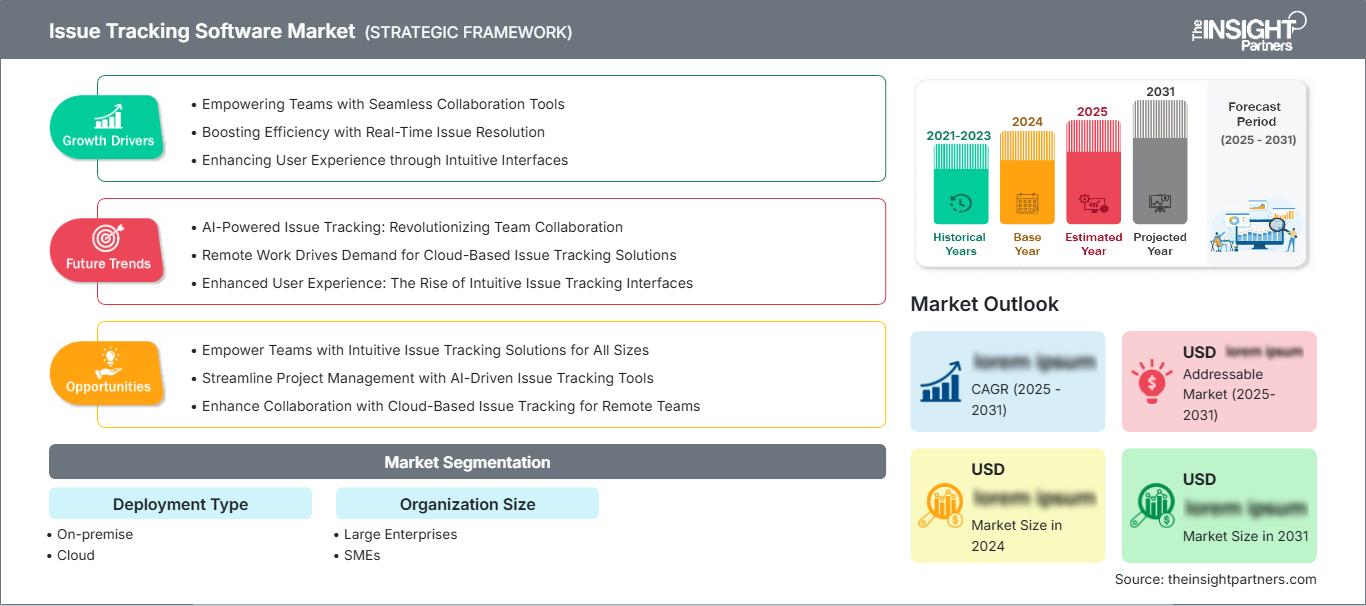
The global issue tracking software market is undergoing rapid expansion as modern enterprises prioritize digital transformation, operational efficiency, and agile continuous delivery. Issue tracking software enables organizations to capture, prioritize, assign, and resolve bugs, task bottlenecks, and customer service incidents across distributed operational teams.
The global Issue Tracking Software Market size is projected to reach US$ 3.78 billion by 2034 from US$ 1.65 billion in 2025. The market is anticipated to register a CAGR of 10.88% during the forecast period 2026-2034. Organizations in information technology, telecom, healthcare, and financial services are increasingly replacing manual spreadsheets and legacy software with cloud-native issue tracking systems to streamline project management.
Key Drivers
- Widespread Adoption of Agile and DevOps Methodologies: Software development and IT operational workflows depend heavily on continuous integration and delivery (CI/CD) pipelines. Issue tracking platforms serve as the central coordination system for real-time task tracking, sprint planning, and bug management.
- Shift Toward Cloud Solutions and Distributed Workforces: The expansion of hybrid and remote work structures has highlighted the necessity of unified, cloud-accessible collaboration platforms. Cloud-based issue tracking tools provide real-time updates and seamless communication across geographically dispersed teams.
- Artificial Intelligence and Machine Learning Integration: Modern platforms leverage AI algorithms to automate ticket generation, route incoming issues to appropriate engineers, perform sentiment analysis, and predict potential workflow delays.
Download Sample Report@ https://www.theinsightpartners.com/sample/TIPRE00012327
Market Opportunities
- Expansion into Non-IT Business Functions: While issue tracking originated within software engineering teams, significant expansion opportunities exist in enterprise service management (ESM). Human resources, marketing, legal, and facilities management departments are adopting task-tracking architectures to handle internal service requests.
- Low-Code and No-Code Customization: Integrating low-code customization capabilities allows non-technical team members to build tailored ticketing workflows, approval matrices, and task dashboards without engineering support.
- AIOps and Predictive Remediation: Integrating Artificial Intelligence for IT Operations (AIOps) creates major opportunities for platforms to move from passive issue logging to proactive incident detection and automated remediation.
Market Segmentation
- By Deployment Model: The cloud-based SaaS segment dominates the market due to minimal hardware requirements, automated feature updates, and cost-efficient subscription models. On-premises deployments retain a specialized presence in strictly regulated environments requiring total data sovereignty.
- By Organization Size: Large enterprises hold a substantial market share driven by high user density and complex multi-departmental requirements. Small and Medium Enterprises (SMEs) represent the fastest-growing segment as accessible SaaS pricing democratizes enterprise-grade management tools.
- By End-User Industry: IT & Telecommunications forms the largest vertical, followed by Financial Services and Healthcare, where fast incident resolution is vital to maintaining compliance and customer satisfaction.
Market News and Recent Developments
Major software vendors are continuously expanding platform ecosystems through strategic software integrations and generative AI enhancements. Key market developments include:
- AI Copilot Integrations: Vendors are embedding natural language processing tools directly into issue creation interfaces, allowing automated summaries of complex bug histories and instant context switching for developers.
- Cybersecurity and Compliance Synergy: Strategic partnerships between issue tracking vendors and security platforms now allow automatic generation of tracking tickets whenever vulnerability scanners detect code defects or security risks.
- Ecosystem Acquisitions: Leading market providers continue to acquire specialized toolmakers in test automation, workflow analytics, and product roadmapping to offer unified end-to-end dev platforms.
Competitive Landscape and Top Players
The competitive environment in the issue tracking software market is moderately consolidated, featuring established global technology conglomerates alongside agile cloud-native SaaS providers. Companies compete primarily on ease of integration, platform scalability, user interface simplicity, and advanced analytics capabilities.
Top Market Players
- Atlassian Corporation (Jira)
- Microsoft Corporation (GitHub & Azure DevOps)
- ServiceNow, Inc.
- IBM Corporation
- GitLab Inc.
- Zoho Corporation
- Monday.com Ltd.
- Freshworks Inc.
- Bugzilla
- Redmine
Get Full Copy of This Report @ https://www.theinsightpartners.com/buy/TIPRE00012327
Future Outlook
Through 2034, the issue tracking software market will transition from conventional ticket logging toward hyper-automated, intelligent task orchestration platforms. As artificial intelligence matures, platforms will automatically identify workflow friction, reassign tasks based on developer capacity, and resolve simple system bugs autonomously. Organizations that adopt unified issue tracking ecosystems will achieve higher operational efficiency, improved team collaboration, and faster digital product delivery.
About The Insight Partners
The Insight Partners provides comprehensive syndicated and tailored market research services in the healthcare, technology, and industrial domains. Renowned for delivering strategic intelligence and practical insights, the firm empowers businesses to remain competitive in ever-evolving global markets.
Contact Information
- Email: sales@theinsightpartners.com
- Website: theinsightpartners.com
- Phone: +1-646-491-9876
