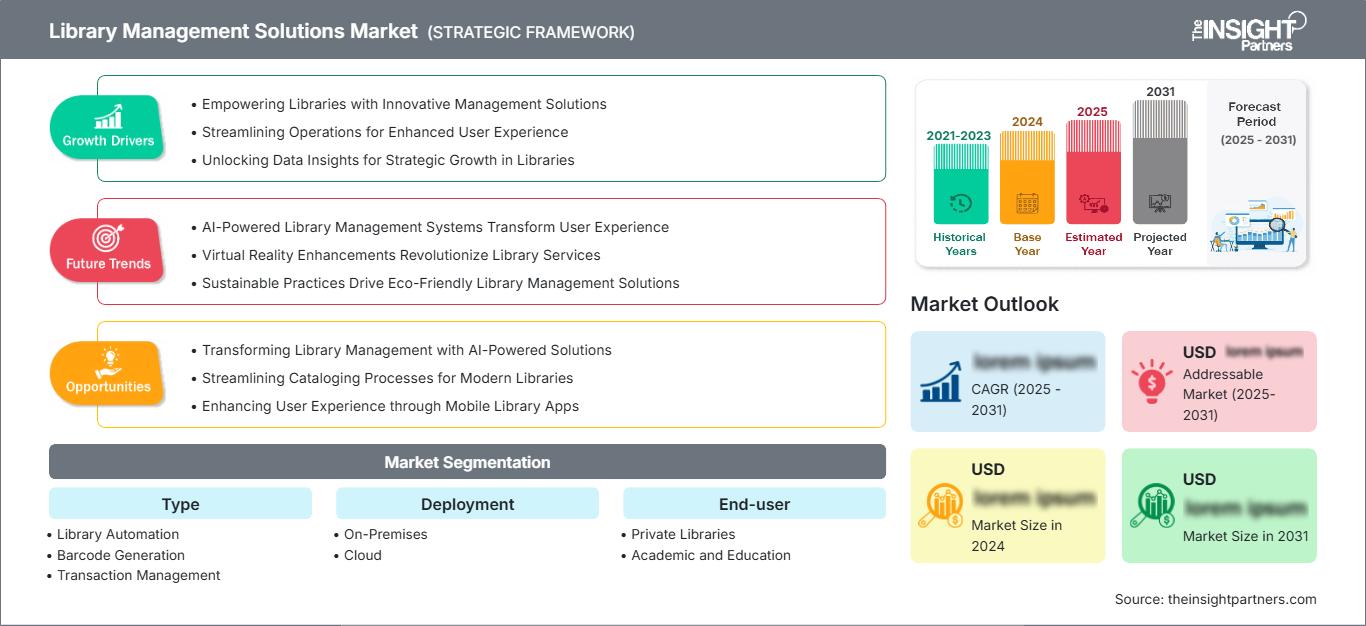
The global library management solutions market is undergoing a structural shift from traditional desktop cataloging systems to scalable, cloud-native library services platforms. Library management software enables academic, public, school, and special libraries to automate core administrative workflows such as cataloging, acquisition, circulation, serials management, and patron record administration.
The Library Management Solutions Market size is expected to reach US$ 3.24 Billion by 2031. The market is anticipated to register a CAGR of 5.7% during 2025–2031.
Key Market Drivers
Rapid Digitalization of Educational and Public Archives
Educational institutions and public municipal networks are accelerating efforts to digitize historical records, research publications, and learning materials. To organize and curate large volumes of digital assets alongside physical inventory, libraries are replacing legacy systems with modern software platforms capable of managing complex metadata and hybrid collections.
Demand for Operational Automation and Efficiency
Manual collection processing, inventory tracking, and circulation management require substantial staff hours. Automated library systems significantly reduce operational overhead through self-check kiosks, automated overdue notification protocols, and RFID integration. This efficiency allows librarians to reallocate resources toward research support and community engagement.
Integration with Educational Systems and E-Learning Ecosystems
In academic settings, library management tools are increasingly integrated directly with Learning Management Systems (LMS) and student information platforms. Seamless interoperability ensures that students and faculty can access course reserves, scholarly journals, and reference materials directly from their digital learning environments.
Shift Toward Cloud-Based Deployment and Mobile Access
Cloud deployment minimizes up-front IT capital expenditure and provides predictable subscription costs. Simultaneously, mobile-friendly interfaces and dedicated library applications cater to modern patrons who demand instant access to catalogs, resource reservations, and digital lending on smartphones and tablets.
Download Sample Report@ https://www.theinsightpartners.com/sample/TIPRE00005307
Market Opportunities
AI and Predictive Analytics Integration
Vendors that incorporate machine learning and predictive analytics present a strong growth value proposition. Artificial intelligence can analyze borrowing trends, forecast resource usage, recommend collection acquisitions, and personalize reading suggestions for patrons, turning basic databases into intelligent discovery engines.
Regional Expansion in Emerging Economies
Governments across Asia-Pacific, Latin America, and parts of the Middle East are investing heavily in educational infrastructure and public literacy programs. The expansion of new university campuses and modernized public library networks in these regions offers substantial commercial opportunities for software vendors.
Subscription-Based Models for Smaller Institutions
Scalable SaaS pricing models enable community libraries, K-12 schools, and niche corporate libraries to access enterprise-grade management features without heavy infrastructure investments.
Market Segmentation
By Deployment Mode
- Cloud-Based Solutions: Dominates current demand due to lower hardware costs, automatic updates, and remote accessibility.
- On-Premise Solutions: Preferred by select specialized or highly secure research facilities requiring localized server control.
By Component
- Software: Core management platforms, cataloging modules, circulation engines, and digital discovery portals.
- Services: System implementation, data migration, ongoing technical support, user training, and custom API integration.
By End User
- Academic Libraries: Universities, colleges, and research institutions requiring sophisticated resource sharing and scholarly repository management.
- Public Libraries: Municipal systems serving diverse community populations with high circulation volumes.
- School Libraries: Primary and secondary educational facilities focused on user-friendly interfaces and reading program management.
- Special and Corporate Libraries: Government agencies, law firms, healthcare centers, and corporate repositories requiring specialized search and security capabilities.
By Geography
- North America: Leading market share driven by high technology adoption and strong educational funding.
- Europe: Strong focus on open-access repositories and GDPR-compliant data security frameworks.
- Asia-Pacific: Fastest-growing regional market due to expanding university networks and digital literacy initiatives.
- Rest of the World: Steady growth supported by municipal modernization and digital access programs.
Market News and Recent Developments
Recent developments in the library management space reflect industry consolidation and a focus on unified discovery tools. Major vendors continue to acquire specialized software providers to build end-to-end research ecosystems. Strategic partnerships between library software vendors and electronic content distributors have streamlined e-book licensing and digital collection management.
In addition, vendors are prioritizing open standards and interoperable API architectures. This enables seamless connection with external repositories, research management systems, and identity management platforms. Enhanced security protocols and strict data privacy protections have also become central to software update releases.
Competitive Landscape and Top Players
The global market is moderately consolidated, featuring established educational technology corporations alongside specialized library software providers. Key market players compete on platform flexibility, search accuracy, integration capabilities, customer support, and total cost of ownership.
Top Market Players Include:
- Ex Libris (A Clarivate Company): Known for enterprise academic platforms such as Alma and Primo.
- SirsiDynix: A global provider offering flexible cloud platforms like Symphony and BLUEcloud.
- OCLC (Online Computer Library Center): Offers widespread cloud services including WorldShare Management Services.
- Follett School Solutions: A major provider specializing in K-12 library management with products like Destiny Library Manager.
- Axiell Group: Focuses on comprehensive cultural software, serving public libraries, archives, and museums.
- Civica: Delivers integrated public sector and library management software across international markets.
- Innovative Interfaces (A Clarivate Company): Provides widely used systems such as Sierra and Polaris.
- The Library Corporation (TLC): Delivers tailored automation solutions like Library.Solution and CARL.Solution.
- Book Systems: Offers accessible automation platforms tailored for smaller public and private libraries.
Get Full Copy of This Report @ https://www.theinsightpartners.com/buy/TIPRE00005307
Future Outlook
Looking ahead toward 2031, the library management solutions market will continue to evolve into a core pillar of modern digital learning and knowledge management. The convergence of smart library technologies, such as Internet of Things (IoT) shelf management, automated return sorting systems, and AI-driven content discovery, will redefine how physical and digital collections operate together. Organizations that embrace flexible cloud architectures and prioritize patron experience will lead the market into the next decade.
About The Insight Partners
The Insight Partners provides comprehensive syndicated and tailored market research services in the healthcare, technology, and industrial domains. Renowned for delivering strategic intelligence and practical insights, the firm empowers businesses to remain competitive in ever-evolving global markets.
Contact Information
- Email: sales@theinsightpartners.com
- Website: theinsightpartners.com
- Phone: +1-646-491-9876
