The Product Life Cycle Management (PLM) has become an important technology for manufacturers seeking to manage increasingly complex product development processes, improve collaboration, and accelerate time to market. PLM solutions provide a centralized environment for managing product-related information, engineering data, design processes, manufacturing requirements, and other activities throughout a product’s life cycle. As manufacturers move toward digital and connected production environments, the demand for PLM solutions is increasing across industries.
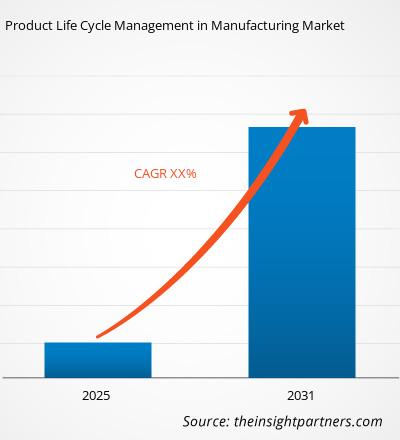
The global Product Life Cycle Management in Manufacturing Market size is projected to reach US$ 67.22 billion by 2034 from US$ 36.07 billion in 2025. The market is anticipated to register a CAGR of 8.09% during the forecast period 2026-2034.
What Is Product Life Cycle Management in Manufacturing?
Product Life Cycle Management in manufacturing refers to the systematic management of a product from its initial concept and design through engineering, production, distribution, service, and eventual retirement. PLM software enables manufacturers to organize product information, manage engineering changes, coordinate teams, and maintain a digital record of the product throughout its lifecycle.
Manufacturing organizations increasingly rely on PLM systems because product development involves large amounts of data generated by computer-aided design, engineering, simulation, manufacturing, quality management, and supply chain applications. Integrating these sources helps manufacturers create a more consistent flow of information and minimize errors caused by disconnected systems.
Get Sample PDF of the report @ https://www.theinsightpartners.com/sample/TIPRE00006256
What Is Driving the Product Life Cycle Management in Manufacturing Market?
One of the major factors supporting market growth is the rapid adoption of digital manufacturing. Manufacturers are investing in connected technologies to improve productivity, flexibility, and product quality. PLM systems serve as an important layer for organizing product data and connecting engineering activities with downstream manufacturing operations.
The increasing complexity of products is another important growth factor. Automotive, aerospace, electronics, industrial machinery, and other manufacturing sectors are developing products with more components, software, electronics, and regulatory requirements. PLM platforms allow companies to manage complex product structures and engineering changes more effectively.
Cloud adoption is also transforming the PLM landscape. Cloud-based PLM solutions can reduce infrastructure requirements and provide users with access to product information from different locations. This is particularly valuable for manufacturers operating global engineering and production networks. Cloud deployment can also make PLM technologies more accessible to small and medium-sized manufacturers.
How Are Industry 4.0 Technologies Influencing PLM Adoption?
Industry 4.0 is significantly influencing the development of modern PLM solutions. Technologies such as artificial intelligence, machine learning, Internet of Things (IoT), digital twins, advanced analytics, and industrial automation are creating new opportunities for manufacturers to connect product development with real-world operational data.
Digital twins are particularly relevant because they allow manufacturers to create virtual representations of physical products or systems. When integrated with PLM environments, digital twins can support product design, simulation, testing, maintenance, and optimization.
Artificial intelligence can further enhance PLM by helping organizations analyze engineering information, automate repetitive tasks, identify potential design issues, and support decision-making. As manufacturers generate larger quantities of product and production data, intelligent PLM capabilities are expected to become increasingly valuable.
What Are the Key Market Trends?
A major trend in the Product Life Cycle Management in Manufacturing Market is the movement toward cloud-based platforms. Cloud PLM enables organizations to provide secure access to product information across geographically distributed teams while supporting collaboration between manufacturers, suppliers, and engineering partners.
Another trend is the integration of PLM with enterprise applications such as Enterprise Resource Planning (ERP), Manufacturing Execution Systems (MES), Customer Relationship Management (CRM), and Computer-Aided Design (CAD) systems. Integration helps manufacturers establish a connected digital thread from product conception to production and after-sales service.
The growing use of digital twins, model-based systems engineering, and data analytics is also influencing PLM adoption. These technologies help organizations improve product visibility and make decisions using information collected throughout the product lifecycle.
What Are the Major Challenges Facing the Market?
Despite its advantages, PLM implementation can present challenges for manufacturers. Integrating PLM platforms with existing enterprise systems may require significant technical resources and organizational planning. Legacy systems can make data integration more complicated, particularly for companies operating multiple facilities with different technology environments.
Data security and privacy are also important considerations, especially when organizations use cloud-based PLM systems. Manufacturers need to protect sensitive intellectual property, engineering designs, supplier information, and other proprietary data.
Another challenge is organizational adoption. PLM affects multiple departments, meaning successful implementation requires cooperation between engineering, manufacturing, procurement, quality, IT, and management teams. Employee training and change management are therefore important components of PLM deployment.
Which Manufacturing Industries Are Adopting PLM?
PLM adoption is prominent across several manufacturing industries. Automotive manufacturers use PLM to manage increasingly complex vehicle architectures, engineering changes, connected vehicle technologies, and supplier relationships. Aerospace and defense companies use PLM to manage complex designs, compliance requirements, long development cycles, and extensive documentation.
Electronics and semiconductor manufacturers also benefit from PLM because product designs frequently involve rapid innovation and complex combinations of hardware and software. Industrial machinery manufacturers use PLM to coordinate product configurations, engineering documentation, production requirements, and lifecycle services.
Medical device manufacturing represents another important application area. Manufacturers must manage strict quality and regulatory requirements while maintaining accurate documentation throughout product development and commercialization.
How Does PLM Improve Manufacturing Operations?
PLM can improve manufacturing performance by establishing a single source of product information. Engineering teams can work with updated product specifications, while manufacturing teams can access relevant design and production information. This reduces the likelihood of errors caused by outdated or inconsistent data.
PLM can also accelerate new product introduction by improving collaboration between product development and manufacturing teams. Faster communication and better change management can help organizations identify problems earlier and reduce delays.
Furthermore, PLM supports cost optimization by helping manufacturers identify design issues before products enter production. Early identification of problems can reduce expensive redesigns, material waste, and production interruptions.
Get the Premium Research Report @ https://www.theinsightpartners.com/buy/TIPRE00006256
Regional Market Outlook
The adoption of PLM varies across regions based on industrial development, digital transformation initiatives, technology investment, and the presence of major manufacturing industries. North America remains an important market for PLM because of its established automotive, aerospace, technology, and industrial manufacturing sectors.
Europe is also a significant market, supported by advanced manufacturing capabilities and the increasing adoption of digital engineering and Industry 4.0 practices. Asia Pacific is expected to offer substantial growth opportunities as manufacturers in countries such as China, Japan, South Korea, and India continue investing in automation, connected production, and digital transformation.
Competitive Landscape
The Product Life Cycle Management market includes several established technology providers offering solutions for product data management, engineering collaboration, digital manufacturing, and lifecycle optimization.
- Accenture PLC
- ANSYS, Inc.
- Autodesk Inc.
- Dassault Systemes
- IBM
- Infor
- Oracle
- PTC
- SAP SE
- Siemens AG
Future Outlook
The future of the Product Life Cycle Management in Manufacturing Market is closely connected to the broader transformation toward intelligent and connected manufacturing. As manufacturers seek to develop products faster, manage increasingly complex product architectures, and improve collaboration across global operations, PLM platforms are expected to become increasingly important.
About The Insight Partners
The Insight Partners is a global leader in market research, delivering comprehensive analysis and actionable insights across diverse industries. The company empowers decision-makers with data-driven intelligence to navigate evolving markets and accelerate growth.
Contact Us:
- Contact Person: Ankit Mathur
- E-mail: ankit.mathur@theinsightpartners.com
- Phone: +1-646-491-9876
Also Available in :
Korean German Japanese French Chinese Italian Spanish
