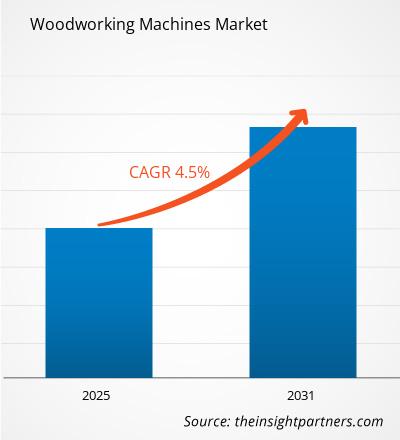
The global woodworking machinery industry is undergoing a significant transformation, driven by advancements in industrial automation, shifting consumer preferences toward custom furniture, and growing demand within residential and commercial construction sectors. Woodworking machines ranging from saws, planers, and routers to advanced computer numerical control (CNC) machining centers play a fundamental role in processing raw timber into refined products for furniture, flooring, cabinetry, and architectural elements.
The Woodworking Machines Market size is expected to reach US$ 7.99 Billion by 2034 from US$ 5.85 Billion in 2025. The market is estimated to record a CAGR of 3.52% from 2026 to 2034.
Market Dynamics & Key Growth Drivers
1. Shift Toward Automation and Industry 4.0 Integration
A key growth driver across the woodworking machinery sector is the adoption of automated, smart, and interconnected equipment. Modern manufacturers and carpentry workshops are increasingly transitioning from traditional manual machinery to CNC-enabled systems, automated robotic loading units, and IoT-integrated diagnostic equipment. This shift significantly boosts operational speed, minimizes raw material waste, mitigates labor shortage challenges, and ensures high precision for complex geometries.
2. Surge in Custom Furniture and Modern Interior Decor
Consumer demand for customized, bespoke furniture that reflects personal aesthetic choices has increased sharply. Traditional mass-production setups are adapting to modular and highly flexible manufacturing configurations that can handle low-volume, highly diverse production runs efficiently. As a result, furniture manufacturers are investing in versatile woodworking machinery to keep pace with changing market dynamics.
3. Expansion in Construction and Prefabricated Housing
The global expansion of residential and commercial construction projects remains a cornerstone of market demand. Furthermore, modern architectural trends favoring sustainable building practices such as cross-laminated timber (CLT) and prefabricated wooden structures are spurring demand for high-capacity woodworking equipment capable of processing heavy-duty structural timber.
Get a PDF Sample- https://www.theinsightpartners.com/sample/TIPRE00009695
Segment Highlights
By Machine Type: The market includes saws, CNC routers, planers, sanders, and shaping machines. CNC machining centers and advanced routers account for substantial investment owing to their multi-functional capabilities and superior efficiency.
By Application: The furniture manufacturing segment accounts for the dominant share of equipment consumption, followed closely by structural building components, flooring, and decorative panel processing.
By Region: North America and Europe continue to maintain strong demand due to high levels of industrial automation, strict energy-efficiency regulations, and robust home renovation activity. Meanwhile, Asia-Pacific represents a rapidly expanding regional market, supported by massive urban construction, expanding manufacturing facilities, and growing consumer expenditure on modern furnishings.
Key Players
The global woodworking machines landscape is characterized by a mix of long-established machinery giants and specialized regional manufacturers focusing on continuous product innovation and global distribution networks. Key companies operating in this market include:
Biesse S.p.A.
Felder Group
Gongyou Group Co.,Ltd.
Holytek Industrial Corp
HOUFEK a.s.
IMA Schelling Group
Michael Weinig Inc.
Oliver Machinery Company
Paolino Bacci
SCM Group
These industry players regularly focus on strategic initiatives such as corporate acquisitions, software upgrades for machine controls, localized service network expansions, and energy-efficient product lines to maintain market position and serve evolving customer needs.
Get Full Copy of This Report- https://www.theinsightpartners.com/buy/TIPRE00009695
Future Outlook
The future outlook for the global woodworking machines market remains highly positive, driven by the convergence of digital technology and sustainable manufacturing. Over the forecast period leading up to 2034, equipment manufacturers will increasingly prioritize energy-efficient motors, noise-reduction features, and intelligent waste-management systems to comply with international environmental standards. Additionally, the rising integration of artificial intelligence for predictive maintenance and real-time operational optimization will allow woodworking businesses to reduce downtime and improve overall plant productivity. As the demand for eco-friendly building practices and customized living spaces continues to rise worldwide, the woodworking machines market is well-positioned for continuous, stable growth.
About Us
The Insight Partners is a one-stop industry research provider of actionable intelligence. We help our clients in getting solutions to their research requirements through our syndicated and consulting research services. We specialize in industries such as Semiconductor and Electronics, Aerospace and Defense, Automotive and Transportation, Biotechnology, Healthcare IT, Manufacturing and Construction, Medical Devices, Technology, Media, and Telecommunications, as well as chemicals and Materials.
Contact Us
If you have any queries about this report or if you would like further information, don’t hesitate to get in touch with us:
Contact Person: Ankit Mathur
E-mail: ankit.mathur@theinsightpartners.com
