The global modular automation market is undergoing rapid transformation, driven by an increasing demand for flexible, scalable, and high-efficiency manufacturing systems. Modular automation refers to industrial systems designed using standardized, plug-and-play components and software frameworks. Unlike traditional, rigid production lines, modular architectures allow enterprises to rapidly reconfigure workflows, scale up production capacities, and minimize downtime when changing product variants.
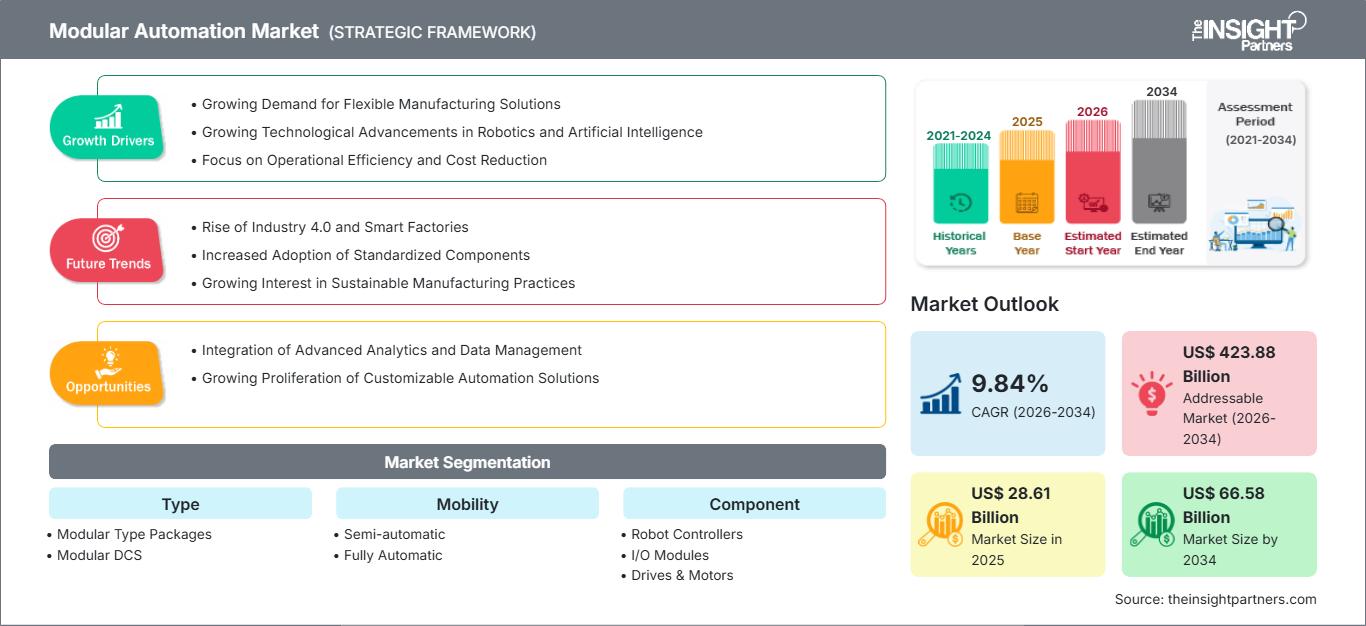
The Modular Automation Market size is expected to reach US$ 66.58 Billion by 2034 from US$ 28.61 Billion in 2025. The market is estimated to record a CAGR of 9.84% from 2026 to 2034.
Key Drivers Fueling Market Growth
Several factors drive the steady adoption of modular automation systems globally:
- Growing Demand for Flexible Manufacturing Solutions: Modern consumer preferences shift rapidly, requiring manufacturers to produce shorter product runs and diverse product portfolios. Modular automation allows factories to adjust lines quickly without investing in entirely new machinery.
- Technological Advancements in AI and Robotics: Rapid progress in artificial intelligence, machine learning, and advanced robotics has elevated the performance of modular control systems. Smart algorithms improve real-time process optimization, predictive maintenance, and quality check capabilities.
- Focus on Operational Efficiency and Capital Optimization: Businesses face ongoing pressure to cut costs and boost operational efficiency. Modular setups allow incremental capital investments, enabling companies to expand system capacities step by step rather than making large upfront financial commitments.
Download Sample Report@ https://www.theinsightpartners.com/sample/TIPRE00039542
Key Opportunities
- Integration of Advanced Analytics and Big Data Management: Combining modular control architectures with data management frameworks offers significant opportunity. Modern systems gather real-time process data from sensor networks to identify bottlenecks, optimize energy usage, and streamline overall equipment effectiveness (OEE).
- Expansion of Highly Customizable Automation Frameworks: As industrial application requirements vary across specialized sectors, demand for tailorable hardware and software modules continues to surge. Solution providers offering custom-configured modular modules stand to capture substantial market share.
Market Segmentation
The modular automation market is categorized into distinct segments based on type, mobility, component, and end-user industry:
By Type
- Modular Type Packages (MTP): Open communication standards that enable seamless integration of decentralized equipment modules into higher-level management systems.
- Modular Distributed Control Systems (DCS): Decentralized control networks providing modular hardware and software scalability for process plants.
By Mobility
- Semi-Automatic Systems: Require human interaction for specific process steps while automating primary operational tasks.
- Fully Automatic Systems: Unattended automated setups designed for continuous, high-throughput manufacturing.
By Component
- Robot Controllers
- Input/Output (I/O) Modules
- Drives and Motors
- Sensors and Actuators
- Safety Components
By End-User Industry
- Pharmaceutical: Rapid validation and flexible batch processing.
- Chemical: Agile production of specialized chemicals with decentralized process control.
- Food and Beverage: Quick line changeovers for packaged goods and varied product sizes.
- Logistics and Warehousing: Automated sorting, picking, and material handling systems.
- Others: Electronics assembly, automotive sub-systems, and consumer packaging.
Market News and Recent Developments
The industrial landscape is actively adopting Industry 4.0 paradigms and smart factory concepts. Major industry developments highlight key trends shaping the space:
- Standardization across Industrial Interoperability: Industry leaders are increasingly adopting standardized communication protocols like MTP and OPC UA. Standardized interfaces reduce engineering integration time and streamline multi-vendor hardware deployments.
- Focus on Sustainable Manufacturing: Modular equipment reduces resource waste and optimizes power usage. Solution providers are building energy-efficient drives and intelligent power-saving operational modes into their modular platforms.
- Rise of Industrial Internet of Things (IIoT): Embedded IIoT connectivity enables remote monitoring, predictive diagnostics, and cloud-based operational controls across distributed modular units.
Competitive Landscape and Top Players
The global modular automation market features a mix of established multinational automation conglomerates, specialized component developers, and custom system integrators. Key market participants focus on continuous product innovation, strategic partnerships, and modular platform expansions to maintain competitiveness.
Key Market Players
- ABB Ltd.
- Siemens AG
- Festo Inc.
- Yokogawa Electric Corporation
- HIMA Paul Hildebrandt GmbH
- Ginolis Ltd.
- Inniti
- Innovative Automation Pvt. Ltd.
- Sojka Automation GmbH
- Messung Industrial Automation & Controls
Get Full Copy of This Report @ https://www.theinsightpartners.com/buy/TIPRE00039542
Future Outlook
The modular automation market is set for sustained multi-year expansion through 2034. As smart factories become standard across chemical, pharmaceutical, logistics, and food processing industries, modular architectures will remain critical for achieving operational resilience, rapid production scalability, and long-term cost efficiencies. Continued convergence of robotics, IIoT networks, and standardized software protocols will solidify modular automation as a foundation of future industrial manufacturing.
About The Insight Partners
The Insight Partners provides comprehensive syndicated and tailored market research services in the healthcare, technology, and industrial domains. Renowned for delivering strategic intelligence and practical insights, the firm empowers businesses to remain competitive in ever-evolving global markets.
Contact Information
- Email: sales@theinsightpartners.com
- Website: theinsightpartners.com
- Phone: +1-646-491-9876
