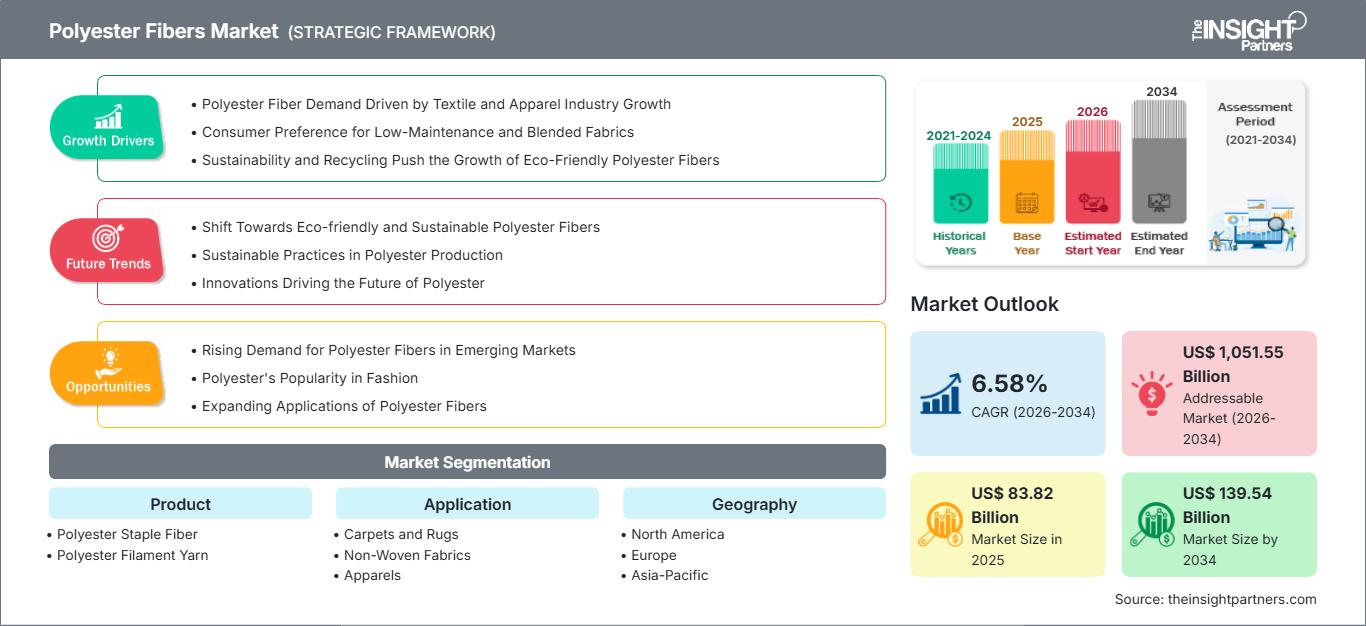
Look at the tag on your shirt, your car seat, or the rug under your feet. There is a good chance polyester fiber holds it all together. The Polyester Fibers Market keeps growing because this one material fits so many jobs at once. It was valued at US$ 83.82 Billion in 2025 and is expected to reach US$ 139.54 Billion by 2034. That marks a strong 6.58% CAGR across the 2026 to 2034 forecast period. Textile and industrial demand together keep this growth steady and broad-based.
What Is the Polyester Fibers Market?
Polyester fiber is a synthetic material made mainly from petroleum-based sources. It offers strength, durability, and low cost, which makes it useful across clothing, home goods, and industrial products. Manufacturers value it for how easily it blends with other fibers too.
Market Drivers
Apparel demand remains the biggest driver here. Polyester holds its shape, resists wrinkles, and costs less than many natural fibers. As fast fashion and everyday clothing brands keep expanding, polyester fiber orders keep rising alongside them.
Request a Sample Copy of the Report: https://www.theinsightpartners.com/sample/TIPRE00023808
Home textiles add real momentum too. Curtains, bedding, and upholstery fabrics often use polyester for its durability and easy care. As more household’s upgrade home furnishings, this steady demand keeps flowing into the market.
What makes this particularly significant is the rise of non-woven fabric use. Hygiene products, filtration materials, and medical textiles all rely on non-woven polyester, and this segment grew sharply after global health concerns pushed hygiene product demand higher across many regions.
Beyond that, carpet and rug manufacturers value polyester for its stain resistance and soft feel. This is not just a niche preference, it reflects a broader shift as polyester carpets increasingly replace older nylon and wool options in both homes and commercial spaces.
Segmentation Overview
Segments Covered
By Product: Polyester Staple Fiber (PSF), Polyester Filament Yarn (PFY), and Others serve different manufacturing needs. PSF suits spun yarns and non-woven products, while PFY offers smoother, continuous strands used widely in apparel and home textiles.
By Application: Carpets and Rugs, Non-Woven Fabrics, Apparels, Home Textiles, and Others show the wide reach of this fiber. Apparel remains the largest application, while non-woven fabrics post some of the fastest growth thanks to hygiene and medical demand.
By Geography: North America, Europe, Asia Pacific, and South and Central America each show rising demand. Asia Pacific dominates on manufacturing scale, while North America and Europe lean more toward specialty and recycled fiber applications.
Key Market Players
- Stein Fibers, Ltd.
- Reliance Industries Limited
- Toray Industries, Inc.
- Nirmal Fibres Private Limited
- Tongkun Group Co., Ltd.
- Indorama Ventures Public Company Limited
- Jiangsu Shenghong Co., Ltd.
- Green Group S.A.
- Märkische Faser GmbH
- ESTAL Packaging, S.A.
This market brings together large integrated producers and specialty fiber makers. Reliance Industries, Indorama Ventures, and Tongkun Group operate at massive scale, supplying fiber to textile mills worldwide. Firms like Green Group and Märkische Faser focus more on recycled and specialty fiber niches.
Sustainability and Innovation Trends
Recycled polyester is reshaping the industry fast. Made from recovered plastic bottles and textile waste, it offers a lower environmental footprint than virgin polyester. Major apparel brands now set public targets for recycled fiber use, which pushes producers to scale up supply.
Bio-based polyester is also gaining research attention. Producers are testing plant-derived feedstocks as alternatives to petroleum-based inputs. While still a small share of total output, this segment is growing as sustainability pressure builds across the textile supply chain.
Fiber-to-fiber recycling technology is advancing too. This is not just an incremental improvement, it represents a real shift toward closed-loop production, where old polyester garments become the raw material for new ones instead of ending up in landfills.
Buy Premium Report: https://www.theinsightpartners.com/buy/TIPRE00023808
Regional Outlook
Asia Pacific leads the market by a wide margin. Massive textile manufacturing bases in China, India, and Southeast Asia keep polyester fiber production and consumption high. Low-cost labour and strong export industries add further support across the region.
North America shows steady demand, increasingly shaped by sustainability preferences. Brands here push harder for recycled fiber content, and specialty applications like automotive textiles and filtration materials keep local demand diverse.
Europe blends regulation with innovation. Strict environmental rules push producers toward recycled and cleaner production methods faster than in other regions. Germany and Italy remain strong hubs for specialty and technical polyester fiber production.
South and Central America show steady, rising demand tied to expanding apparel and home textile manufacturing. Local production capacity is growing slowly, though the region still relies heavily on imports for higher-value fiber types.
Related Reports:
About The Insight Partners
The Insight Partners is among the leading market research and consulting firms in the world. We take pride in delivering exclusive reports along with sophisticated strategic and tactical insights into the industry. Reports are generated through a combination of primary and secondary research, solely aimed at giving our clientele a knowledge-based insight into the market and domain. This is done to assist clients in making wiser business decisions. A holistic perspective in every study undertaken forms an integral part of our research methodology and makes the report unique and reliable.
Contact Us:
If you have any queries about this report or if you would like further information, please contact us:
Phone: +1-646-491-9876
E-mail: sales@theinsightpartners.com
Also Available in: Korean | German | Japanese | French | Chinese | Italian | Spanish
