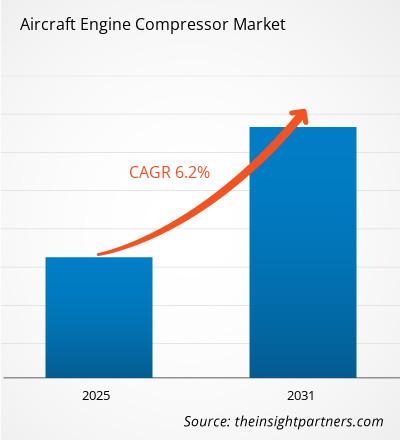
The global aviation industry is experiencing steady modernization driven by rising commercial passenger traffic, fleet expansions, and ongoing technological innovations in propulsion systems. As core components in modern turbofan, turbojet, and turboprop engines, aircraft engine compressors play an essential role in dictating overall fuel efficiency, compression efficiency, thermal management, and noise performance.
The Aircraft Engine Compressor Market size is expected to reach US$ 18.89 Billion by 2034 from US$ 9.88 Billion in 2025. The market is estimated to record a CAGR of 7.46% from 2026 to 2034.
This robust market expansion reflects increased global demand for both new aircraft deliveries (line-fit) and aftermarket maintenance, repair, and overhaul (MRO) activities. As engine original equipment manufacturers (OEMs) continuously seek to boost fuel efficiency and meet stringent decarbonization targets set by international regulatory bodies, high-performance compressor assemblies have become a major focal point for aerospace engineering research and development.
Key Market Drivers and Technological Advancements
Surging Air Traffic and Commercial Aircraft Deliveries- Emerging markets across Asia-Pacific, Latin America, and the Middle East are experiencing accelerated demand for air travel. To meet this surging passenger demand, major commercial airlines are modernizing their fleets with next-generation single-aisle and wide-body aircraft, creating long-term demand for advanced compressor components.
Integration of Lightweight Materials and Composites- Manufacturers are increasingly replacing traditional heavy metallic components with high-temperature titanium alloys, nickel-based superalloys, and Ceramic Matrix Composites (CMCs). High-pressure compressors (HPC) and low-pressure compressors (LPC) utilizing advanced materials allow engines to operate efficiently under elevated temperatures and pressures without compromising structural integrity.
Transition Toward Additive Manufacturing and Blisks- The adoption of integrated bladed disks (blisks) produced via 3D printing and advanced CNC machining has revolutionized compressor architecture. Blisks reduce aerodynamic drag, minimize overall engine weight, reduce component counts, and significantly enhance overall fuel economy.
Focus on Sustainable Aviation and Reduced Emissions- Aviation regulatory authorities worldwide have established strict guidelines to reduce carbon emissions and jet noise levels. Advanced compressor configurations optimize airflow compression and combustion efficiency, serving as a vital lever for lowering specific fuel consumption (SFC) and overall environmental impact.
Get a PDF Sample- https://www.theinsightpartners.com/sample/TIPRE00020695
Key Market Players
The global aircraft engine compressor landscape is characterized by a mix of major global engine OEMs, specialized component manufacturers, and advanced tier-1 aerospace suppliers. Key prominent players operating in this market include:
Bharat Forge
CFM International
GE Aviation
Honeywell International Inc.
Melrose Industries Plc
MTU Aero Engines AG
Rolls-Royce Holdings Plc.
Safran SA
Turbocam Inc.
Collins Aerospace
These industry players continue to invest heavily in additive manufacturing, digital twin technologies, predictive engine monitoring, and strategic supply chain partnerships to strengthen their market presence and meet delivery schedules.
Get Full Copy of This Report- https://www.theinsightpartners.com/buy/TIPRE00020695
Segment Analysis
By Engine Type: The market spans compressors utilized across turbofan, turbojet, turboprop, and turboshaft propulsion systems. Turbofan engines maintain the dominant share due to their widespread use across commercial and narrow-body passenger fleets.
By Component Configuration: High-pressure compressor (HPC) assemblies, low-pressure compressors (LPC), stator vanes, rotor blades, and variable geometry inlet guide vanes form crucial sub-segments.
By Fit Type: The industry is broadly categorized into Line Fit (OEM installations on brand-new aircraft) and Retrofit/MRO (replacement and maintenance services on operational engine fleets).
Future Outlook
The future of the aircraft engine compressor market looks exceptionally promising as the global aerospace sector transitions toward hybrid-electric architectures, ultra-high bypass ratio (UHBR) turbofans, and adaptive-cycle propulsion systems. Over the coming decade, compressor designs will incorporate advanced sensor technologies and real-time health monitoring capabilities to enable predictive maintenance and minimize unexpected operational downtime. Furthermore, as Sustainable Aviation Fuels (SAF) become more integrated into commercial aviation, engine compressors will undergo strategic design refinements to ensure seamless fuel compatibility and optimal thermal efficiency. Supported by steady fleet renewals, military defense spending, and material science innovations, the market is well-positioned for sustained economic growth through 2034.
Related Reports-
About Us
The Insight Partners is a one-stop industry research provider of actionable intelligence. We help our clients in getting solutions to their research requirements through our syndicated and consulting research services. We specialize in industries such as Semiconductor and Electronics, Aerospace and Defense, Automotive and Transportation, Biotechnology, Healthcare IT, Manufacturing and Construction, Medical Devices, Technology, Media, and Telecommunications, as well as chemicals and Materials.
Contact Us
If you have any queries about this report or if you would like further information, don’t hesitate to get in touch with us:
Contact Person: Ankit Mathur
E-mail: ankit.mathur@theinsightpartners.com
