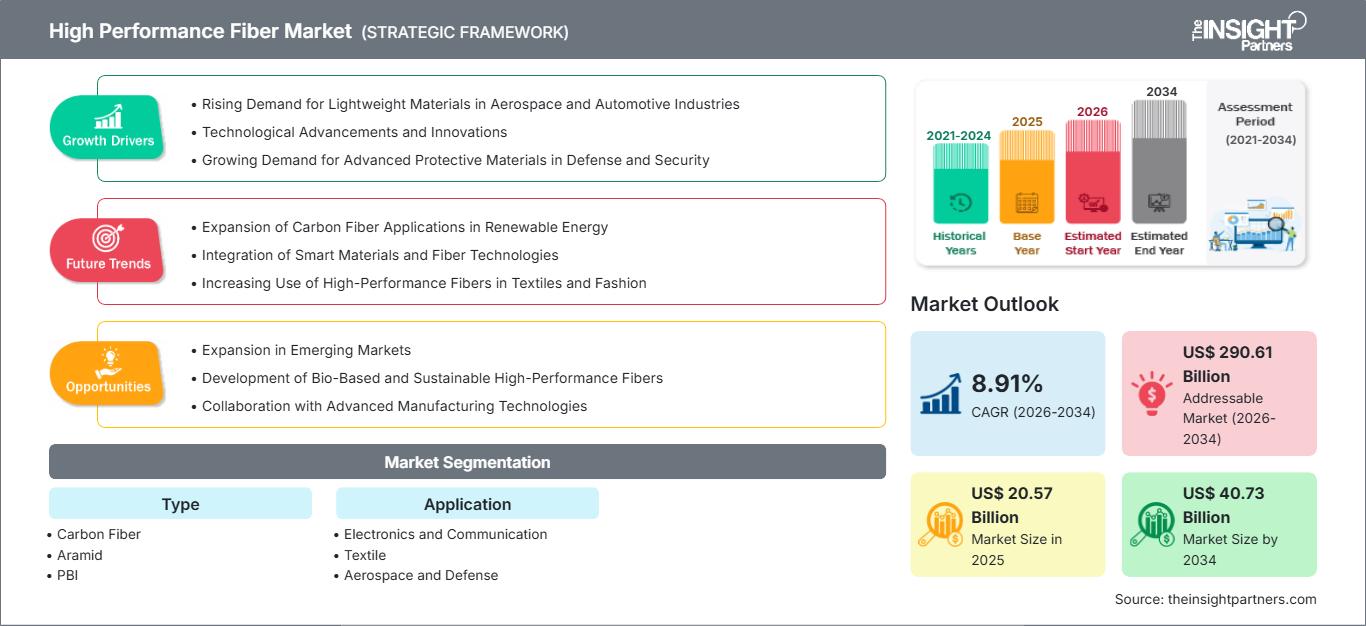
Body armour, wind turbine blades, and fighter jet fuselages don’t share a manufacturing floor, but they often share a material category. High performance fibres are engineered to survive conditions that ordinary textiles simply can’t, extreme heat, ballistic impact, or years of structural stress. The High Performance Fiber Market Size is expected to reach US$ 40.73 Billion by 2034 from US$ 20.57 Billion in 2025, registering a CAGR of 8.91% from 2026 to 2034. Nearly doubling in under a decade puts this market among the faster-growing materials categories tracked today.
What Is a High Performance Fiber?
A high performance fiber is an engineered material, such as carbon fiber, aramid, PBI, PPS, glass fiber, or ceramics, designed to deliver exceptional strength, heat resistance, or chemical stability beyond what conventional fibres can offer. These fibres are used wherever weight reduction and structural reliability matter most.
What’s Driving Growth in the High Performance Fiber Market?
Aerospace and defence remain the anchor demand driver. Aircraft manufacturers keep replacing metal components with carbon fibre composites to cut weight and improve fuel efficiency, while defence procurement continues to specify aramid fibres for body armour and vehicle protection. Neither trend shows signs of slowing.
Request a Sample Copy of the Report: https://www.theinsightpartners.com/sample/TIPRE00040391
Automotive lightweighting is pulling harder each year. What makes this particularly significant is that EV manufacturers need every possible weight reduction to offset battery mass and extend driving range, and carbon fibre composites are increasingly showing up in structural body panels rather than just premium trim components.
Electronics and communication infrastructure add a less obvious but fast-growing demand stream. High performance fibres reinforce everything from 5G antenna housings to circuit board substrates that need to withstand heat and mechanical stress. So what ties fighter jets, EVs, and cell towers together? A shared requirement for materials that stay strong and stable under conditions that would fatigue or fail ordinary fibres within months.
Segments Covered
By Type
Carbon Fiber holds the largest share, driven by aerospace and automotive structural applications.
Aramid fibres remain essential for ballistic protection and heat-resistant industrial applications.
PBI serves niche high-heat applications where few other fibres can perform.
PPS is used where chemical resistance combined with thermal stability is required.
Glass Fiber remains a cost-effective option across construction and general industrial uses.
Ceramics are the fastest-growing type, gaining ground in extreme-heat aerospace and defence applications.
By Application
Aerospace and Defense leads application-based demand, tied to both commercial aircraft and military procurement.
Automotive is the fastest-growing application, propelled by EV lightweighting requirements.
Electronics and Communication rely on high performance fibres for structural and thermal stability.
Textile applications include protective clothing and industrial fabrics requiring durability.
Key Market Players
- Teijin Ltd.
- E. I. du Pont de Nemours and Company
- Yantai Tayho Advanced Materials Co., Ltd.
- Cytec Industries Inc.
- Mitsubishi Rayon Co., Ltd.
- Owens Corning
- PBI Performance Products Inc.
- Koninklijke Ten Cate N.V.
- Kureha Corporation
- Toray Industries Inc.
Competition centres on fibre-grade purity, production scale-up capability, and long-term supply agreements with aerospace and automotive manufacturers, given the lengthy qualification cycles those industries require.
Sustainability and Innovation Trends
Manufacturers are investing in recycled carbon fibre processing, recovering material from aerospace and automotive scrap rather than relying solely on virgin fibre production, which is energy-intensive. Beyond that, bio-based precursor research is advancing for fibres traditionally derived from petroleum feedstocks. This is not just a cost consideration, it reflects a structural shift as aerospace and automotive customers increasingly factor lifecycle emissions into materials procurement decisions.
Buy Premium Report: https://www.theinsightpartners.com/buy/TIPRE00040391
Regional Outlook
North America leads the market, anchored by a concentrated aerospace and defence manufacturing base in the US. Europe follows closely, supported by automotive lightweighting initiatives and aerospace programmes across Germany, France, and the UK. Asia Pacific is the fastest-growing region, as China, Japan, and South Korea scale up carbon fibre production capacity alongside growing EV and electronics manufacturing. South and Central America remain a smaller market, with gradual growth tied to industrial and automotive expansion.
Trending Reports
Thermoplastic Vulcanizate (TPV) Market
Fiber Reinforced Polymer (FRP) Panels and Sheets Market
Thermal Interface Materials Market
About The Insight Partners
The Insight Partners is among the leading market research and consulting firms in the world. We take pride in delivering exclusive reports along with sophisticated strategic and tactical insights into the industry. Reports are generated through a combination of primary and secondary research, solely aimed at giving our clientele a knowledge-based insight into the market and domain. This is done to assist clients in making wiser business decisions. A holistic perspective in every study undertaken forms an integral part of our research methodology and makes the report unique and reliable.
Contact Us:
If you have any queries about this report or if you would like further information, please contact us:
Phone: +1-646-491-9876
E-mail: sales@theinsightpartners.com
Also Available in: Korean | German | Japanese | French | Chinese | Italian | Spanish
