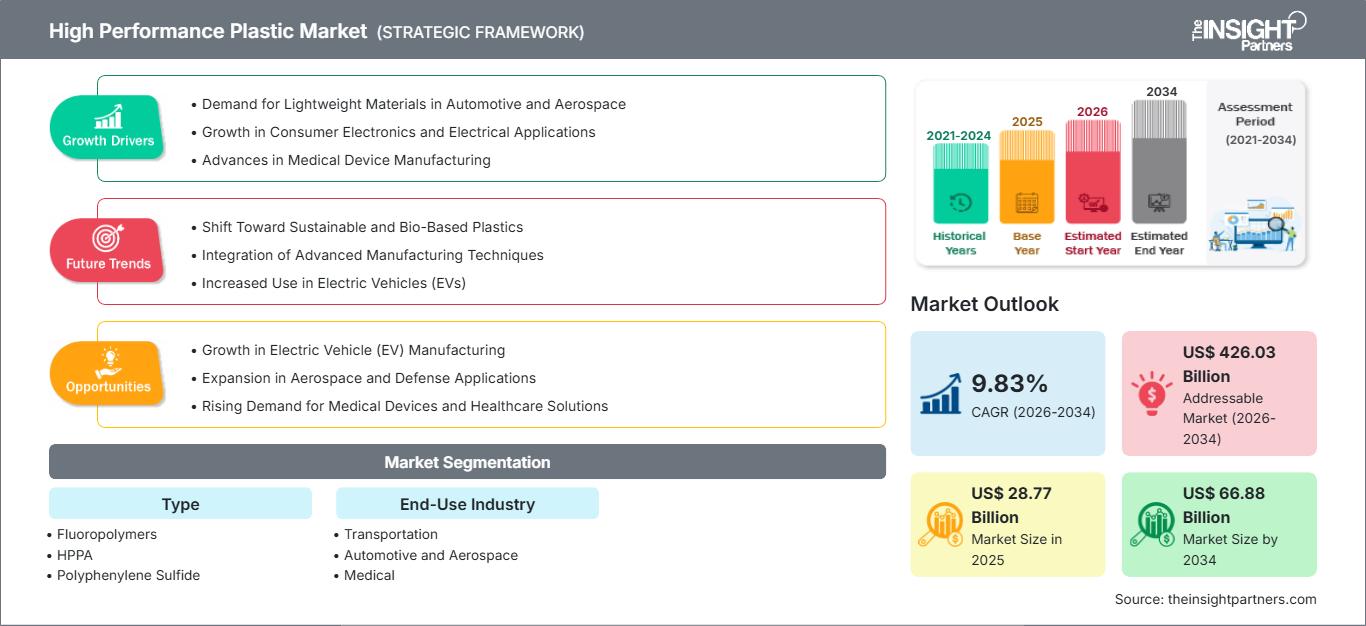
A surgical implant and a downhole oil well component rarely appear in the same sentence, yet both depend on plastics engineered to survive conditions that would melt, crack, or degrade an ordinary polymer. High performance plastics fill that gap wherever metal is too heavy or standard plastic simply can’t hold up. The High-Performance Plastic Market Size is expected to reach US$ 66.88 Billion by 2034 from US$ 28.77 Billion in 2025, registering a CAGR of 9.83% during the forecast period 2026–2034. That pace puts it among the fastest-growing specialty materials categories tracked today.
What Is a High-Performance Plastic?
A high performance plastic is an engineered polymer, such as fluoropolymers, polyphenylene sulfide, liquid crystal polymers, or polyimides, designed to withstand extreme heat, chemical exposure, or mechanical stress far beyond commodity plastics. These materials are used wherever metal replacement or extreme durability is required.
What’s Driving Growth in the High-Performance Plastic Market?
Electric vehicle production is one of the strongest pull factors. Battery housings, connectors, and under-the-hood components need materials that resist heat and chemical exposure without adding weight, and high-performance plastics are replacing metal in more of those parts each year as automakers chase range improvements.
Request a Sample Copy of the Report: https://www.theinsightpartners.com/sample/TIPRE00040411
Medical device manufacturing is expanding just as fast. What makes this particularly significant is how many implantable and surgical device makers are shifting to high performance polymers for their biocompatibility and sterilisation resistance, a combination few materials outside this category can match consistently.
Electronics and oil and gas add further momentum. Miniaturised electronics need materials that handle heat in tight spaces, while oil and gas operators use high performance plastics in seals and components exposed to corrosive downhole conditions. So what connects an EV battery pack, a surgical implant, and a drilling rig seal? All three demand materials that perform reliably where failure isn’t an option, and that requirement keeps expanding into new industries each year.
Segments Covered
By Type
Fluoropolymers hold the largest share, valued for exceptional chemical resistance across industrial applications.
HPPA is gaining traction in automotive components requiring high thermal stability.
Polyphenylene Sulfide is widely used in electronics for its flame resistance and dimensional stability.
Liquid Crystal Polymers are the fastest-growing type, favoured in miniaturised electronic components.
Polyimides serve high-heat aerospace and electronics applications where few alternatives perform as reliably.
By End-Use Industry
Transportation and Automotive and Aerospace lead demand, tied to lightweighting and thermal management needs.
Medical is a fast-growing end-use industry, driven by implantable and surgical device manufacturing.
Oil and Gas relies on these plastics for seals and components in corrosive environments.
Electrical and Electronics uses high performance plastics for insulation and miniaturised component housings.
Key Market Players
- Daikin Industries Ltd.
- Solvay S.A.
- BASF SE
- Evonik Industries AG
- I. du Pont de Nemours and Company
- SABIC
- Celanese Corporation
- Arkema SA
- Victrex Plc
- Kuraray Co., Ltd.
Competition centres on proprietary polymer formulations and long-term supply agreements with automotive and medical device manufacturers, given the rigorous qualification processes those industries require before adopting a new material.
Sustainability and Innovation Trends
Manufacturers are investing in bio-based feedstock research for polymer production, aiming to reduce reliance on petroleum-derived raw materials without sacrificing performance characteristics. Beyond that, recycling technology for high performance plastics is advancing, though it remains more complex than commodity plastic recycling due to the materials’ chemical resistance. This is not just a compliance response, it reflects a structural shift as automotive and electronics customers increasingly factor lifecycle impact into materials sourcing decisions.
Buy Premium Report: https://www.theinsightpartners.com/buy/TIPRE00040411
Regional Outlook
Asia Pacific leads the market, driven by China, Japan, and South Korea’s dominant electronics manufacturing base and expanding EV production. North America follows, supported by aerospace, medical device, and oil and gas demand concentrated in the US. Europe holds a steady share, with automotive lightweighting initiatives and a strong specialty chemicals sector across Germany, France, and the UK. South and Central America remain a smaller market, with gradual growth tied to industrial and automotive expansion.
Trending Reports
Thermal Interface Materials Market
About The Insight Partners
The Insight Partners is among the leading market research and consulting firms in the world. We take pride in delivering exclusive reports along with sophisticated strategic and tactical insights into the industry. Reports are generated through a combination of primary and secondary research, solely aimed at giving our clientele a knowledge-based insight into the market and domain. This is done to assist clients in making wiser business decisions. A holistic perspective in every study undertaken forms an integral part of our research methodology and makes the report unique and reliable.
Contact Us:
If you have any queries about this report or if you would like further information, please contact us:
Phone: +1-646-491-9876
E-mail: sales@theinsightpartners.com
Also Available in: Korean | German | Japanese | French | Chinese | Italian | Spanish
