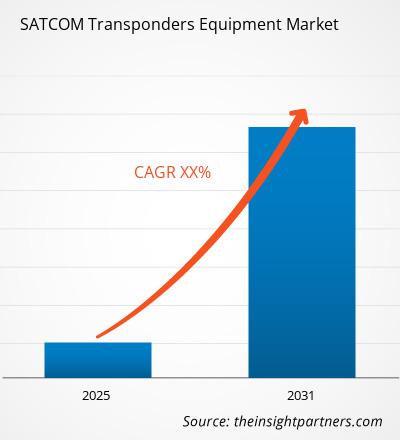
The global satellite communications (SATCOM) landscape is experiencing a profound transformation, driven by an expanding demand for high-bandwidth connectivity, continuous advancement in low Earth orbit (LEO) constellations, and an increasing reliance on satellite networks across commercial, civil, and defense domains. At the core of these satellite systems are SATCOM transponders and their associated onboard equipment—critical hardware responsible for receiving, amplifying, up-converting, and retransmitting signals across vast terrestrial distances.
According to a comprehensive industry report published by The Insight Partners, the global SATCOM Transponders Equipment Market size is projected to reach US$ 33.16 billion by 2034 from US$ 17.67 billion in 2025. The market is anticipated to register a CAGR of 7.25% during the forecast period 2026-2034. This substantial growth reflects increasing investments in next-generation satellite constellations, heightened defense spending on resilient communication architecture, and soaring data consumption across aviation, maritime, and remote enterprise operations.
Industry Overview & Key Market Drivers
SATCOM transponder equipment encompasses a broad range of high-frequency hardware components, including power amplifiers (such as Traveling Wave Tube Amplifiers and Solid-State Power Amplifiers), low-noise block downconverters (LNBs), multiplexers, synthesizers, and channelizers. These systems function as the fundamental link between ground control hubs and orbital payloads, enabling seamless data, voice, and video transmission.
Several key trends are steering the market toward unprecedented expansion:
Proliferation of SmallSat and LEO Constellations: The industry is moving from traditional, heavy Geostationary Earth Orbit (GEO) satellites toward massive constellations operating in Low Earth Orbit (LEO) and Medium Earth Orbit (MEO). LEO satellites offer significantly lower latency and higher coverage density, requiring compact, highly efficient, and lightweight SATCOM transponder hardware to manage signal routing.
Soaring Demand for Airborne and Maritime Connectivity: Modern commercial airlines, maritime fleets, and offshore logistics networks increasingly view continuous, high-speed Wi-Fi as a necessity rather than a luxury. In-Flight Connectivity (IFC) and maritime broadband systems rely heavily on multi-band transponders capable of switching across Ku, Ka, and Q/V bands without signal degradation.
Defense Modernization and Secure Communications: Geopolitical tensions and evolving defense doctrines have forced military organizations worldwide to modernize their Satellite Communications Beyond Line-of-Sight (SATCOM BLOS) infrastructure. Secure, anti-jamming, and radiation-hardened transponder equipment is critical for tactical communications, unmanned aerial vehicles (UAVs), and naval command systems.
Shift Toward High-Throughput Satellites (HTS) and VHTS: High-Throughput Satellite systems utilize frequency re-use and spot-beam technology to significantly boost total bandwidth capacity. This transition demands advanced transponders with higher power efficiency, dynamic channel allocation, and digital transparent processing capabilities.
Get a PDF Sample- https://www.theinsightpartners.com/sample/TIPRE00021514
Strategic Market Segmentation Insights
The market for SATCOM transponders equipment is segmented by frequency band, equipment type, satellite orbit, and end-user vertical.
By Bandwidth/Frequency: Ku-band and Ka-band transponders currently lead adoption due to their widespread use in commercial broadband, direct-to-home (DTH) broadcasting, and tactical military networks. Meanwhile, emerging Q/V and E-band technologies are seeing accelerated research and deployment to address bandwidth congestion in lower frequency bands.
By Orbital Layer: While Geostationary orbit (GEO) transponders continue to handle extensive broadcasting and high-power broad-coverage tasks, Non-Geostationary Orbit (NGSO) transponder hardware is experiencing the highest relative compound growth rate.
By End-User Sector: Commercial enterprises, telecommunications operators, government agencies, and military forces form the primary consumer base, with commercial aviation and maritime defense logistics representing high-yield adoption channels.
Key Market Players
The market landscape is characterized by established aerospace defense contractors, satellite systems integrators, and specialized RF technology developers. These key players are actively investing in research and development, strategic partnerships, and modular transponder designs to secure a competitive edge:
Antwerp Space
Airbus S.A.S.
Ball Corporation
General Dynamics Corporation
ISISPACE GROUP
Honeywell International Inc.
L3Harris Technologies, Inc.
Maxar Technologies
Mitsubishi Electric Corporation
Oxford Space Systems
These organizations are focused on reducing payload mass, improving power-to-weight ratios, and integrating software-defined technology into transponder architectures to permit remote orbital reconfiguration.
Get Full Copy of This Report- https://www.theinsightpartners.com/buy/TIPRE00021514
Regional Analysis
North America currently dominates a major portion of the global revenue, fueled by substantial budget allocations from defense agencies, early adoption of LEO satellite internet services, and a concentration of major aerospace manufacturing hubs. Europe follows closely, driven by initiatives from regional space agencies and European telecommunication satellite operators investing heavily in secure European satellite architecture.
Meanwhile, the Asia-Pacific region is projected to register the fastest growth rate over the forecast period (2026–2034). Rapid urbanization, expansion of space programs in emerging economies, digital transformation in rural regions, and surging demand for maritime surveillance in the Indo-Pacific are driving infrastructure investments across the region.
Future Outlook
The future of the global SATCOM transponders equipment market points toward unprecedented software integration, miniaturization, and flexible payload capabilities. Over the next decade, the industry will transition rapidly toward Software-Defined Transponders (SDTs) and fully digital payloads that allow operators to reconfigure frequency, bandwidth, and coverage beams on-demand directly from ground stations. Furthermore, as optical satellite communications (laser communication terminals) continue to mature alongside traditional Radio Frequency (RF) systems, hybrid optical-RF transponders will emerge as a vital standard to process multi-gigabit data streams across orbital networks. Supported by steady global investments in space tech infrastructure and an unyielding global appetite for real-time connectivity, the SATCOM transponders equipment market is well-positioned for robust expansion through 2034 and beyond.
Related Reports-
About Us
The Insight Partners is a one-stop industry research provider of actionable intelligence. We help our clients in getting solutions to their research requirements through our syndicated and consulting research services. We specialize in industries such as Semiconductor and Electronics, Aerospace and Defense, Automotive and Transportation, Biotechnology, Healthcare IT, Manufacturing and Construction, Medical Devices, Technology, Media, and Telecommunications, as well as chemicals and Materials.
Contact Us
If you have any queries about this report or if you would like further information, don’t hesitate to get in touch with us:
Contact Person: Ankit Mathur
E-mail: ankit.mathur@theinsightpartners.com
