The global industrial sector is experiencing a significant shift toward automated, precise, and high-strength fastening solutions. Stud welding machines—specialized equipment designed to weld metal fasteners, threaded studs, or unthreaded pins onto a metal substrate—have become essential across diverse manufacturing industries. Known for producing strong, invisible, and reliable joints without compromising the structural integrity or appearance of the base metal, these systems are critical in high-stress, high-volume production environments.
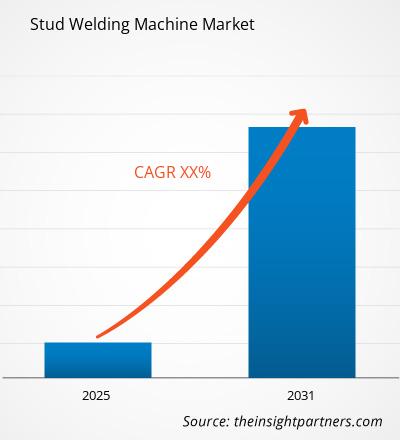
The global Stud Welding Machine Market size is projected to reach US$ 1.94 billion by 2034 from US$ 1.32 billion in 2025. The market is anticipated to register a CAGR of 4.33% during the forecast period 2026-2034. This steady expansion is largely propelled by the rapid expansion of the automotive manufacturing sector, continuous investments in global infrastructure projects, and the growing integration of robotic automation in heavy industries.
Key Market Drivers and Trends
1. Automotive Lightweighting and Electric Vehicle (EV) Production
Automotive manufacturers are under continuous pressure to meet stringent emissions standards and improve fuel efficiency, leading to the adoption of lightweight materials such as aluminum and high-strength steel alloys. Stud welding plays a pivotal role in assembling these materials, especially in vehicle chassis, heat shields, and battery tray enclosures for electric vehicles. Drawn arc stud welding and capacitor discharge stud welding techniques offer high precision without causing thermal distortion, making them ideal for delicate modern automotive architectures.
2. Infrastructure and Construction Boom
In structural engineering and civil construction, stud welding is widely utilized to secure shear connectors on steel beams, bridge decks, and high-rise commercial structures. The global surge in urbanization, along with government investments in smart cities and transportation infrastructure, continues to drive demand for heavy-duty drawn arc stud welding machines capable of high-amperage, long-cycle operations.
3. Transition Toward Industrial Automation
Industry 4.0 integration has transformed stud welding from a manual process into an automated, highly efficient system. Modern stud welding units feature digital microprocessors, real-time welding parameter monitoring, robotic hand-held guns, and fully automated CNC feeding systems. These advancements minimize human error, reduce cycle times, and improve overall operational safety in manufacturing plants.
Get a PDF Sample- https://www.theinsightpartners.com/sample/TIPRE00022738
Segment Highlights
By Technology: The market is primarily segmented into Capacitor Discharge (CD) Stud Welding, Drawn Arc (DA) Stud Welding, and Short Arc Stud Welding. Capacitor discharge technology holds a significant share in sheet metal fabrication and light-duty applications due to its fast discharge times and minimal thermal impact. Drawn arc technology remains dominant in structural, shipbuilding, and heavy machinery industries.
By Operation: Automated and robotic stud welding systems are gaining traction over manual systems due to the rising need for high repeatability, consistency, and elevated production rates in mass-assembly facilities.
By End-Use Industry: The key end-use sectors include Automotive, Construction & Structural Engineering, Shipbuilding, Energy & Electrical Equipment, and Industrial Machinery.
Regional Analysis
Asia-Pacific: Expected to command the largest market share during the forecast period, driven by aggressive industrialization, rising vehicle manufacturing in China and India, and major public infrastructure projects.
North America & Europe: Driven by established automotive manufacturing hubs, advanced aerospace engineering, and strict industrial safety standards. These regions are seeing accelerated adoption of robotic, automated stud welding units to counter high labor costs and boost yield.
Key Players
The global stud welding machine market is characterized by a mix of established international manufacturers and specialized regional vendors focusing on continuous product engineering, strategic partnerships, and geographic expansion. Key players operating in the market include:
Heinz Soyer Bolzenschweißtechnik GmbH
Nelson Fastener Systems
HBS Bolzenschweiß-Systeme GmbH
Köco GmbH
Taylor Studwelding Systems Ltd
Nippon Stud Welding Co., Ltd
Bolte GmbH
Stud Welding Products Ltd
Tru-Weld Stud Welding
Image Industries Inc.
Get Full Copy of This Report- https://www.theinsightpartners.com/buy/TIPRE00022738
Future Outlook
Looking ahead, the global stud welding machine market is poised for robust development as manufacturers increasingly prioritize energy-efficient equipment, digital process control, and adaptive welding power sources. The ongoing growth of the electric vehicle market, coupled with rising investments in renewable energy infrastructure (such as offshore wind turbine manufacturing and solar mounting structures), will present lucrative opportunities for market players. Furthermore, advancements in lightweight alloys and dissimilar metal joining technologies are expected to broaden the application scope of stud welding equipment, securing its critical position in next-generation industrial manufacturing through 2034 and beyond.
Related Reports-
About Us
The Insight Partners is a one-stop industry research provider of actionable intelligence. We help our clients in getting solutions to their research requirements through our syndicated and consulting research services. We specialize in industries such as Semiconductor and Electronics, Aerospace and Defense, Automotive and Transportation, Biotechnology, Healthcare IT, Manufacturing and Construction, Medical Devices, Technology, Media, and Telecommunications, as well as chemicals and Materials.
Contact Us
If you have any queries about this report or if you would like further information, don’t hesitate to get in touch with us:
Contact Person: Ankit Mathur
E-mail: ankit.mathur@theinsightpartners.com
