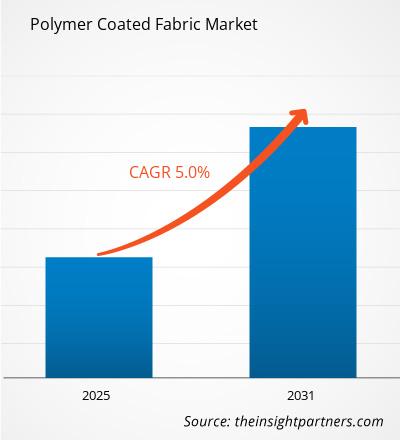
The global Polymer Coated Fabrics Market is witnessing steady expansion, driven by accelerating demand across automotive manufacturing, protective clothing, industrial filtration, architectural membranes, and commercial furniture upholstery. Polymer coated fabrics—comprising base textiles such as woven or nonwoven polyester, nylon, or cotton treated with polymeric layers like polyvinyl chloride (PVC), polyurethane (PU), polyethylene (PE), and silicone—deliver superior mechanical strength, weather resistance, flame retardancy, and chemical durability. The Polymer Coated Fabrics Market size is expected to reach US$ 32.51 Billion by 2034 from US$ 22.04 Billion in 2025. The market is estimated to record a CAGR of 4.98% from 2026 to 2034.
Applying high-performance polymer coatings onto flexible fabric backings enables formulators to engineer materials tailored for extreme operational environments. Coated fabrics protect against intense UV radiation, water ingress, mechanical abrasion, and environmental weathering while maintaining the flexibility and ease of fabrication required for transport seating, protective suits, tarpaulins, and inflatable structures. As end-use industries prioritize lightweighting, safety compliance, and extended product lifespans, polymer coated textiles remain indispensable functional components across global supply chains.
Download Exclusive Sample PDF of the Polymer Coated Fabrics Market Study — https://www.theinsightpartners.com/sample/TIPRE00040375
Key Market Report Drivers
Surging Demand in the Automotive and Transportation Sectors: Automotive original equipment manufacturers (OEMs) rely extensively on polyurethane and vinyl coated fabrics for vehicle interior seating, airbags, door panels, instrument panels, and convertible tops. These materials offer an optimal balance of abrasion resistance, easy maintenance, tactile comfort, and weight reduction compared to natural leather.
Stringent Workplace Safety Regulations and Protective Apparel Mandates: Occupational health authorities enforce strict personal protective equipment (PPE) standards across chemical handling, firefighting, oil & gas, and industrial maintenance. High-barrier polymer coated fabrics protect workers against toxic chemical splashes, hazardous biological agents, thermal extreme exposure, and physical tears.
Advancements in Coating Technologies and Sustainable Polymers: Continuous innovations in waterborne polyurethane dispersions, bio-based resin coatings, and solvent-free processing techniques enable manufacturers to produce low-VOC, eco-friendly coated textiles that align with strict global environmental standards without compromising physical durability.
Expansion in Architectural Tensile Structures and Industrial Covers: Increasing adoption of clear-span tensile membrane roofs, weather-resistant awnings, heavy-duty logistics tarpaulins, and agricultural covers drives volume consumption of flame-retardant PVC and PTFE coated polyester fabrics.
Top Players in the Polymer Coated Fabrics Market
The global competitive ecosystem features leading technical textile coaters, specialty polymer formulators, and material science conglomerates focused on coating adhesion, environmental compliance, and multi-functional barrier properties. Key industry players operating in the market include:
Continental AG
Low & Bonar (Freudenberg Performance Materials)
Omnova Solutions Inc. (Syntomer plc)
Saint-Gobain S.A.
Seaman Corporation
Serge Ferrari Group
Sioen Industries NV
Spradling International Inc.
SRF Limited
Trelleborg AB
Buy Complete Report: https://www.theinsightpartners.com/buy/TIPRE00040375
Frequently Asked Questions (FAQs)
What was the global Polymer Coated Fabrics Market size in 2025?
The global polymer coated fabrics market size was valued at US$ 22.04 Billion in 2025.
What is the projected market size and CAGR by 2034?
The market is projected to reach US$ 32.51 Billion by 2034, expanding at a CAGR of 4.98% during the forecast period from 2026 to 2034.
What polymer types are primarily used for coating fabrics?
Polyvinyl chloride (PVC), polyurethane (PU), polyethylene (PE), silicone, and fluoropolymers are the primary polymers used to produce coated fabrics.
Which application segments generate the highest demand for polymer coated fabrics?
Transportation (automotive, aerospace, marine seating, and trims), protective clothing, industrial tarpaulins, and commercial furniture upholstery represent the largest application segments.
About Us
The Insight Partners is a one-stop industry research provider of actionable intelligence. We help our clients get solutions to their research requirements through our syndicated and consulting research services. We specialize in industries such as Semiconductor and Electronics, Aerospace and Defense, Automotive and Transportation, Energy and Utilities, Healthcare, Chemicals and Materials, and Technology.
Contact Us
If you have any queries about this report or would like further information, please contact us:
Contact Person: Sameer Joshi
E-mail: sales@theinsightpartners.com
Phone: +1-646-491-9876
