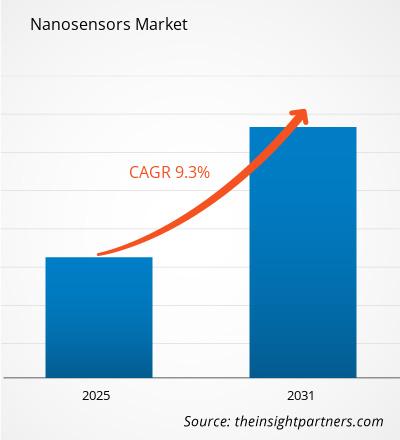
Nanosensors are advanced sensing devices engineered using nanotechnology to detect physical, chemical, and biological changes with exceptional precision and sensitivity. Their ultra-small size, rapid response capabilities, and ability to monitor minute environmental variations make them valuable across healthcare, consumer electronics, automotive, aerospace, environmental monitoring, defense, and industrial applications. Continuous innovations in nanomaterials, miniaturization, and smart sensing technologies are expanding the role of nanosensors in next-generation diagnostic, monitoring, and automation solutions.
According to The Insight Partners, the Nanosensors Market was valued at US$ 1,010.29 Million in 2025 and is projected to reach US$ 2,101.52 Million by 2034, registering a CAGR of 8.48% during the forecast period from 2026 to 2034. Rising advancements in nanotechnology, increasing demand for real-time monitoring systems, and expanding applications across healthcare, automotive, environmental monitoring, and consumer electronics continue to drive long-term market growth.
Key Market Insights
- Market Size (2025): US$ 1,010.29 Million
- Forecast Market Size (2034): US$ 2,101.52 Million
- CAGR (2026–2034): 8.48%
- Key Growth Driver: Advancements in nanotechnology and growing demand for real-time monitoring
- Major Trend: Integration of nanosensors with IoT devices and wearable technologies
- Forecast Period: 2026–2034
Get a Sample PDF of the Report: https://www.theinsightpartners.com/sample/TIPRE00002909
Market Drivers
Advancements in Nanotechnology
Continuous developments in nanotechnology are enabling highly sensitive, accurate, and compact nanosensors capable of detecting molecular-level changes across multiple industrial and healthcare applications.
Growing Demand for Real-Time Monitoring
Industries are increasingly adopting nanosensors for continuous monitoring, predictive diagnostics, environmental analysis, and industrial process optimization, driving widespread deployment.
Increasing Adoption in Healthcare
Nanosensors are gaining importance in biomedical diagnostics, disease detection, personalized medicine, and patient monitoring due to their ability to provide rapid and precise analytical results.
Expanding Consumer Electronics Applications
The growing use of smart devices, wearable electronics, and connected consumer products is creating significant demand for miniaturized sensing technologies with enhanced performance.
Purchase the Premium Research Report: https://www.theinsightpartners.com/buy/TIPRE00002909
Market Trends
Integration with IoT and Wearable Devices
Nanosensors are increasingly being integrated into IoT platforms and wearable technologies to enable continuous monitoring, remote diagnostics, and intelligent data collection.
Healthcare and Biomedical Innovation
Advanced nanosensors are supporting early disease detection, biomarker identification, drug delivery monitoring, and precision healthcare applications.
Environmental Monitoring Solutions
Governments and industries are deploying nanosensors for real-time monitoring of air quality, water quality, soil contamination, and hazardous substances.
Smart Automotive Technologies
Automotive manufacturers are integrating nanosensors into vehicle safety systems, emissions monitoring, engine diagnostics, and intelligent transportation solutions.
Regional Analysis
North America
North America continues to lead the industry due to significant investments in nanotechnology research, advanced healthcare infrastructure, and rapid adoption of smart sensing technologies.
Europe
Europe is witnessing steady growth supported by increasing investments in environmental monitoring, industrial automation, and biomedical research.
Asia Pacific
Asia Pacific is expected to experience the fastest growth owing to expanding electronics manufacturing, healthcare innovation, government support for nanotechnology research, and rapid industrialization.
Middle East and Africa
Growing investments in healthcare modernization, industrial automation, and environmental sustainability initiatives are creating new opportunities across the region.
Competitive Landscape
Leading companies continue investing in nanotechnology research, advanced sensor development, intelligent sensing platforms, and strategic collaborations to strengthen their competitive position and accelerate commercialization of nanosensor technologies.
Key Players
- OMRON Corporation
- Texas Instruments Inc.
- Oxonica
- Lockheed Martin Corporation
- Analog Devices Inc.
- Honeywell International Inc.
- Samsung Electronics Co.
- Robert Bosch GmbH
- Nippon Denso Corp.
- Toshiba Corp.
Emerging Trends
The industry is evolving through AI-enabled sensing platforms, IoT-connected nanosensors, wearable health monitoring devices, biomedical diagnostics, environmental monitoring systems, smart manufacturing, automotive sensing technologies, nanomaterial innovations, precision agriculture, and next-generation industrial automation.
Future Outlook
The Nanosensors Market is expected to witness steady growth through 2034 as advancements in nanotechnology, healthcare diagnostics, Industrial IoT, environmental monitoring, and smart connected devices continue to expand application opportunities. Continuous innovation in nanomaterials, intelligent sensing platforms, and miniaturized electronics will remain key factors supporting long-term industry growth.
Related Market Research Reports
Solar Outdoor LED Lights Market Growth, Trends & Forecast by 2034
Power Distribution Component Market Trends, Size & Forecast by 2034
Tunable Capacitors Market Size, Growth & Trends by 2034
Automotive Intelligent Battery Sensor Market Size, Share by 2034
About The Partners
The Insight Partners is a Insight global leader in market research, delivering comprehensive analysis and actionable insights across diverse industries. The company empowers decision-makers with data-driven intelligence to navigate evolving markets and accelerate growth.
Contact Us:
- Contact Person: Ankit Mathur
- E-mail: ankit.mathur@theinsightpartners.com
- Phone: +1-646-491-9876
Also Available in :
