The global maritime industry is undergoing a digital transformation, driven by the need for enhanced operational efficiency, heightened navigational safety, and compliance with stringent environmental and maritime safety regulations. A pivotal component of this shift is the transition from traditional paper-based nautical charts to advanced digital mapping systems.
Get a PDF Sample- https://www.theinsightpartners.com/sample/TIPRE00017907
Electronic cartography systems primarily Electronic Navigational Charts (ENCs) integrated with Electronic Chart Display and Information Systems (ECDIS) provide mariners with real-time positional awareness, bathymetric data, route planning tools, and hazard detection. By integrating Global Navigation Satellite System (GNSS) feeds, radar overlays, and Automatic Identification System (AIS) data into a dynamic display, electronic charts significantly reduce human error and mitigate the risk of groundings and collisions in congested or complex waterways.
Key Drivers Accelerating Market Growth
Regulatory Mandates and Maritime Safety Standards
The International Maritime Organization (IMO) mandates the installation of ECDIS on commercial vessels subject to Safety of Life at Sea (SOLAS) regulations. As international bodies enforce tighter marine safety protocols, vessel operators worldwide are upgrading legacy systems to modern, hydrographically verified vector chart systems.
Expansion of International Trade & Merchant Fleets
With over 80% of global merchandise trade transported by sea, global shipping activity continues to surge. Commercial operators, cargo carriers, and tanker fleets rely on electronic cartography to optimize routing, reduce voyage times, and optimize fuel consumption amid rising operational costs and decarbonization targets.
Technological Innovations in Cartography and Connectivity
Advances in high-speed satellite connectivity, cloud-based chart updates, and artificial intelligence (AI) are expanding the functionality of electronic mapping systems. Modern electronic charts feature dynamic weather overlays, real-time tidal stream predictions, high-resolution 3D seafloor bathymetry, and automated route safety checks.
Market Forecast-
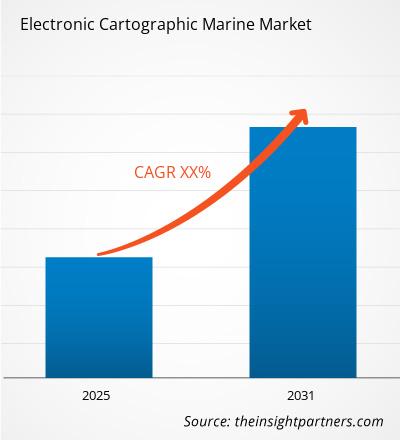
According to a detailed market analysis by The Insight Partners, the global Electronic Cartographic Marine Market size is projected to reach US$ 3.64 billion by 2034 from US$ 1.76 billion in 2025. The market is anticipated to register a CAGR of 8.41% during the forecast period 2026–2034.
Market Segmentation Highlights
The market serves various vessel categories and operational end-users:
Commercial Shipping: Cargo vessels, container ships, and oil tankers account for the largest market share due to mandatory compliance rules and continuous demand for automated route planning.
Defense & Government Operations: Naval forces and coast guards utilize specialized electronic charting software offering tactical data layers, encrypted communications, and custom hydrographic mapping.
Leisure & Recreational Boating: Increasing participation in yachts, motorboats, and recreational fishing vessels particularly in North America and Europe drives demand for consumer-grade cartography software compatible with multi-function displays (MFDs) and mobile devices.
Key Players Operating in the Market
The competitive landscape of the electronic cartographic marine market features leading marine electronics manufacturers, hydrographic data providers, and navigational software developers. Key players highlighted in the report include:
C-MAP
FURUNO ELECTRIC CO., LTD.
GEM elettronica
IIC TECHNOLOGIES
Navionics S.r.l.
Northrop Grumman (Sperry Marine)
Raytheon Anschütz
Simrad
TOKYO KEIKI
Wärtsilä
These key market players focus on continuous technological innovation, strategic alliances with hydrographic offices, and acquisitions to enhance chart precision, improve user interface design, and expand global market coverage.
Get Full Copy of This Report- https://www.theinsightpartners.com/buy/TIPRE00017907
Regional Insights
Asia-Pacific: Represents a key market driven by major maritime hubs, massive shipbuilding facilities in China, Japan, and South Korea, and high shipping traffic through major trade passages like the Malacca Strait.
Europe: Maintains steady demand driven by stringent EU maritime safety standards, strong naval capabilities, and large commercial fleet operators based in major port cities like Rotterdam, Hamburg, and Antwerp.
North America: Supported by commercial coastal trade, substantial defense spending by naval forces, and a large recreational boating market across coastal and inland waters.
Rest of the World: Growing port modernization projects across Latin America, the Middle East, and Africa present significant long-term growth opportunities as regional shipping infrastructure expands.
Future Outlook
Looking ahead, the electronic cartographic marine market is set to enter a transformative phase fueled by autonomous shipping, cloud-native navigation platforms, and next-generation hydrographic standards such as S-100. The adoption of S-100 universal hydrographic data models will enable seamlessly integrated real-time data streaming combining high-definition bathymetry, dynamic surface currents, surface weather, and port operational updates directly onto a unified electronic navigational display. Furthermore, as the maritime sector embraces remote vessel monitoring, cybersecurity frameworks, and AI-driven predictive route optimization to lower carbon emissions, electronic cartography will serve as the foundational spatial intelligence engine. These continuous technological enhancements will ensure sustained market expansion, keeping electronic cartographic solutions central to global maritime safety and efficiency through 2034 and beyond.
Related Reports-
About Us
The Insight Partners is a one-stop industry research provider of actionable intelligence. We help our clients in getting solutions to their research requirements through our syndicated and consulting research services. We specialize in industries such as Semiconductor and Electronics, Aerospace and Defense, Automotive and Transportation, Biotechnology, Healthcare IT, Manufacturing and Construction, Medical Devices, Technology, Media, and Telecommunications, as well as chemicals and Materials.
Contact Us
If you have any queries about this report or if you would like further information, don’t hesitate to get in touch with us:
Contact Person: Ankit Mathur
E-mail: ankit.mathur@theinsightpartners.com
