Advancements in ophthalmic diagnostics are transforming the way eye care professionals evaluate corneal health and refractive conditions. Growing awareness of preventive eye care, coupled with the rising burden of visual impairments, is accelerating the adoption of precision diagnostic equipment worldwide. Healthcare providers are increasingly investing in advanced ophthalmic technologies to improve diagnostic accuracy and patient outcomes.
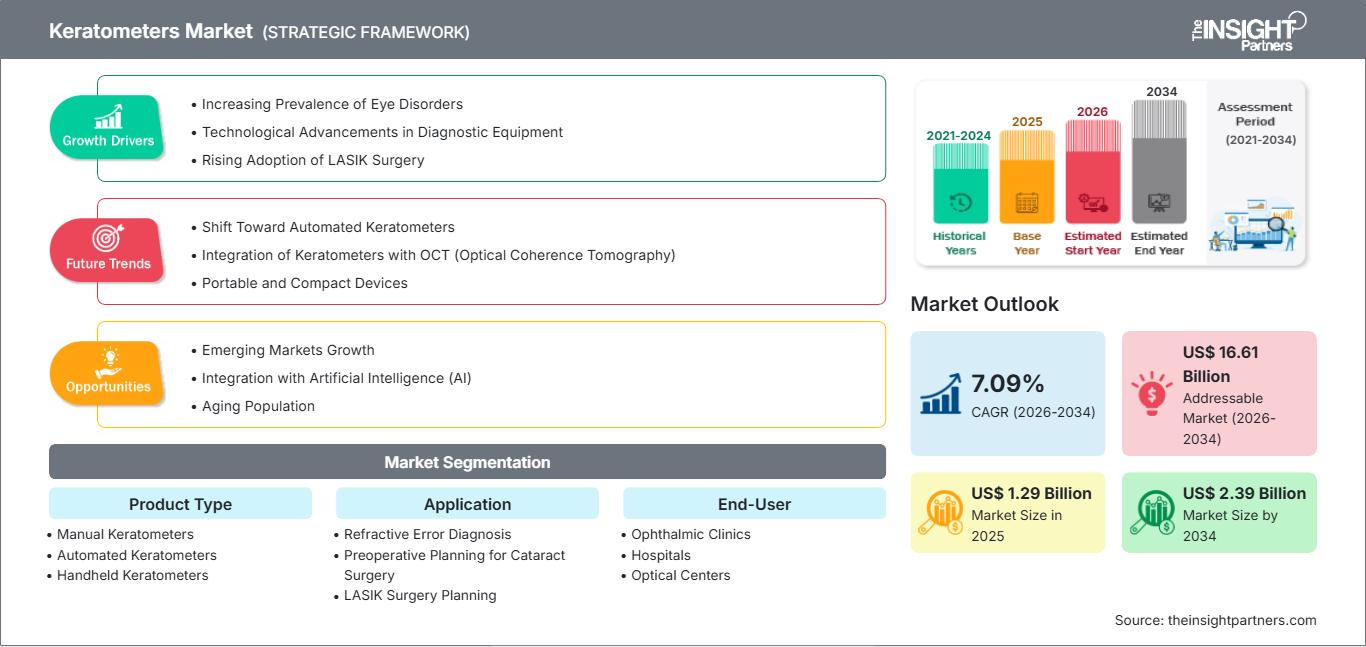
The Keratometers Market was valued at US$ 1.29 billion in 2025 and is projected to reach US$ 2.39 billion by 2034, registering a CAGR of 7.09% during the forecast period of 2026 to 2034. The Keratometers Market is witnessing steady growth as healthcare systems prioritize early diagnosis of eye disorders and preoperative planning for refractive and cataract surgeries. The increasing prevalence of astigmatism, myopia, and age related eye disorders, along with technological advancements in automated ophthalmic equipment, continues to support long term market growth.
Get Sample PDF @ https://www.theinsightpartners.com/sample/TIPRE00040644
Rising Eye Disorders and Surgical Procedures Drive Demand
The increasing incidence of refractive errors and corneal diseases is one of the primary factors fueling industry expansion. Millions of people worldwide require accurate corneal curvature measurements for diagnosis and treatment planning, making keratometers an essential component of modern ophthalmic practice.
Growing demand for cataract surgeries and LASIK procedures is further supporting equipment adoption. Accurate keratometry measurements help ophthalmologists determine intraocular lens power and optimize refractive surgery outcomes. As aging populations continue to increase globally, the number of patients requiring cataract diagnosis and treatment is expected to rise significantly.
Healthcare infrastructure improvements across developing economies are also expanding access to specialized ophthalmic care, creating additional opportunities for manufacturers.
Technological Innovations Enhance Diagnostic Accuracy
Technology remains a major catalyst for growth in the keratometers industry. Manufacturers are introducing automated and digital keratometers that deliver faster, more reliable, and highly accurate corneal measurements while minimizing operator dependency.
Integration with Optical Coherence Tomography (OCT) systems is becoming increasingly common. These integrated diagnostic platforms enable comprehensive assessment of the anterior eye, improving clinical decision making for refractive surgeries and corneal disease management.
Portable and handheld keratometers are also gaining popularity because they allow healthcare professionals to conduct examinations in remote clinics, outreach programs, and mobile healthcare facilities. These compact devices improve accessibility without compromising diagnostic performance.
Artificial intelligence is expected to become an important innovation area by supporting automated image interpretation, enhanced measurement precision, and personalized treatment planning.
Product and Application Segmentation Support Diverse Clinical Needs
The market serves a broad range of diagnostic and surgical applications through multiple product categories.
By product type, the industry includes:
- Manual Keratometers
- Automated Keratometers
- Handheld Keratometers
Automated keratometers continue to experience the strongest adoption due to their superior efficiency, ease of operation, and consistent measurement accuracy.
Major application areas include refractive error diagnosis, preoperative planning for cataract surgery, LASIK surgery planning, and other ophthalmic diagnostic procedures. The increasing popularity of elective vision correction surgeries continues to strengthen equipment demand across hospitals and specialty eye care centers.
Based on end users, ophthalmic clinics represent a significant share owing to their specialized diagnostic capabilities, while hospitals, optical centers, and research institutes also contribute substantially to overall demand.
Regional Landscape Highlights Emerging Opportunities
North America maintains a leading position due to advanced healthcare infrastructure, widespread adoption of innovative ophthalmic technologies, and a large patient population affected by age related eye diseases. The United States continues to represent one of the largest revenue generating countries.
Europe also demonstrates stable growth supported by established healthcare systems, favorable reimbursement environments, and increasing investment in ophthalmic research.
Asia Pacific is expected to record the fastest growth throughout the forecast period. Rapid urbanization, expanding healthcare expenditure, growing awareness regarding vision care, and increasing access to advanced ophthalmology services are contributing to higher demand across China, India, Japan, and other developing economies.
Meanwhile, South and Central America along with the Middle East and Africa present attractive long term opportunities as governments continue investing in healthcare modernization and vision care initiatives.
Competitive Landscape
Leading companies continue investing in product innovation, strategic partnerships, and geographic expansion to strengthen their competitive position. The introduction of intelligent diagnostic systems, compact devices, and integrated ophthalmic platforms remains a key focus area.
Major players operating in the Keratometers Market include:
- Topcon Corporation
- Carl Zeiss AG
- Nidek Co., Ltd.
- Essilor International
- Canon Inc.
- Optikon 2000 S.R.L.
- Haag-Streit Group
- Bausch & Lomb Incorporated
- Medtronic PLC
- Reichert Technologies
These companies continue emphasizing research and development to improve measurement accuracy, workflow efficiency, and patient experience while expanding their global distribution networks.
Interested in Purchasing this Report? Click here @ https://www.theinsightpartners.com/buy/TIPRE00040644
Future Outlook
The Keratometers Market is expected to maintain healthy growth through 2034, supported by the rising prevalence of eye disorders, increasing demand for cataract and refractive surgeries, and continuous technological innovation. The growing adoption of automated and AI enabled diagnostic systems, combined with expanding ophthalmic infrastructure in emerging economies, will create significant opportunities for manufacturers.
Related Report:
1) Colorectal Cancer Diagnostics Market Key Players and Opportunities by 2028
2) C-Reactive Protein Rapid Test Market Growth, Demand & Size by 2034
3) Mesotherapy Market Size and Growth 2031
About Us –
The Insight Partners provides comprehensive syndicated and tailored market research services in the healthcare, technology, and industrial domains. Renowned for delivering strategic intelligence and practical insights, the firm empowers businesses to remain competitive in ever-evolving global markets.
Contact Us:
Ankit Mathur | The Insight Partners
E-mail: ankit.mathur@theinsightpartners.com
Phone: +1-646-491-9876
