The aviation sector is undergoing a profound digital and environmental transformation. As air travel volume recovers and continues to expand worldwide, airport operators are increasingly prioritizing operational efficiency, energy conservation, passenger comfort, and safety. Central to this infrastructure evolution is the adoption of intelligent illumination technologies across airfield grounds, passenger terminals, and landside facilities.
Get a PDF Sample- https://www.theinsightpartners.com/sample/TIPRE00021218
Key Drivers Accelerating Market Expansion
Energy Efficiency and Carbon Neutrality Goals: Airports are high-energy consumers operating 24/7. To align with international environmental targets and achieve Net-Zero carbon emissions, aviation authorities are replacing legacy incandescent and halogen lighting with smart LED systems. Intelligent lighting fixtures equipped with automated dimming, scheduling, and daylight harvesting significantly reduce energy consumption and operational costs.
Surging Air Passenger Traffic and Airport Modernization: The rapid rebound in global air travel has led to increased congestion at major hubs and accelerated the construction of new greenfield airports, particularly across emerging economies in Asia-Pacific and the Middle East. Existing airports are simultaneously undertaking major terminal expansion and runway renovation projects, integrating smart infrastructure from the ground up.
Integration of IoT, Automation, and Sensing Technologies: Smart airport lighting goes beyond mere illumination. Modern installations leverage Internet of Things (IoT) sensors, wireless connectivity, and central management software (CMS). These technologies enable automated fault detection, real-time status monitoring, dynamic lighting control based on passenger density or aircraft movement, and predictive maintenance capabilities, drastically reducing downtime and manual inspection expenses.
Enhanced Safety and Operational Standards: In airside applications such as runway centerlines, taxiway edge lighting, approach lighting systems, and apron illumination visibility and reliability are paramount. Smart lighting solutions provide adaptive brightness, remote control during severe weather conditions, and seamless integration with Advanced Surface Movement Guidance and Control Systems (A-SMGCS) to improve runway safety and tarmac coordination.
Market Forecast
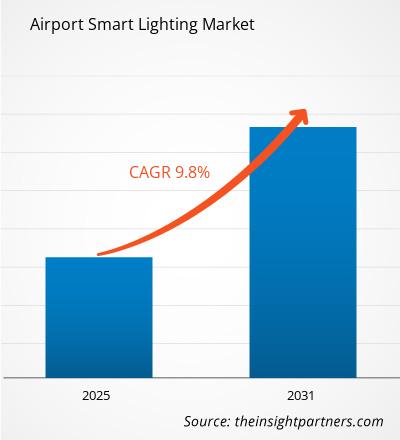
According to market research published by The Insight Partners, the Airport Smart Lighting Market size is expected to reach US$ 2.64 Billion by 2034 from US$ 1.62 Billion in 2025. The market is estimated to record a CAGR of 5.56% from 2026 to 2034.
Market Segmentation Highlights
The global airport smart lighting market is categorized across distinct functional areas within airport facilities:
Terminal Lighting: Modern terminal buildings rely on smart architectural lighting to enhance passenger experience, improve wayfinding, and create dynamic indoor environments. Human-centric lighting (HCL) systems adjust color temperature throughout the day to mirror natural sunlight, reducing travel fatigue and improving ambiance across departure gates, lounges, and retail zones.
Airside Lighting: Encompassing runways, taxiways, aprons, and airfield perimeter zones, airside smart lighting focuses heavily on high durability, extreme weather resistance, automated monitoring, and adherence to strict International Civil Aviation Organization (ICAO) and Federal Aviation Administration (FAA) safety regulations.
Landside Lighting: Covering parking structures, access roads, passenger drop-off zones, and exterior walkways, landside smart lighting enhances security through motion-activated control and automated power management during low-traffic periods.
By component, the market spans Hardware (smart luminaires, sensors, microcontrollers, gateways), Software (centralized lighting management platforms, energy management dashboards), and Services (installation, system integration, continuous support, and maintenance).
Regional Market Dynamics
North America and Europe hold substantial market shares due to stringent environmental regulations, high adoption rates of advanced technologies, and early commitments to green airport initiatives. Major hubs in these regions are systematically retrofitting aging airfield and terminal lighting setups with connected LED infrastructure.
Concurrently, the Asia-Pacific region is projected to register rapid growth during the forecast period. Massive government investments in expanding airport networks in countries like China, India, and Southeast Asian nations are generating high demand for state-of-the-art smart lighting implementations.
Get Full Copy of This Report- https://www.theinsightpartners.com/buy/TIPRE00021218
Key Market Players
The global airport smart lighting landscape is characterized by a mix of established lighting manufacturers, industrial technology giants, and specialized aviation lighting suppliers. Prominent players profiled in the market study include:
AIRPORT LIGHTING SPECIALISTS
C2 SmartLight Oy
Carmanah Technologies Corp.
Eaton
HELLA GmbH and Co. KGaA
Honeywell International Inc.
Koninklijke Philips
OSRAM GmbH
Schreder
Verizon
These companies actively focus on technological innovation, strategic partnerships, product customization, and long-term service contracts with municipal airport authorities and private hub operators to strengthen their market footprint.
Future Outlook
The future of the airport smart lighting market is intrinsically linked to the broader evolution of autonomous and fully connected “smart airport” ecosystems. Over the next decade, integration with Artificial Intelligence (AI) and machine learning algorithms will enable dynamic lighting control systems that automatically optimize energy usage based on real-time flight schedules, weather forecasts, and crowd density analytics. Furthermore, as airports transition toward smart microgrids and renewable energy sources, smart lighting fixtures will serve as vital data-collecting nodes within unified IoT networks, facilitating continuous surface tracking, security monitoring, and environmental sensing. These ongoing technological advancements guarantee that smart lighting will remain an indispensable pillar of modern, sustainable aviation infrastructure well into 2034 and beyond.
Related Report-
About Us
The Insight Partners is a one-stop industry research provider of actionable intelligence. We help our clients in getting solutions to their research requirements through our syndicated and consulting research services. We specialize in industries such as Semiconductor and Electronics, Aerospace and Defense, Automotive and Transportation, Biotechnology, Healthcare IT, Manufacturing and Construction, Medical Devices, Technology, Media, and Telecommunications, as well as chemicals and Materials.
Contact Us
If you have any queries about this report or if you would like further information, don’t hesitate to get in touch with us:
Contact Person: Ankit Mathur
E-mail: ankit.mathur@theinsightpartners.com
