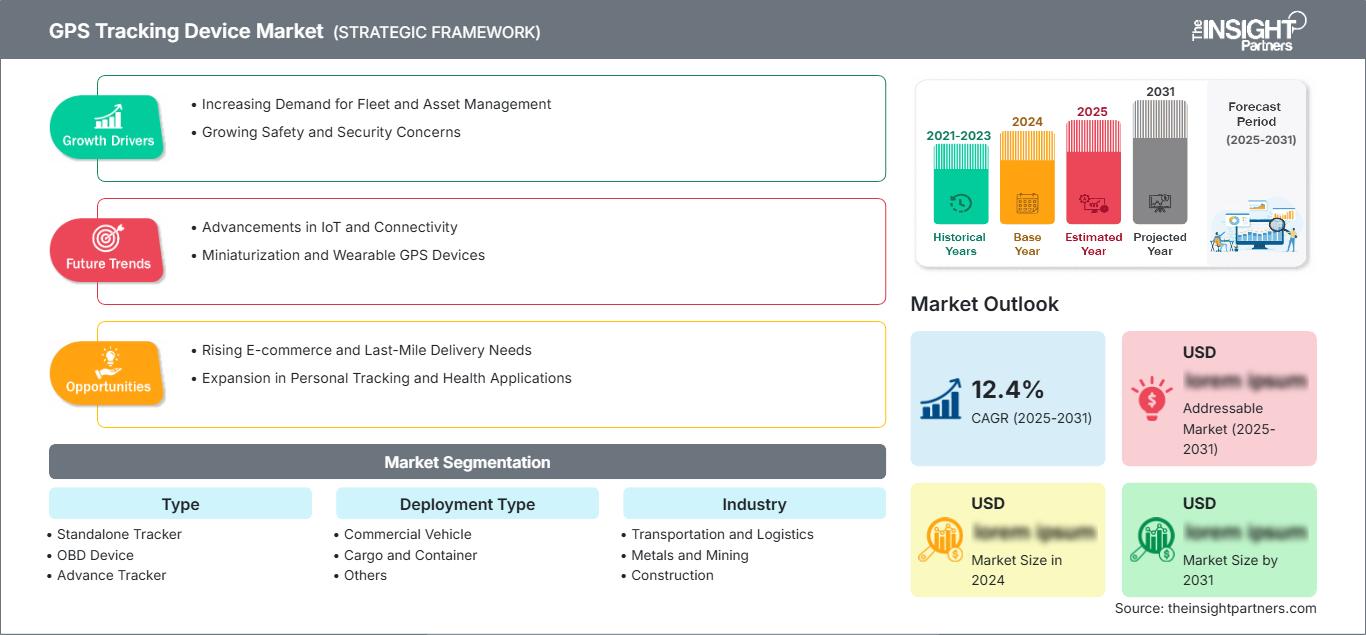
The global GPS tracking device industry is undergoing a significant transformation as organizations increasingly rely on real-time location intelligence to improve fleet visibility, asset security, workforce management, and operational efficiency. Growing digitalization across logistics, transportation, construction, healthcare, agriculture, retail, and public safety has strengthened the demand for advanced tracking technologies capable of delivering accurate positioning and actionable insights. The integration of artificial intelligence, cloud platforms, Internet of Things (IoT), and predictive analytics is enabling organizations to move beyond conventional location monitoring toward intelligent decision-making. Businesses worldwide are also adopting connected mobility solutions to improve customer experiences, enhance regulatory compliance, reduce operational risks, and optimize resource utilization. Continuous technological advancements, combined with increasing investments in smart infrastructure and connected transportation ecosystems, are expected to create substantial opportunities for manufacturers, software providers, and telematics companies over the coming years.
The GPS Tracking Device Market continues to gain momentum as enterprises prioritize digital transformation and intelligent fleet management. Rising adoption of connected vehicles, asset monitoring solutions, wearable tracking devices, and smart logistics platforms is driving innovation across the ecosystem. Industries are increasingly investing in GPS-enabled solutions that provide real-time visibility, geofencing, theft prevention, predictive maintenance, route optimization, and driver behavior monitoring. The growing integration of satellite connectivity, 5G communication, edge computing, and AI-powered analytics is further strengthening the industry’s long-term outlook. Analysts expect technological innovation, expanding industrial applications, and increasing enterprise digitization to support sustained demand through the forecast period.
Get a Sample PDF: https://www.theinsightpartners.com/sample/TIPRE00007508
As industries continue embracing automation, GPS tracking technologies are evolving into comprehensive digital intelligence platforms rather than standalone tracking devices. The adoption of cloud-native telematics, subscription-based software services, and integrated analytics solutions is enabling organizations to gain greater operational visibility while improving safety and compliance.
Market Size, Share, Trends, Analysis and Forecast by 2031
- Growing adoption across fleet management, transportation, logistics, healthcare, and construction industries.
- Rising demand for real-time asset tracking and operational visibility.
- Increasing integration of AI, IoT, cloud computing, and advanced telematics.
- Expanding deployment of connected vehicle technologies worldwide.
- North America expected to maintain significant industry leadership.
- Asia Pacific projected to witness the fastest adoption rate through 2031.
- Strong opportunities emerging from smart city initiatives and digital infrastructure investments.
- Continuous innovation in battery technology, satellite communication, and predictive analytics expected to reshape industry competition.
Updated Industry News
Recent developments demonstrate how tracking technologies continue to evolve beyond traditional vehicle monitoring. Reliance Jio recently introduced JioTag 2, a Bluetooth-enabled tracker supporting both Android and iOS ecosystems through Google’s Find My Device and Apple’s Find My networks, reflecting the industry’s growing emphasis on cross-platform compatibility and consumer-friendly tracking solutions.
Similarly, Casio expanded its connected wearable portfolio by introducing Bluetooth-enabled fitness tracking watches and an upgraded smart ring featuring health monitoring capabilities, highlighting increasing convergence between wearable electronics and location intelligence technologies.
These innovations illustrate how location tracking technologies are expanding into consumer electronics, enterprise mobility, healthcare, and personal safety applications.
Industry Trends Driving Growth
Several long-term trends continue to influence industry development:
- Rising enterprise investment in fleet digitalization.
- Increased adoption of AI-enabled route optimization.
- Expansion of smart logistics and connected supply chains.
- Growing use of predictive maintenance platforms.
- Integration with cloud-based fleet management software.
- Higher demand for real-time cargo monitoring.
- Increased adoption of wearable GPS solutions.
- Growing emphasis on cybersecurity and secure data transmission.
- Expansion of satellite-enabled tracking in remote locations.
- Strong focus on sustainability through optimized transportation planning.
Global Analysis
The global landscape continues to experience strong adoption as organizations seek greater operational efficiency and enhanced security. Logistics providers increasingly rely on intelligent tracking platforms for route optimization, cargo visibility, fuel management, and driver safety. Construction companies deploy connected equipment monitoring solutions to reduce equipment loss and improve utilization rates. Healthcare organizations are implementing GPS-enabled asset tracking to monitor medical equipment and ensure efficient resource allocation.
Rapid advancements in artificial intelligence, cloud computing, and digital connectivity are enabling manufacturers to develop more sophisticated tracking ecosystems capable of delivering predictive insights alongside real-time positioning. Growing investments in digital transformation across public and private sectors continue to strengthen long-term business opportunities.
Regional Analysis
North America
North America continues to lead adoption owing to strong investments in fleet telematics, connected mobility, regulatory compliance, and advanced transportation technologies. The presence of leading technology providers and widespread enterprise digitization further supports regional expansion.
Europe
Europe benefits from increasing adoption of connected transportation solutions, sustainability initiatives, and intelligent logistics infrastructure. Growing implementation of digital fleet management systems continues to support regional innovation.
Asia Pacific
Asia Pacific represents one of the fastest-growing regions due to expanding logistics infrastructure, increasing vehicle ownership, smart city initiatives, and rapid industrialization. Countries including China, India, Japan, and South Korea continue investing heavily in connected transportation technologies.
Middle East & Africa
Infrastructure modernization, logistics expansion, and smart transportation investments continue creating new opportunities across commercial fleet operations and public transportation.
South & Central America
Growing e-commerce activities, transportation modernization, and expanding logistics networks continue supporting increased adoption of GPS-enabled tracking technologies.
Key Players
- ✔ Geotab
- ✔ Teltonika
- ✔ TomTom
- ✔ CalAmp
- ✔ Queclink Wireless Solutions
- ✔ Sierra Wireless
- ✔ Hexagon AB
- ✔ Orbocomm
- ✔ Concox
- ✔ Trackimo
Competitive Landscape
Industry participants continue focusing on strategic partnerships, cloud platform expansion, AI-enabled analytics, subscription-based telematics services, and integrated software ecosystems. Companies are investing heavily in research and development to improve positioning accuracy, battery efficiency, cybersecurity, predictive analytics, and remote fleet intelligence. Increasing collaborations with automotive manufacturers, logistics providers, insurance companies, and smart city projects are expected to strengthen competitive positioning across global markets.
Get the Premium Research Report @ https://www.theinsightpartners.com/buy/TIPRE00007508
Future Outlook
The future of the GPS Tracking Device Market appears highly promising as intelligent mobility, connected infrastructure, autonomous transportation, and industrial digitalization continue expanding worldwide. Next-generation GPS tracking solutions are expected to integrate advanced artificial intelligence, edge computing, satellite communication, digital twins, and predictive analytics to deliver smarter operational intelligence across industries. As organizations increasingly prioritize real-time visibility, safety, sustainability, and operational efficiency, GPS tracking technologies will continue evolving into comprehensive connected intelligence platforms that support long-term business growth, innovation, and digital transformation through 2031.
Related Reports –
Home Energy Management System Market Regional Share, Trend, and Growth Opportunity
Vision Transformers Market Regional Share, Trend, and Growth Opportunity
Differential-Pressure Mass Flow Controller Market Regional Share, Trend, and Growth Opportunity
About The Insight Partners
The Insight Partners is a leading market research and consulting firm delivering actionable insights through in-depth industry analysis and strategic intelligence. The firm supports clients across various industries in making informed business decisions by providing comprehensive market forecasts, competitive assessments, and growth opportunities.
Contact Us:
If you have any queries about this report or if you would like further information, please contact us:
Contact Person: Ankit Mathur
E-mail: sales@theinsightpartners.com
Phone: +1-646-491-9876
Also Available in :
Korean | German | Japanese | French | Chinese | Italian | Spanish
