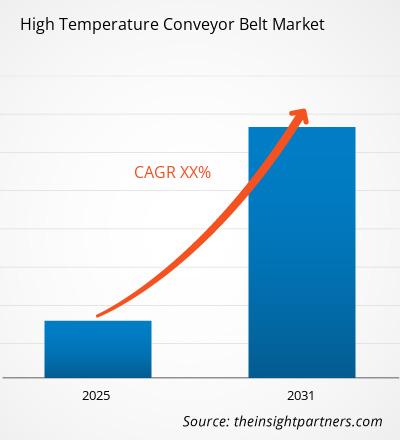
The global industrial manufacturing landscape is experiencing unprecedented acceleration, driven by heavy reliance on automated material handling solutions capable of surviving extreme thermal and physical environments. Industrial sectors such as metallurgy, cement production, glass manufacturing, chemical processing, and industrial baking operate continuously under elevated heat levels, requiring specialized continuous-transport components. Consequently, high-temperature conveyor belts have transitioned from niche equipment to indispensable assets across major processing facilities.
Get a PDF Sample- https://www.theinsightpartners.com/sample/TIPRE00022616
Market Growth Drivers
Expanding Heavy Industrial Operations: Industries such as steel manufacturing, foundries, and cement production demand material handling systems capable of transporting materials at temperatures ranging from 100°C to over 400°C. Standard conveyor belts degrade rapidly under severe thermal stress, leading to structural failures, unscheduled downtime, and safety hazards. High-temperature belts, engineered with heat-resistant synthetic elastomers, fiberglass mesh, modular plastics, and metallic weaves, ensure prolonged durability under direct exposure to hot clinker, sintered ores, and molten materials.
Growth in Thermal Processing and Food Industry Automation: The food and beverage processing sector relies on high-temperature conveyor belts for continuous baking, frying, drying, and thermal sterilization processes. Heat-resistant modular plastic and fiberglass mesh belts ensure hygiene compliance, non-stick performance, and uniform heat transfer, fueling steady adoption in automated commercial bakeries and industrial drying units.
Innovations in Advanced Material Science: Manufacturers are investing heavily in material engineering to enhance belt longevity and heat resistance. Modern compounding utilizes specialized rubbers (such as EPDM, silicone, and fluoroelastomers), stainless steel alloys, and aramid fiber reinforcements. These innovations protect against thermal oxidation, surface cracking, ply separation, and mechanical wear, ultimately lowering the total cost of ownership (TCO) for industrial plant operators.
Market Forecsat
The High Temperature Conveyor Belt Market size is expected to reach US$ 5.68 Billion by 2034 from US$ 3.47 Billion in 2025. The market is estimated to record a CAGR of 6.35% from 2026 to 2034.
Key Players in the High Temperature Conveyor Belt Market
The global market features a blend of established multinational rubber and conveyor manufacturers along with specialized engineering solution providers focusing on custom heat-resistant belt designs. Prominent key players identified in the research include:
Lauyans and Company, Inc.
DUNLOP CONVEYOR BELTING
Sparks Belting
Bridgestone Corporation
Miprcorp
Jagruti Rubber Enterprises
Bando. USA
mk North America, Inc.
LEWCO, Inc.
Canning Conveyor Co. Ltd.
Fenner Dunlop Australia
These industry participants are focusing on strategic developments such as high-performance belt formulation, product customization for niche processing plants, and strategic distribution partnerships to strengthen their footprint across global manufacturing hubs.
Get Full Copy of This Report- https://www.theinsightpartners.com/buy/TIPRE00022616
Regional Insights and Industry Dynamics
Asia-Pacific: Represents a dominant and fast-growing regional segment due to extensive steel production, heavy mining activity, cement manufacturing, and rapid industrialization in countries like China and India.
North America & Europe: Driven by facility modernization, strict industrial safety regulations, and the integration of smart sensors into automated material handling equipment to monitor thermal belt wear in real-time.
Future Outlook
The future of the high temperature conveyor belt market remains highly positive, anchored by ongoing technological advancements in heat-resistant polymers and metallic composites. As heavy manufacturing and bulk material handling industries prioritize operational efficiency and reduced downtime, demand for specialized belts capable of enduring continuous, extreme thermal strain will intensify. Additionally, the integration of Predictive Maintenance (PdM) technology—such as thermal sensing elements and IoT-enabled belt health monitors—is set to redefine product standards. Industry players that focus on energy-efficient belt constructions, extended service life formulations, and customized heat-resistant solutions will be best positioned to capitalize on market opportunities through 2034.
Related Report-
