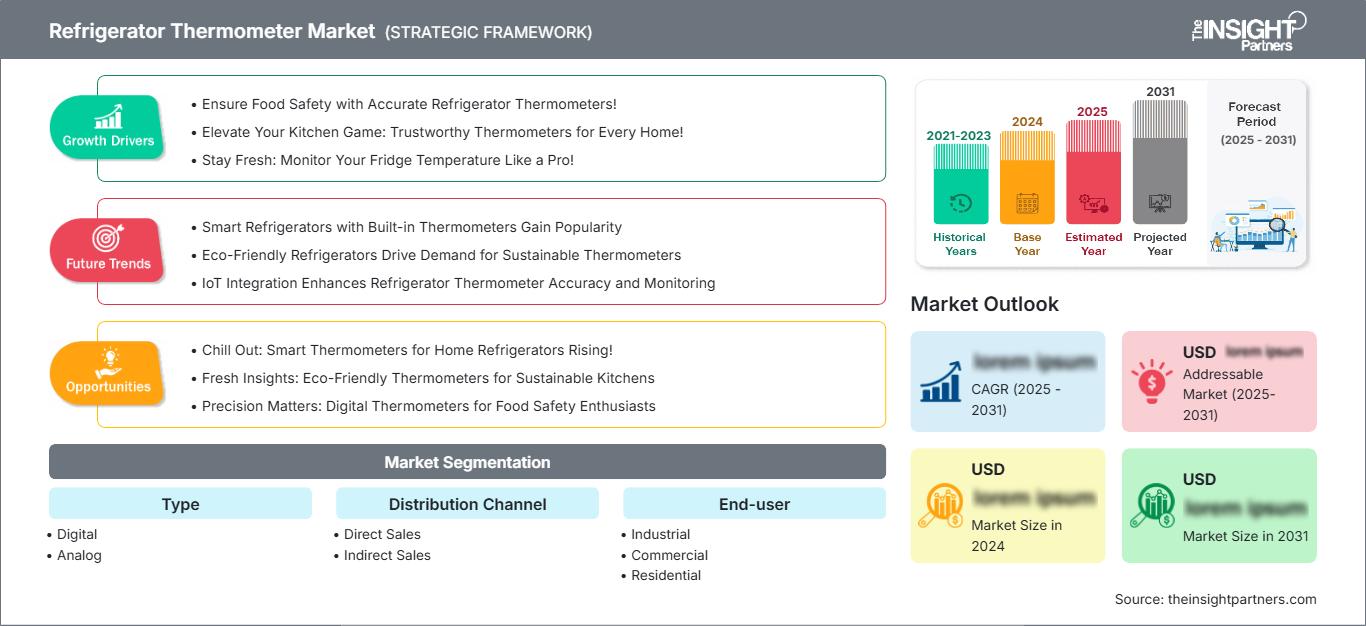
Food safety, household awareness, and the growing need for dependable temperature control are reshaping how consumers and businesses manage refrigerated storage. As extreme weather conditions, power interruptions, food waste concerns, and changing food-handling habits receive greater attention, temperature monitoring is becoming a practical part of everyday refrigeration. Standalone thermometers provide an independent way to verify actual internal conditions when appliance displays or temperature settings do not fully reflect the temperature experienced by stored food.
The Refrigerator Thermometer Market is gaining momentum as consumers, foodservice operators, retailers, and other end users seek simple and accurate solutions for monitoring refrigeration conditions. Increasing adoption of digital displays, wireless sensors, alarm functions, minimum and maximum temperature recording, and smartphone connectivity is expanding the role of these devices beyond basic temperature measurement. The trend toward connected kitchens and smart home technologies is also creating opportunities for manufacturers to introduce more intelligent monitoring solutions.
Get a Sample PDF: https://www.theinsightpartners.com/sample/TIPRE00010563
Refrigerator Thermometer Market: Key Growth Highlights Through 2031
- Market Size: The market is expected to expand steadily through 2031 as temperature awareness becomes increasingly important in residential and commercial refrigeration.
- Market Share: Digital and wireless products are positioned to gain share as consumers increasingly prioritize convenience, visibility, alerts, and remote monitoring.
- Market Trends: Smart sensors, app connectivity, high-low temperature alerts, compact displays, multiple-sensor systems, and improved battery performance are among the major product trends.
- Market Analysis: Demand is supported by food safety awareness, increasing refrigerator ownership, growth in foodservice applications, cold-storage requirements, and concerns about food spoilage.
- Market Forecast: Through 2031, product innovation is expected to encourage the transition from conventional analog devices toward connected digital monitoring solutions.
- Application Outlook: Residential applications remain important, while restaurants, grocery stores, laboratories, healthcare facilities, and other temperature-sensitive environments create additional opportunities.
- Technology Outlook: Wireless and IoT-enabled monitoring is expected to become increasingly relevant as users seek real-time visibility and notifications.
Food Safety Awareness Strengthens Demand
Temperature control is directly connected with food safety. The U.S. Food and Drug Administration recommends keeping refrigerators at or below 40°F and freezers at 0°F, while the U.S. Department of Agriculture emphasizes the importance of appliance thermometers for verifying refrigeration conditions. These recommendations are particularly relevant because refrigerator control settings do not always provide a direct measurement of the actual internal temperature.
Recent food-safety discussions have further highlighted the importance of monitoring household refrigerator temperatures. A study covering homes across European countries found average refrigerator temperatures above the FDA’s recommended threshold, renewing attention around real-world refrigeration conditions and the usefulness of dedicated thermometers.
This growing awareness creates a favorable environment for manufacturers offering products that are easy to install, simple to read, and capable of providing continuous monitoring.
Digital and Wireless Technology Transform Product Demand
Traditional analog thermometers continue to appeal to users seeking affordability, durability, and simplicity. However, digital models are increasingly attractive because they can provide clearer readings, minimum and maximum temperature records, alarms, and additional monitoring capabilities.
Wireless products are extending this evolution. Connected refrigerator thermometers can allow users to monitor temperature without repeatedly opening the appliance. Some solutions can transmit readings to displays, mobile applications, or smart-home platforms, making them particularly useful for households with secondary refrigerators, freezers, wine storage units, and other temperature-sensitive equipment.
Recent consumer discussions also indicate continued interest in wireless sensors, smartphone notifications, and integration with home-automation ecosystems.
Global and Regional Analysis
North America: North America represents a significant opportunity because of strong consumer awareness regarding food safety, widespread household refrigeration, established foodservice infrastructure, and demand for smart-home technologies. The region is also seeing interest in connected temperature monitoring for residential and commercial applications. Established brands and specialized instrumentation companies contribute to a competitive product environment.
Europe: European demand is supported by food-safety awareness, household appliance penetration, and increasing attention toward actual refrigerator operating temperatures. Recent research highlighting temperature variations in household refrigerators has reinforced the importance of independent temperature monitoring.
Asia Pacific: Asia Pacific is expected to provide strong long-term opportunities because of urbanization, rising household appliance adoption, expanding foodservice industries, and growing awareness of food preservation. The increasing availability of affordable digital and wireless products through online retail is also helping broaden consumer access.
Latin America: Growth opportunities are associated with expanding modern retail, foodservice operations, household appliance adoption, and improving consumer awareness of food storage practices.
Middle East & Africa: Demand is supported by the expansion of organized food retail, hospitality infrastructure, healthcare applications, and cold-chain requirements. Temperature monitoring can be particularly valuable where refrigeration performance is affected by high ambient temperatures and demanding operating environments.
Key Players
The competitive landscape includes established thermometer manufacturers, instrumentation companies, smart-device brands, and specialized temperature-monitoring providers. Key players include:
- ThermoWorks
- Taylor Precision Products
- Cooper-Atkins Corporation
- CDN (Component Design Northwest)
- ETI Ltd.
- DeltaTrak
- Comark Instruments
- OMEGA Engineering
- Testo SE & Co. KGaA
- La Crosse Technology
- AcuRite
- Thermo Fisher Scientific
- TFA Dostmann
- Etekcity
- Govee
Industry reports identify these and other manufacturers as active participants across analog, digital, wireless, and professional temperature-monitoring categories.
AcuRite, for example, offers refrigerator and freezer thermometers with Fahrenheit and Celsius readings, mounting options, and designated safe-temperature zones, illustrating the continued importance of straightforward monitoring alongside newer connected technologies.
Competitive Landscape and Emerging Opportunities
Competition is increasingly shifting from basic temperature measurement toward value-added functionality. Manufacturers are focusing on improved sensor accuracy, larger displays, waterproof construction, compact designs, wireless communication, alert systems, and longer battery life.
Online retail is also changing purchasing behavior. Consumers can compare features, reviews, accuracy specifications, and monitoring capabilities before purchasing, encouraging brands to differentiate through product reliability and user experience. Commercial customers, meanwhile, are placing greater emphasis on continuous monitoring, historical records, alerts, and operational visibility.
The combination of affordable basic products and advanced connected devices is likely to keep the competitive landscape diverse through 2031.
Get the Premium Research Report @ https://www.theinsightpartners.com/buy/TIPRE00010563
Future Outlook
The future of the Refrigerator Thermometer Market will increasingly be shaped by the convergence of food safety, connected-home technologies, and real-time monitoring. Basic analog products are expected to remain relevant because of their simplicity and affordability, while digital and wireless devices are positioned to capture growing demand for convenience and proactive temperature management. As consumers and businesses become more conscious of food preservation, waste reduction, energy efficiency, and refrigeration reliability, temperature monitoring is likely to become an increasingly standard component of modern cold-storage management. Innovation in IoT connectivity, mobile alerts, multi-sensor monitoring, and data-based temperature analysis is expected to create new opportunities for manufacturers through 2031.
Related Reports –
Home Energy Management System Market Regional Share, Trend, and Growth Opportunity
Vision Transformers Market Regional Share, Trend, and Growth Opportunity
Differential-Pressure Mass Flow Controller Market Regional Share, Trend, and Growth Opportunity
About The Insight Partners
The Insight Partners is a leading market research and consulting firm delivering actionable insights through in-depth industry analysis and strategic intelligence. The firm supports clients across various industries in making informed business decisions by providing comprehensive market forecasts, competitive assessments, and growth opportunities.
Contact Us:
If you have any queries about this report or if you would like further information, please contact us:
Contact Person: Ankit Mathur
E-mail: sales@theinsightpartners.com
Phone: +1-646-491-9876
Also Available in :
Korean | German | Japanese | French | Chinese | Italian | Spanish
