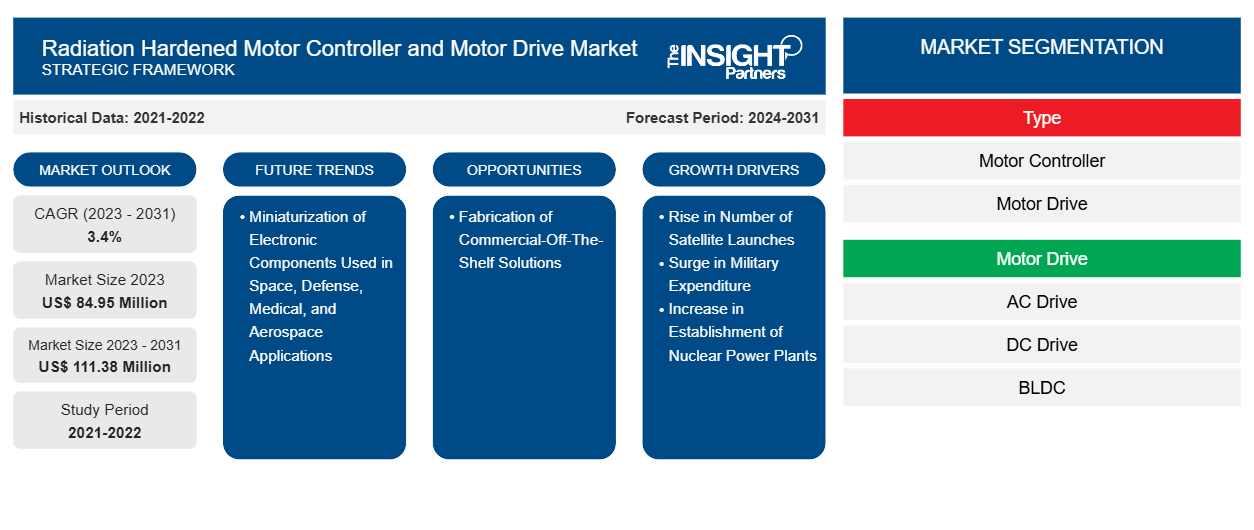
Space missions, defense platforms, nuclear facilities, and advanced aerospace systems increasingly depend on electronics that can operate reliably in extreme radiation environments. As spacecraft become more sophisticated and satellite constellations expand, the need for dependable motion-control technologies is gaining strategic importance. Motors are essential for positioning solar arrays, antennas, robotic systems, optical instruments, and other critical mechanisms, making radiation resilience a key design consideration.
The Radiation Hardened Motor Controller and Motor Drive Market is gaining attention as governments, aerospace companies, defense organizations, and semiconductor manufacturers invest in high-reliability electronics. According to The Insight Partners, the industry is projected to expand through 2031, supported by satellite launches, defense modernization, nuclear power infrastructure, and the growing use of radiation-hardened components in demanding environments.
Get a Sample PDF: https://www.theinsightpartners.com/sample/TIPRE00039370
Market Size, Share, Trends, Analysis, and Forecast by 2031
- Market Size: The global industry is projected to maintain a steady expansion through 2031, supported by increasing requirements for radiation-resistant motion-control electronics.
- Market Share: North America held the leading regional position, supported by strong aerospace, defense, and satellite-development activities.
- Market Trends: Miniaturization, higher integration, radiation-hardened-by-design architectures, and increasing adoption of brushless DC motor solutions are shaping product development.
- Market Analysis: Space exploration represents a major application area, while military and defense and nuclear power applications provide additional demand.
- Market Forecast: Growth is expected to continue through 2031 as satellite deployments, advanced spacecraft, robotic systems, and high-reliability defense platforms expand globally.
Satellite Expansion Creates New Demand
One of the most important growth drivers is the continued expansion of satellite programs. Modern satellites require precise and reliable motion control for solar-panel positioning, antenna pointing, reaction wheels, optical instruments, actuators, and other electromechanical systems. The increasing deployment of low Earth orbit constellations and small satellites is therefore creating opportunities for suppliers of radiation-resistant controllers and drives.
The Insight Partners identifies the rising number of satellite launches as a significant factor supporting industry growth. Increasing public and private investment in space exploration is encouraging manufacturers to develop compact, efficient, and highly reliable components capable of operating throughout demanding mission lifecycles.
Military and Nuclear Applications Strengthen the Opportunity
Beyond space, radiation-hardened motor-control technologies are becoming important for military and defense equipment exposed to harsh operating conditions. Modern aircraft, surveillance platforms, advanced vehicles, and specialized defense systems require dependable electronic controls, particularly where component failure can affect mission performance.
Nuclear power facilities represent another important application. Equipment operating close to radiation sources requires components designed to maintain functionality under challenging environmental conditions. As countries focus on energy security and expand or modernize nuclear infrastructure, demand for highly reliable electronic systems is expected to create additional opportunities.
Technology Trends Reshaping Product Development
Miniaturization is emerging as a particularly important technology trend. Spacecraft designers continually seek to reduce weight, power consumption, and board space while increasing functionality. Integrated motor-control architectures can address these requirements by combining multiple control and sensing functions into fewer components.
Recent technology developments illustrate this direction. Microchip Technology’s LX7720 integrates multiple motor-control and position-sensing functions for satellite robotics, multi-axis pointing mechanisms, optical systems, and other space applications. The company states that the device is designed for radiation tolerance and has been adopted for space robotics and human-rated space programs.
Another emerging direction is the use of radiation-hardened or radiation-tolerant microcontrollers with sophisticated motor-control capabilities. In 2025, VORAGO Technologies highlighted the growing importance of radiation-hardened and radiation-tolerant motor-control systems for spacecraft actuators, including systems used to orient satellites, steer antennas, position solar arrays, and operate robotic mechanisms.
Global and Regional Analysis
North America remains a major center of activity because of its established aerospace and defense ecosystem, extensive satellite programs, and strong investment in space technologies. The US is particularly important, with government programs, commercial satellite operators, spacecraft manufacturers, and semiconductor companies supporting demand for radiation-resistant electronics. The Insight Partners identifies North America as the leading regional contributor.
Europe also represents an important technology hub. Investments in Earth observation, satellite navigation, connectivity, space research, and robotics are supporting the adoption of specialized motion-control components. European semiconductor manufacturers are also contributing to the development of radiation-hardened technologies.
Asia Pacific is expected to be the fastest-growing regional market through the forecast period. Increasing satellite deployment, space exploration programs, defense modernization, and demand for advanced electronics across countries including China, India, Japan, and Australia are creating significant opportunities. The region’s growing emphasis on satellite communications, navigation, and remote sensing is particularly relevant to radiation-hardened motor-control suppliers.
Competitive Landscape and Key Players
The competitive environment includes semiconductor manufacturers, space-electronics specialists, motor-control companies, and high-reliability component suppliers. Companies are focusing on integrated architectures, radiation tolerance, compact designs, higher efficiency, and solutions tailored to specific spacecraft and defense requirements.
Key players include:
- ✓ Microchip Technology Inc.
- ✓ MACCON GmbH & Co. KG
- ✓ Renesas Electronics Corporation
- ✓ STMicroelectronics
- ✓ Texas Instruments Incorporated
- ✓ Data Device Corporation
- ✓ Power Device Corporation
- ✓ Frontgrade Technologies
- ✓ ESI Motion
- ✓ Motiv Space Systems Inc.
- ✓ TTM Technologies Inc.
- ✓ Micross Components Inc.
Updated Industry Developments
Recent technology activity indicates that suppliers are moving toward more integrated and application-specific solutions. Microchip continues to demonstrate radiation-hardened motor-control technologies for spacecraft and high-reliability applications, including BLDC and stepper-motor systems. Its reference designs also target PMSM motor control for satellites and exploration robots, demonstrating the industry’s shift toward complete hardware and software solutions rather than standalone components.
At the same time, VORAGO’s recent industry analysis emphasizes the importance of combining radiation tolerance with embedded intelligence, compact architectures, and reliable motor-control functionality. These developments indicate that future solutions will need to balance radiation resilience with performance, power efficiency, size, and system-level integration.
Get the Premium Research Report @ https://www.theinsightpartners.com/buy/TIPRE00039370
Future Outlook
The outlook for the Radiation Hardened Motor Controller and Motor Drive Market remains positive through 2031 as space exploration, satellite communications, defense modernization, and nuclear infrastructure continue to evolve. Future product development is likely to focus on smaller footprints, higher integration, improved energy efficiency, BLDC and PMSM compatibility, enhanced fault protection, and radiation-hardened-by-design architectures. As commercial space activity expands alongside government missions, suppliers capable of delivering reliable, cost-effective, and highly integrated motor-control solutions are positioned to capture emerging opportunities. The combination of increasing spacecraft complexity and the need for dependable operation in radiation-intensive environments will remain a central factor shaping the industry’s long-term trajectory.
Related Reports –
Home Energy Management System Market Regional Share, Trend, and Growth Opportunity
Vision Transformers Market Regional Share, Trend, and Growth Opportunity
Differential-Pressure Mass Flow Controller Market Regional Share, Trend, and Growth Opportunity
About The Insight Partners
The Insight Partners is a leading market research and consulting firm delivering actionable insights through in-depth industry analysis and strategic intelligence. The firm supports clients across various industries in making informed business decisions by providing comprehensive market forecasts, competitive assessments, and growth opportunities.
Contact Us:
If you have any queries about this report or if you would like further information, please contact us:
Contact Person: Ankit Mathur
E-mail: sales@theinsightpartners.com
Phone: +1-646-491-9876
Also Available in :
Korean | German | Japanese | French | Chinese | Italian | Spanish
