The growing adoption of compact, reliable, and low-power sensing technologies is transforming how modern electronic and industrial systems detect position, movement, speed, and fluid levels. From vehicles and security equipment to medical devices and smart appliances, magnetic sensing solutions are becoming increasingly important for dependable operation in demanding environments. The combination of miniaturization, durability, contactless operation, and simple integration is creating new opportunities across several end-use industries.
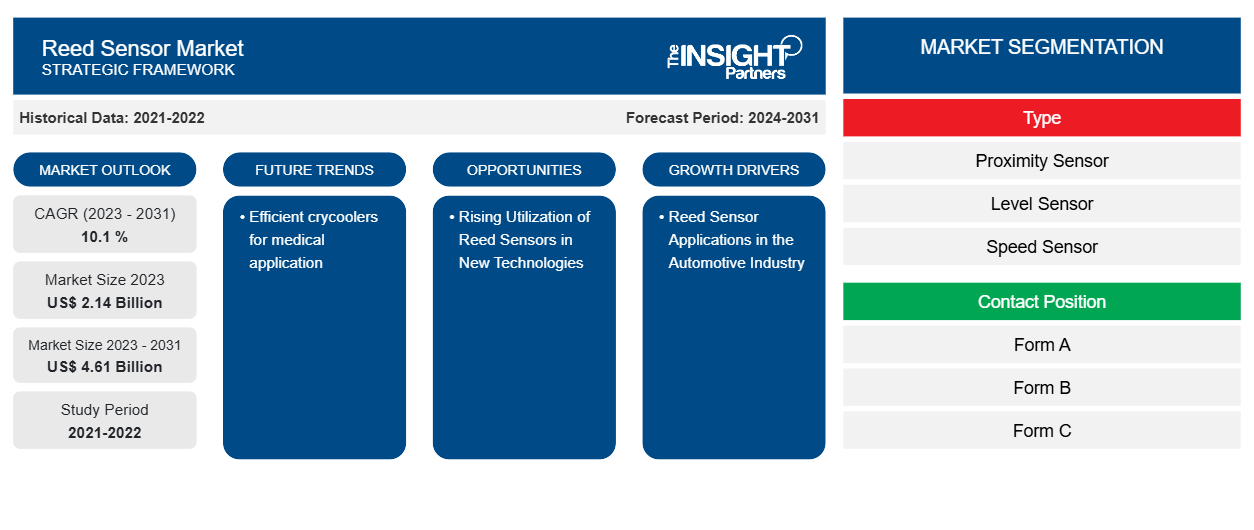
The Reed Sensor Market is gaining momentum as manufacturers increasingly incorporate reliable magnetic sensing into automotive systems, industrial equipment, consumer electronics, telecommunications infrastructure, medical devices, and security applications. According to The Insight Partners, the industry is projected to maintain strong growth through 2031, supported particularly by automotive applications, emerging technologies, robotics, automation, and the growing requirement for dependable sensing in compact electronic systems.
Get a Sample PDF: https://www.theinsightpartners.com/sample/TIPRE00003353
Industry Growth Driven by Automotive and Automation Applications
Automotive remains one of the most influential application areas for reed sensors. Modern vehicles require numerous sensing mechanisms for detecting position, movement, door status, actuator operation, fluid levels, and other mechanical conditions. The ability of reed-based devices to provide reliable switching without continuous power consumption makes them attractive for selected battery-powered and embedded applications.
The increasing development of connected and increasingly automated vehicles is also creating additional opportunities. As vehicle architectures become more electronically controlled, manufacturers are looking for compact sensing components that can operate reliably in restricted spaces. The Insight Partners identifies applications associated with autonomous vehicles as an important future trend for the industry.
Beyond automotive, industrial automation and robotics are emerging as important growth areas. Factories are increasingly deploying automated machinery, linear actuators, motion-control equipment, and smart monitoring systems. Reed sensors can provide straightforward position and limit detection while supporting designs where durability and low maintenance are important.
Market Size, Share, Trends, Analysis, and Forecast to 2031
- Market size: The global industry is entering a sustained expansion phase, with increasing adoption across automotive, industrial, security, healthcare, consumer electronics, and telecommunications applications.
- Market share: Automotive and transportation represent important demand centers, while security and safety, medical equipment, consumer electronics, and telecommunications contribute to broader application diversification.
- Market trends: Miniaturization, high reliability, contactless operation, low power requirements, customized sensitivity, and integration into compact electronic systems are shaping product development.
- Market analysis: Proximity, level, speed, and flow sensing represent major product categories, while Form A, Form B, Form C, Form D, and other contact configurations address different design requirements.
- Forecast to 2031: Growth is expected to remain robust through 2031 as automotive electronics, robotics, automation, smart devices, security systems, and emerging technologies increase their reliance on compact magnetic sensing solutions.
Technology Trends Reshaping the Industry
Miniaturization is one of the most visible trends influencing product development. Equipment manufacturers increasingly need sensing components that occupy minimal board or installation space while maintaining dependable switching performance. Recent product offerings demonstrate this direction, with miniature flange-mounted reed sensors designed for position, limit, security, door, and linear-actuator applications.
Another important trend is customization. Manufacturers are increasingly offering different sensitivity levels, contact configurations, cable lengths, connectors, and mounting approaches to meet application-specific requirements. This flexibility allows reed sensors to be integrated into equipment ranging from industrial machinery to security systems and consumer products.
Reliability in challenging environments is also becoming increasingly important. Reed sensors can provide noncontact switching through materials such as plastic, wood, and aluminum, while certain designs are suitable for high-moisture and contaminated environments. This makes them relevant for applications where conventional mechanical switching may be less desirable.
Global and Regional Analysis
Asia Pacific is expected to remain a significant regional growth center because of its established electronics and automotive manufacturing base. China, Japan, South Korea, and other Asian economies have extensive production ecosystems for vehicles, electronic equipment, appliances, telecommunications products, and industrial machinery. The expansion of smart-home technologies and electronics manufacturing is supporting additional demand for magnetic sensing components.
North America represents another important opportunity, supported by automotive electronics, industrial automation, security systems, medical technologies, and advanced manufacturing. The United States is specifically identified as a key country within the global industry, with automotive applications contributing to demand.
Europe continues to benefit from its strong automotive and industrial engineering ecosystem. Demand for reliable position and proximity sensing in manufacturing equipment, transportation systems, and advanced machinery is expected to support continued adoption.
Meanwhile, South and Central America and the Middle East & Africa present emerging opportunities as industrial automation, security infrastructure, electronics adoption, and modernization initiatives create new applications for sensing technologies.
Competitive Landscape and Key Players
Competition is increasingly centered on product reliability, miniaturization, application-specific customization, manufacturing capabilities, and the ability to support customers across multiple industries. Leading participants include:
- HSI Sensing
- Coto Technology
- Littelfuse Inc.
- PIC GmbH
- Pickering Electronics Ltd.
- RMCIP
- SMC Corporation
- Standex Electronics Inc.
- STG-Germany Group
- Zhejiang Xurui Electronic Co., Ltd.
The competitive environment is supported by ongoing product development and application engineering. For example, Littelfuse offers miniature and industrial reed sensor configurations for position, limit, security, door, actuator, and heavy-duty applications. Standex Electronics also maintains a broad portfolio of reed switch-based sensing solutions serving automotive, industrial automation, medical, aerospace, and consumer electronics applications.
Recent Industry Developments
Recent product activity highlights the continued focus on compact and application-specific sensing. Littelfuse has developed miniature flange-mounted reed sensors with multiple contact options and configurable sensitivity for space-constrained applications. Its product portfolio also includes stainless-steel threaded sensors designed for industrial processes, position detection, linear actuators, and heavy-duty equipment.
The broader sensor industry is simultaneously moving toward greater integration with connected electronics and automated systems. This trend is increasing the importance of sensors that can provide dependable physical-state detection while fitting within increasingly compact system architectures.
Get the Premium Research Report @ https://www.theinsightpartners.com/buy/TIPRE00003353
Future Outlook
The outlook through 2031 remains positive as manufacturers pursue smaller, more reliable, energy-efficient, and application-specific sensing technologies. Automotive electronics, autonomous vehicle technologies, robotics, industrial automation, smart security, medical equipment, consumer electronics, and connected devices are expected to create additional opportunities. The growing utilization of reed sensors in new technologies is also expected to encourage product innovation and expand application possibilities.
As equipment becomes smarter and more compact, the need for dependable physical-state detection will continue to grow. Companies that combine miniaturized designs, customized configurations, robust performance, and application-focused engineering are likely to remain well positioned to capture emerging opportunities through 2031.
Related Reports –
Home Energy Management System Market Regional Share, Trend, and Growth Opportunity
Vision Transformers Market Regional Share, Trend, and Growth Opportunity
Differential-Pressure Mass Flow Controller Market Regional Share, Trend, and Growth Opportunity
About The Insight Partners
The Insight Partners is a leading market research and consulting firm delivering actionable insights through in-depth industry analysis and strategic intelligence. The firm supports clients across various industries in making informed business decisions by providing comprehensive market forecasts, competitive assessments, and growth opportunities.
Contact Us:
If you have any queries about this report or if you would like further information, please contact us:
Contact Person: Ankit Mathur
E-mail: sales@theinsightpartners.com
Phone: +1-646-491-9876
Also Available in :
Korean | German | Japanese | French | Chinese | Italian | Spanish
