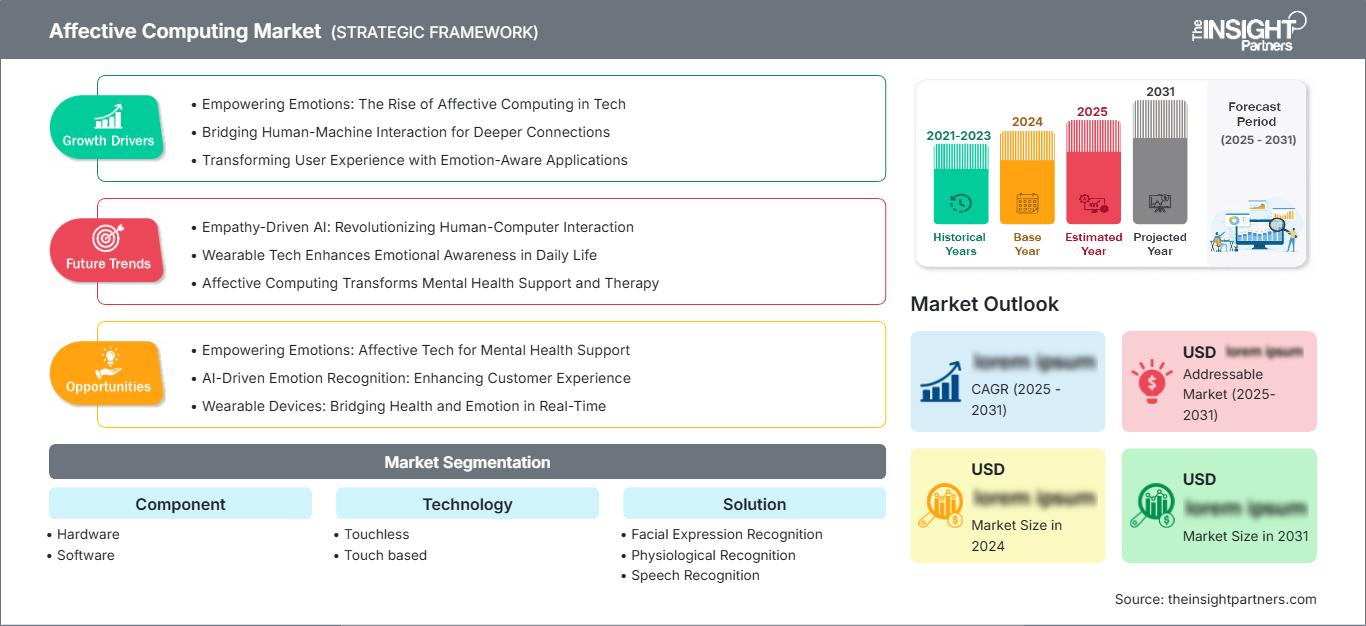
The global affective computing market is experiencing rapid expansion as human-computer interaction shifts toward emotionally intelligent digital systems. Affective computing, also recognized as Emotion AI or artificial emotional intelligence, combines computer science, cognitive psychology, and neuroscience to enable systems to detect, process, and respond to human emotions. By interpreting non-verbal indicators such as facial expressions, vocal tone, body language, and physiological signals, affective computing transforms standard technology into empathetic interfaces.
The affective computing market was valued at US$17.14 billion in 2025 and is projected to reach US$55.51 billion by 2034, expanding at a CAGR of 13.95% during 2026 to 2034.
Key Market Drivers
Demand for Enhanced Customer Experience and Contact Center Automation
Businesses are increasingly adopting affective computing across contact centers and digital platforms to evaluate customer sentiment during real-time interactions. Voice analytics and speech recognition software process pitch, cadence, and vocal strain to determine customer satisfaction or frustration. This real-time intelligence empowers automated agents and human representatives to adjust their responses, de-escalate tension, and deliver tailored resolution paths.
Growth in Automotive In-Cabin Monitoring Systems
Vehicle safety regulations and the evolution of autonomous driving have elevated the importance of driver state monitoring. Affective computing algorithms monitor driver drowsiness, distraction, and emotional stress through interior cameras and steering sensors. By alerting drivers to impaired attention or adjusting cabin ambient conditions, emotion-aware automotive systems directly support driver safety initiatives.
Proliferation of Smart Wearables and Physiological Sensors
The widespread adoption of smartwatches, fitness bands, and biometric sensors has created continuous streams of health data. Modern wearable hardware captures heart rate variability, galvanic skin response, and skin temperature. Integrating affective computing platforms with wearable devices allows users and healthcare professionals to monitor daily stress levels, sleep quality, and physiological emotional reactions in real time.
Download Sample Report@ https://www.theinsightpartners.com/sample/TIPRE00004090
Major Market Opportunities
Expansion in Telehealth and Mental Healthcare Applications
Affective computing provides objective, quantifiable metrics for mental health diagnostic tools and remote patient monitoring. Healthcare providers leverage emotion recognition algorithms to screen for early signs of depression, anxiety disorders, and neurodevelopmental conditions. AI-driven therapeutic platforms can adjust therapy protocols dynamically based on patient facial cues and vocal distress, creating expansive growth avenues for health tech developers.
Convergence with Generative AI and Conversational Avatars
Integrating emotion AI with large language models and virtual avatars creates conversational agents capable of expressing and detecting empathy. This synergy unlocks significant opportunities in interactive e-learning platforms, virtual customer service representatives, immersive gaming, and enterprise coaching applications where personalized human-like feedback improves engagement.
Market Segmentation
The affective computing market is structured across several core categories based on components, core technologies, solutions, and end-user industries:
By Component
- Hardware: Sensors (optical, biometric, acoustic), high-resolution cameras, storage systems, and dedicated processors / Neural Processing Units (NPUs).
- Software: Emotion analytics software, enterprise integration platforms, sentiment analysis tools, and real-time processing engines.
By Technology
- Touchless Technology: Optical facial monitoring, speech analytics, and gesture recognition via cameras and far-field microphones.
- Touch-Based Technology: Biometric sensor arrays embedded in wearables, smart controllers, and touchscreens tracking skin conductance and pulse rate.
By Solution
- Facial Expression Recognition: Computer vision systems analyzing micro-expressions.
- Speech Recognition & Vocal Analytics: Audio signal processing identifying pitch, tempo, and vocal frequency changes.
- Physiological Recognition: Monitoring cardiovascular, muscular, and galvanic skin metrics.
- Gesture & Posture Recognition: Tracking skeletal movement and physical body language cues.
By Industry End-User
- Healthcare and Telemedicine
- Automotive and Transportation
- Retail, E-Commerce, and Advertising
- Banking, Financial Services, and Insurance (BFSI)
- Media, Gaming, and Entertainment
- IT, Telecom, and Education
Market News and Recent Developments
Technological advancements in multimodal emotion recognition continue to accelerate market expansion. Hardware manufacturers are introducing dedicated AI chips equipped with low-power neural processing units designed specifically for on-device, low-latency emotion processing. These hardware breakthroughs eliminate reliance on constant cloud connectivity, addressing crucial latency and user privacy requirements.
In parallel, major software developers are shifting from unimodal analytics to multimodal AI models. Modern platforms combine facial expression mapping, vocal acoustic analysis, and natural language sentiment processing into unified scoring systems. Strategic acquisitions and research partnerships between technology providers and automotive Tier-1 suppliers have expanded in-cabin driver monitoring standardizations globally.
Competitive Landscape and Top Players
The global affective computing market features an increasingly competitive landscape populated by global tech conglomerates, specialized AI firms, and niche biometric component providers. Key industry players focus on research and development to boost emotion recognition accuracy across diverse demographic profiles and ambient environmental conditions. Strategic alliances, software patent expansions, and cloud platform integrations remain dominant competitive strategies.
Top Key Players
- Affectiva (A Smart Eye Company)
- IBM Corporation
- Microsoft Corporation
- Alphabet Inc. (Google)
- Apple Inc.
- Intel Corporation
- Qualcomm Technologies, Inc.
- Realeyes
- Noldus Information Technology
- Tobii AB
Future Outlook
Heading toward 2034, affective computing is set to become a foundational component of modern computing environments. The transition from reactive software to proactive, emotionally aware artificial intelligence will reshape enterprise software, personal devices, and automated vehicles. Edge processing will dominate deployment architectures, ensuring that sensitive biometric emotion data remains localized and secure. As ethical standards and clear data privacy governance mature alongside technical capabilities, emotion AI will foster more natural, empathetic, and effective interactions between humans and machines across global industries.
Get Full Copy of This Report @ https://www.theinsightpartners.com/buy/TIPRE00004090
About The Insight Partners
The Insight Partners provides comprehensive syndicated and tailored market research services in the healthcare, technology, and industrial domains. Renowned for delivering strategic intelligence and practical insights, the firm empowers businesses to remain competitive in ever-evolving global markets.
Contact Information
- Email: sales@theinsightpartners.com
- Website: theinsightpartners.com
- Phone: +1-646-491-9876
Also Available in : Korean|German|Japanese|French|Chinese|Italian|Spanish
Related Reports:
Touchless Affective Computing Market Size, Trends & Growth by 2034
Touch-Based Affective Computing Market Growth, Share & Trends by 2034
