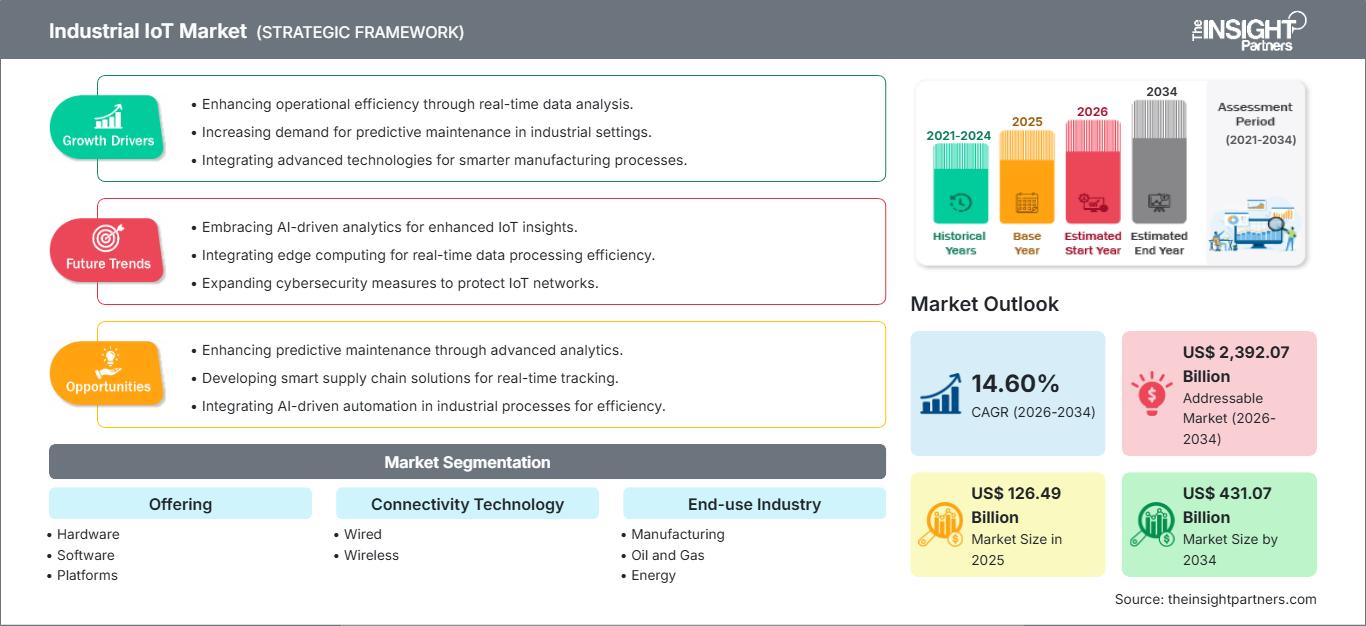
The global Industrial IoT (IIoT) market is experiencing a significant structural evolution as capital-intensive industries move toward fully automated, interconnected, and data-driven operational ecosystems. Industrial enterprises are rapidly deploying smart sensor networks, edge gateways, and cloud platforms to bridge operational technology (OT) with enterprise information technology (IT). This convergence enables real-time visibility, automated asset optimization, and predictive maintenance across production lines, supply chains, and utilities.
The Industrial IoT market was valued at US$ 126.49 Billion in 2025 and is projected to reach US$ 431.07 Billion by 2034, expanding at a CAGR of 14.60% during 2026–2034.
Key Drivers
Accelerated Transition to Industry 4.0 and Smart Manufacturing
Industrial facilities worldwide are upgrading legacy infrastructure to support Industry 4.0 standards. Integrating intelligent sensors and control systems directly on shop floors gives operators real-time control over assembly lines, material throughput, and environmental safety conditions, significantly boosting baseline productivity.
Deployment of Private 5G Infrastructure and Edge Computing
The expansion of private 5G networks and Multi-Access Edge Computing (MEC) provides the ultralow latency and ultrahigh device density necessary for time-critical industrial processes. Processing data locally at the edge reduces bandwidth expenditures, ensures uninterrupted operational reliability, and secures sensitive operational data.
Focus on Predictive Maintenance and Operational Cost Optimization
Unplanned equipment downtime causes massive revenue losses in heavy industries such as automotive, chemical processing, and power generation. IIoT platforms equipped with machine learning algorithms detect performance anomalies early, transitioning enterprise operations from reactive fixes to proactive asset management.
Download Sample Report@ https://www.theinsightpartners.com/sample/TIPRE00039473
Market Opportunities
- Artificial Intelligence and Generative AI Integration (AIoT): Combining Artificial Intelligence with Industrial IoT enables automated root-cause failure analysis, dynamic production scheduling, and generative design workflows for factory layouts.
- Supply Chain and Fleet Telematics Optimization: Demand for end-to-end asset tracking creates high-growth opportunities in smart logistics. Sensor-equipped cargo units and material handling fleets give logistics managers continuous visibility into location, condition, and transit parameters.
- Sustainability and Carbon Footprint Tracking: Governments and institutional investors are demanding greater compliance with environmental, social, and governance (ESG) standards. IIoT architectures monitor energy consumption, water usage, and emissions in real time, helping companies streamline resource allocation and reduce carbon emissions.
Market Segmentation
The Industrial IoT market is segmented across key categories to capture its dynamic enterprise landscape:
By Component
- Hardware: Sensors, gateways, actuators, microprocessors, and industrial routers.
- Software: Application enablement platforms, network management tools, device management software, and edge analytics platforms.
- Services: Professional services (consulting, system integration, deployment) and managed services.
By Application
- Predictive Maintenance: Real-time equipment condition monitoring to forecast asset failures.
- Asset Tracking and Monitoring: Geographic and operational tracking of machinery, tools, and inventory.
- Automation and Process Control: Closed-loop industrial control systems and robotics execution.
- Smart Logistics and Supply Chain: End-to-end fleet, warehouse, and supply chain visibility.
By End-User Industry
- Manufacturing: Automotive, heavy machinery, electronics, and fast-moving consumer goods (FMCG).
- Energy and Utilities: Smart grid management, oil and gas pipeline inspection, and renewable energy storage.
- Healthcare and Pharmaceuticals: Connected medical equipment monitoring and cold-chain supply integrity.
- Logistics and Transportation: Fleet telematics, automated warehousing, and port operational tracking.
- Agriculture: Precision farming, soil analysis systems, and automated irrigation management.
Market News and Recent Developments
Industrial automation leaders are actively expanding their software ecosystems and AI integrations to bolster platform capabilities:
- Siemens Industrial Copilot Capabilities: Siemens upgraded its AI-powered Industrial Copilot portfolio within the Siemens Xcelerator platform, enhancing generative AI capabilities for predictive maintenance, complex diagnostic automation, and smart shop-floor troubleshooting.
- PTC ThingWorx Platform Enhancements: PTC introduced major upgrades to its ThingWorx IIoT platform, incorporating generative AI-assisted application building tools, dynamic digital twin modules, and expanded edge device orchestration capabilities for complex production environments.
- Rockwell Automation Cloud Expansion: Rockwell Automation expanded its visualization and control platform capabilities with browser-based human-machine interface (HMI) deployments, simplifying remote device monitoring across geographically dispersed facilities.
- Private Wireless Expansion: Major telecom providers and hardware manufacturers are partnering to deploy pre-packaged, turnkey private 5G networks directly tailored for high-density industrial campuses and logistics hubs.
Competitive Landscape and Top Players
The global Industrial IoT market features a highly competitive, technology-driven marketplace. Market leaders focus on strategic mergers, open-architecture software investments, and deep partnerships with hyperscale cloud providers to offer end-to-end industrial software stacks.
Top Players
- Siemens AG
- General Electric (GE Vernova / GE Digital)
- Cisco Systems, Inc.
- Honeywell International Inc.
- ABB Group
- Rockwell Automation, Inc.
- PTC Inc.
- Schneider Electric
- International Business Machines (IBM) Corporation
- Huawei Technologies Co., Ltd.
- Intel Corporation
- Bosch Rexroth AG
Get Full Copy of This Report @ https://www.theinsightpartners.com/buy/TIPRE00039473
Future Outlook
The trajectory of the Industrial IoT market up to 2034 points toward autonomous, self-healing industrial environments. As edge devices become more powerful and private 5G networks achieve widespread coverage, centralized control rooms will evolve into decentralized, intelligent execution nodes. Enterprise technology investments will shift from simple connectivity implementations toward unified data architectures, digital twin adoption, and zero-trust cybersecurity frameworks. Industry leaders that build resilient, scalable IIoT architectures will establish significant operational efficiencies, faster production cycles, and long-term market leadership.
About The Insight Partners
The Insight Partners provides comprehensive syndicated and tailored market research services in the healthcare, technology, and industrial domains. Renowned for delivering strategic intelligence and practical insights, the firm empowers businesses to remain competitive in ever-evolving global markets.
Contact Information
- Email: sales@theinsightpartners.com
- Website: theinsightpartners.com
- Phone: +1-646-491-9876
Also Available in : Korean|German|Japanese|French|Chinese|Italian|Spanish
