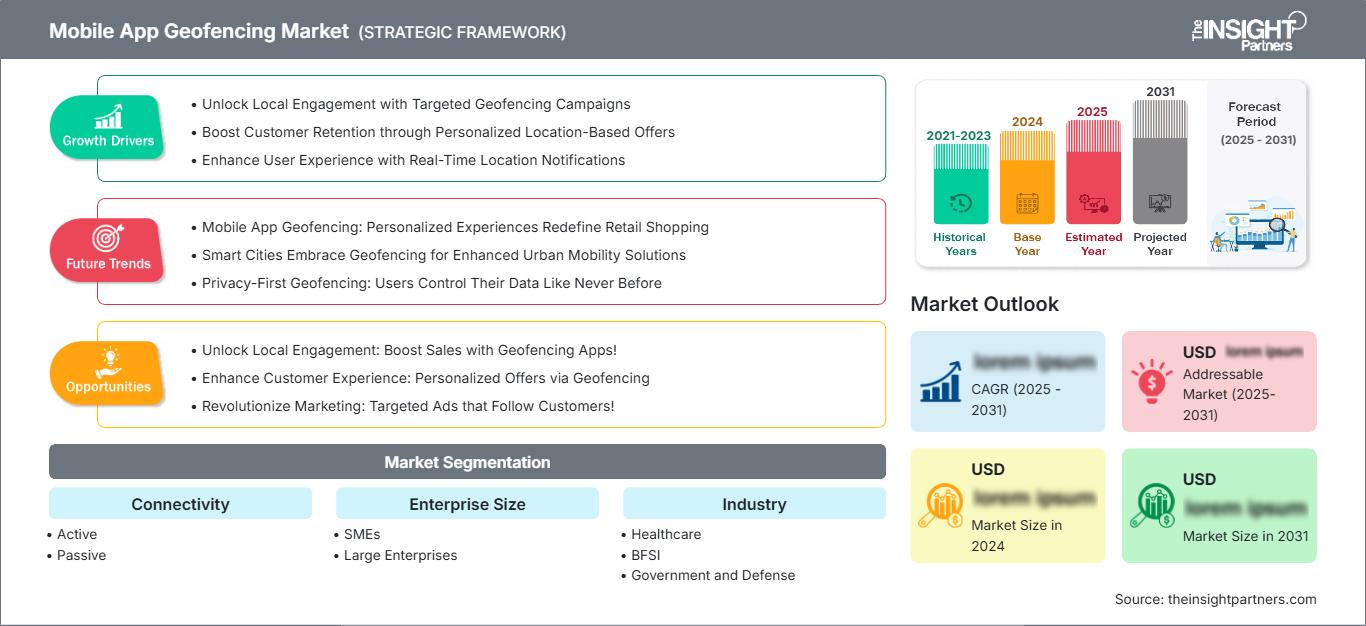
The global mobile app geofencing market is undergoing significant growth, driven by the rapid proliferation of smartphones, increasing reliance on location-based services (LBS), and rising demand for hyper-personalized marketing. Geofencing utilizes Global Positioning System (GPS), cellular data, Wi-Fi, and Radio Frequency Identification (RFID) to establish virtual boundaries around specific geographic zones. When a mobile device enters or exits a geofenced area, location-aware mobile applications trigger automated actions, such as pushing real-time notifications, coupons, safety alerts, or automated check-ins.
The Mobile App Geofencing Market size is expected to reach US$ 5.72 Billion by 2034 from US$ 1.45 Billion in 2025. The market is estimated to record a CAGR of 16.50% from 2026 to 2034.
Key Market Drivers
- Surge in Smartphone Adoption and High-Speed Connectivity: The worldwide expansion of 5G networks and ubiquitous smartphone usage provide the low-latency infrastructure necessary to process precise location telemetry in real time.
- Demand for Hyper-Personalized Mobile Marketing: Modern consumers expect tailored interactions. Geofencing empowers brands to deliver relevant deals, reminders, and product recommendations precisely when potential buyers are near a physical outlet.
- Operational Optimization in Logistics and Transportation: Fleet operators and delivery providers leverage geofenced corridors to automate arrival/departure logs, streamline asset tracking, improve driver safety, and reduce operational overhead.
- Advancements in Location-Based Analytics: Businesses are increasingly leveraging spatial analytics to evaluate foot traffic, examine consumer behavior patterns, and optimize store placement strategies.
Download Sample Report@ https://www.theinsightpartners.com/sample/TIPRE00015054
Strategic Market Opportunities
- Integration with Internet of Things (IoT) and Smart Cities: Integrating geofence boundaries with smart city infrastructure, urban transit platforms, and IoT sensors unlocks powerful applications in parking management, public safety, and automated tolling.
- Artificial Intelligence and Predictive Analytics: Combining geofencing with machine learning algorithms allows mobile applications to predict user intent based on historical movement patterns, enabling proactive context delivery rather than purely reactive triggers.
- Workforce and Asset Safety Applications: Industrial facilities, healthcare institutions, and construction enterprises can deploy passive and active geofencing to manage perimeter security, enforce hazardous zone compliance, and enhance lone-worker safety protocols.
Market Segmentation Analysis
The mobile app geofencing market is categorized across several distinct parameters:
By Connectivity Type
- Active Geofencing: Requires active user participation via mobile applications, GPS, or cellular location services to send and receive real-time updates.
- Passive Geofencing: Operates continuously in the background, harvesting location data to build behavioral insights or trigger automated routines without requiring active app interaction.
By Component
- Solution / Software: Geofencing platforms, software development kits (SDKs), location APIs, and management dashboards.
- Services: Professional consulting, system integration, deployment, and ongoing maintenance services.
By Enterprise Size
- Small and Medium Enterprises (SMEs): Rapidly adopting cost-effective cloud-based geofencing SDKs to compete with larger brands through localized marketing.
- Large Enterprises: Deploying multi-location geofence networks integrated into broader enterprise resource planning (ERP) and customer relationship management (CRM) frameworks.
By End-Use Industry
- Retail and E-Commerce: Driving foot traffic through proximity-based notifications, digital coupons, and in-store navigation.
- Healthcare: Facilitating patient check-ins, indoor tracking of medical equipment, and perimeter security.
- BFSI (Banking, Financial Services, and Insurance): Fraud prevention, location-verified transaction monitoring, and localized branch offer delivery.
- Government and Defense: Perimeter defense, public warning distribution, and boundary monitoring.
- Automotive and Transportation: Automated vehicle check-ins, ride-hailing pick-up triggers, and telemetry tracking.
Market News and Recent Developments
- SDK Optimization for Battery Efficiency: Major technology providers are updating location SDKs to reduce background energy consumption, overcoming a long-standing barrier to consumer opt-in rates.
- Privacy-First Location Frameworks: In response to strict global data protection standards such as GDPR and CCPA, developers are adopting differential privacy mechanisms and on-device processing to secure user coordinates.
- Cross-Platform Location Tech Acquisitions: Leading cloud and analytics vendors continue to acquire specialized location technology firms to augment their omnichannel marketing platforms.
Competitive Landscape and Top Players
The global mobile app geofencing market features a mix of established technology conglomerates and specialized location platform developers. Industry players focus on enhancing location accuracy, maintaining high data privacy compliance, and simplifying SDK integration for third-party mobile applications.
Top Market Players Include:
- Apple Inc.
- Google LLC (Alphabet Inc.)
- Microsoft Corporation
- IBM Corporation
- Esri (Environmental Systems Research Institute)
- Radar Labs, Inc.
- Bluedot Innovation
- Plot Projects
- Gimbal (InMarket)
- Qualcomm Technologies, Inc.
Companies are expanding their market footprints through continuous product enhancements, strategic developer partnerships, and cloud infrastructure integration to offer seamless enterprise location architectures.
Get Full Copy of This Report @ https://www.theinsightpartners.com/buy/TIPRE00015054
Future Outlook
Looking toward 2034, the mobile app geofencing market will continue to mature as spatial intelligence becomes an essential layer of digital interactions. The convergence of ultra-reliable 5G connectivity, ambient computing, and privacy-preserving algorithms will allow geofences to become more dynamic and contextual. Rather than relying solely on static circular radii, future solutions will deploy highly flexible polygonal perimeters and multi-story indoor spatial boundaries.
Organizations that successfully pair geofencing technology with robust data security protocols and customer-centric value propositions will lead the next wave of location-driven innovation, redefining how businesses interact with the physical world through mobile devices.
About The Insight Partners
The Insight Partners provides comprehensive syndicated and tailored market research services in the healthcare, technology, and industrial domains. Renowned for delivering strategic intelligence and practical insights, the firm empowers businesses to remain competitive in ever-evolving global markets.
Contact Information
- Email: sales@theinsightpartners.com
- Website: theinsightpartners.com
- Phone: +1-646-491-9876
Also Available in : Korean|German|Japanese|French|Chinese|Italian|Spanish
